
Phil Lions
-
Posts
243 -
Joined
-
Last visited
Content Type
Profiles
Forums
Blogs
Everything posted by Phil Lions
-
In 1966 there was a unique television event in pro wrestling history where representatives of the four biggest French catch companies agreed to go on national television to debate members of the public on the topic of "Is catch a real sport or just a show?", basically. I had mentioned this in the past, and I now I've put together a complete transcript of it so I figured I'd share it here. Link: The Pro Wrestling Debate on French National Television in 1966
-
No idea, but it's not a Greek TV channel if that's what you're thinking. There's never been a channel by that name in Greece.
-
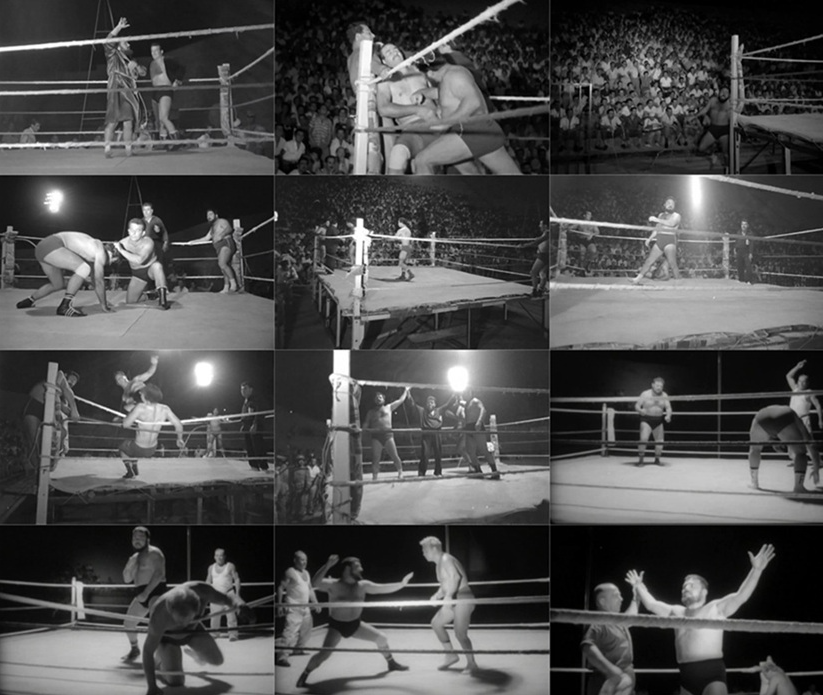
So, it turns out there is *some* Greek wrestling footage from the early 1960s that exists. Not TV footage, of course, because Greek wrestling never aired on TV (and television launched in Greece in 1966), but some newsreel stuff. By some stuff I mean two Andreas Lambrakis matches (see the screenshots below) and another singles match between two young wrestlers who I don't recognize. The first Lambrakis match is him teaming with Kostas Papalazarou vs. Dimitris Karystinos & Georgios Alexiou, and I'm pretty sure that one is from July 1961. The second one (i.e. the last four screenshots) may or may not be Lambrakis vs. Rudi Saturski from June 1962. That's my working theory at least, but it's not confirmed so don't quote me on it. The footage exists somewhere within the archives of the Hellenic Broadcasting Corporation, but it's not released publicly, nor listed publicly anywhere as best as I can tell (which would explain why it's never popped up on my radar before). With that in mind, it is certainly possible they may have footage from other matches too. I have no idea if they do though and if their licensing rates weren't so high I probably would be trying to look into this further. You may be wondering, if HBC have not released the footage, then how do I have these screenshots? Well, as it turns out a few years back a documentary on Greek pro wrestling aired on TV in Greece and it featured some scattered clips from the matches I mentioned above (plus some late 1980s or early 1990s clips I hadn't seen before). I managed to get my hands on the documentary and grabbed the screenshots from there.

-
A ton of new Greek newspapers have becoming available since I originally researched Greece eight years ago. At some point in the future I will need to do a major overhaul of my past article on Greek pro wrestling. For now though I focused specifically on Andreas Lambrakis, who will be on the WON HOF ballot this year. I did a whole bunch of new research on him and have put together a new detailed article about his career. It's a pretty long article packed with the wrestling history of Lambrakis, photos, attendance information, storyline stuff, details of his troubles with the law, and some general information on pro wrestling in Greece. Link: The Pro Wrestling Career of Andreas Lambrakis (1935-1966) A major name in his home country for many years, who has sadly been forgotten over time as wrestling completely went out of style in the country. The article is almost as much a history of him as is of Greek wrestling. He was a key figure there.
-
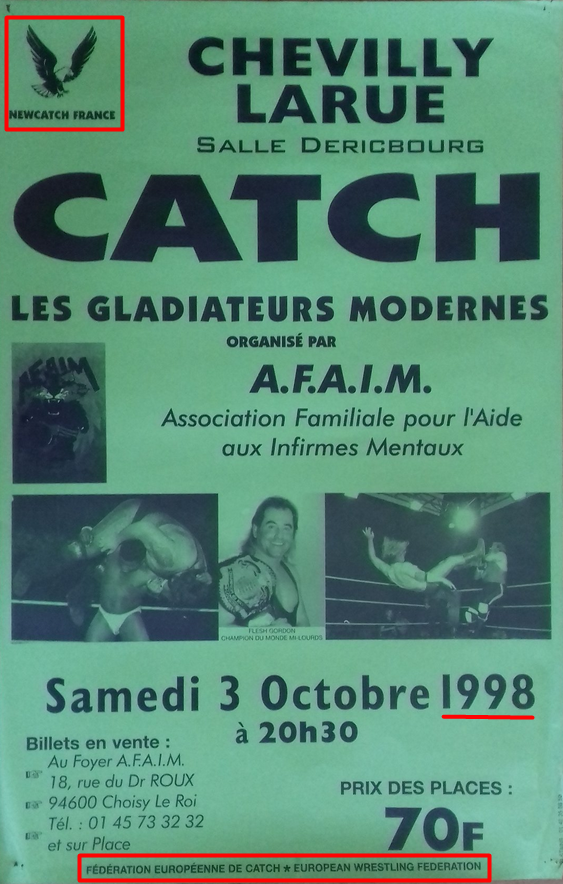
Flesh was still using the New Catch name way past 1992. The latest use I've seen is from February 2002. An example:
-
No, he was the reigning champion on that date. I saw this on the poster for the Elysee Montmartre card for that night. He was wrestling Jean Corne in the main event that night and I think it was a title defense, IIRC. Although my memory is hazy on that last part so don't quote me on it. I don't know when/if he won the title or it was just a case where Delaporte randomly gave him the recognition. I've completely ignored the New Catch titles in my article. I figured there's no point. Especially the singles titles were pretty much vanity titles for Flesh and Zefy to hold (for years and years on end). Championnat Du Monde Des Poids Mi-lourds was actually Flesh's title originally. He had it from at least 1994 until 1999 or 2000, and then Zefy got the title. P.S. The French Titles article is about to get a few small updates whenever I manage to get it. For example: I've narrowed down when and where Modesto Aledo beat George Kidd for the World Lightweight Title (either February or March 1955 in Amiens).
-
Marty wrestled in France as early as 1982. He was the World Middleweight champion for Roger Delaporte's promotion in May 1982.
-
I don't know.
-
I figured I'd plug this here, because some people might be interested. I did some new research recently and I put together four articles covering pro wrestling (catch) in the Soviet Union in 1989-1991 (and beyond when the USSR was no more). It's a little known fact, but there was pro wrestling in the Soviet Union back then. Not a ton, but some. Article 1: The Soviet Perspective: Soviet Wrestlers in NJPW and NJPW in Russia - Tracing the Soviet press' coverage of the Soviet wrestlers in NJPW and providing some additional details on the NJPW show in Moscow in 1989. At the end there are also translated interviews with the likes of Antonio Inoki, Victor Zangiev, Salman Hasimikov, and more. Article 2: An Ambitious Pro Wrestling Tour of the Soviet Union in 1990 - A unique tour, run by Olympic silver medalist and World champion wrestler Andrzej Supron, that went all over the Soviet Union visiting more than 20 cities with probably over 50 shows in total in venues with a capacity ranging from 5,000 to 50,000. Article 3: Stallone Rockets - Russia's Early 1990s Version of GLOW - A Soviet entrepreneur with a let's just say interesting career trajectory teams up with Jacqueline Stallone to launch a Russian version of GLOW. A few American GLOW stars actually went to Moscow too. The article includes footage from the show. Article 4: The Soviet/Russian Pro Wrestling Promotions of the Early 1990s - The USSR Pro Wrestling Association and RAMB'S. A look at their events featuring the likes of Bam Bam Bigelow, Victor Zangiev, Andrei Kopylov, South African wrestlers, etc. If you have any comments or questions, feel free to post them below.
-
As promised, here it is: Spanish Title Histories (1943-1983). Putting this together was quite frustrating (due to there being many mistakes and conflicting information in the Spanish press), but overall I'm happy with how this turned out, even if it's not perfect (and it will never be perfect). Spain was different than France in that throughout the whole period all promotions were under the rule of the same governing body so therefore the title lineages were pretty straight forward, for the most part. In France there could be two or three World Heavyweight champions, for example, at the same time, because they worked for different promotional groups. That wasn't the case in Spain. In Spain there could only be one champion (well, with a few small exceptions by the looks of it).
-
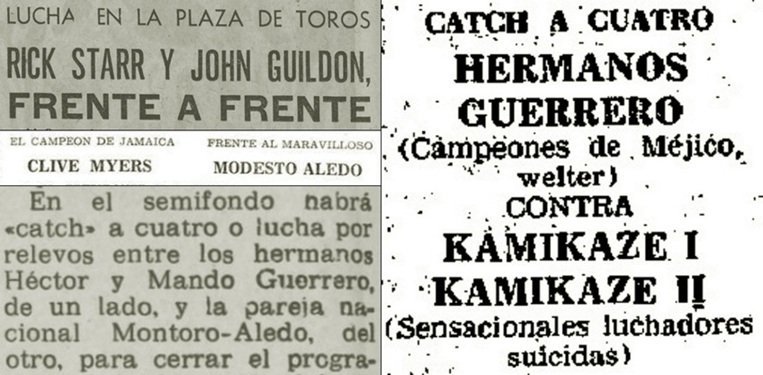
Here's something random. A few matches that I didn't have on my Spanish lucha libre bingo card, but they definitely did happen (in 1974-1975): Ricki Starr vs. Jon Guil Don Clive Myers vs. Modesto Aledo Hector & Mando Guerrero vs. Antonio Montoro & Modesto Aledo Kamikaze I & Kamikaze II vs. Hector & Mando Guerrero I checked in with Hector himself. He said him and Mando did a three and a half month tour of Spain. Hector was only 19 at the time. He was very complimentary of Aledo. Said they learned a lot from him.
-
This is a case of two different titles being mixed up. In the late 60s Febrer was the Spanish Mid-Heavyweight champion. In 1978 he became the World Heavyweight champion. This will all be addressed in my upcoming Spanish Title histories article once it's ready. Sullivan/Fortuna was said to be originally from Tonga so not quite a "North American from Hawaii", but close enough, I guess.
-
Better known as Leon Fortuna.
-
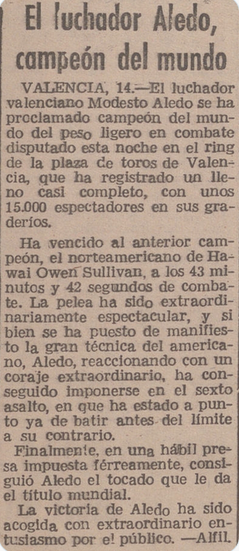
Yep, so there you have it. "Wrestling was at its peak between 1958 and 1975 approximately" is nowhere near the same statement as "the wrestling scene ended in 1975". Speaking of peaks... I made this new random discovery yesterday. Modesto Aledo winning the World Lightweight Championship in Valencia in August 1964 in front of 15,000 fans. This is the type of business they were doing in Spain back then. I find it especially cool in this case because it's lightweights that are reported to have drawn this level of a crowd and generally in wrestling you don't see lightweights drawing such crowds.
-
No such thing. And Spain wasn't "taken over" by anyone. There were still local promotions and shows through the mid 80s, and even some occasional small shows after that too. Obviously, not to the level of prior decades, but Spanish wrestling didn't just poof and disappear in 1975. I know where you're getting the "there was no Spanish wrestling in the 80s" idea from and in general that is a good article on the history wrestling of Spain, but it's old and outdated. As more newspapers have become available over the past decade, that claim can easily be proven to be false.
-
I put down Empresa because that's how the Spanish press always referred to the promotions. Some promotions, like Empresa del Gran Price in Barcelona, were based out of a particular arena (hence their name). That wasn't the case with all "Empresas". Some were known by the name of their promoter/owner (e.g. Empresa Bamala). In reality I don't think there were any official promotional names. There was no "WWF, "WCW", etc. Not until Colosos del Ring (Madrid) in 1975-76 and Inter-Catch (Barcelona) in 1981. Well, for example, Empresa Bamala (also often referred to as Organizaciones Bamala) closed shop in 1975. I'd have to doublecheck the exact year for Gran Price, but I think it ended around 1973 or so. Their venue had been torn down already by that point, but they moved to a new venue for a while. So basically the top two promotions in the history of Spain ended around the same time.
-
There's no need to guess about that. The French rules were definitely based on the American rules. That was the intention from the very start. They did have some slight differences initially though, for example being able to win the match on points (if there was no winner within the time limit), but that was eventually dropped (I wanna say at some point in the mid 1950s but I'd have to doublecheck). FFL, the major governing body for wrestling (amateur and pro) in France at the time, actually officially changed the format of the French catch matches to 5-minute rounds in September 1952, but there was a lot of pushback and the decision was quickly reversed.
-
I've been doing some new research on Spain and just posted a new article on the history of luchas de apuestas (mask vs. mask, mask vs. hair, etc.) in Spanish lucha libre from 1960 to 1978. It's available here: https://phil-lions-research.blogspot.com/2026/06/luchas-de-apuestas-spain.html Had fun putting this one together. I don't go too in-depth and it's more of a list than anything else, but it is a fun bit of wrestling history that I thought I'd share. L'Ange Blanc, the Kamikazes, Los Halcones de Oro, a masked hunchback, etc. Over 40 matches on record. I've also been working on a big update on the various Spanish title histories. It's been a tough challenge but I've got a clearer picture now, although far from perfect, and the update should hopefully be ready very soon. Will share it here.
-
That narrative of Blanc and Bethune being some big TV rivals is something that often gets mentioned in French articles about catch and is complete nonsense. They worked for rival promotions (Goldstein's and Durand's respectively). Never wrestled each other on TV. L'Homme Masque was the big L'Ange Blanc rival, not Le Borreau de Bethune. As a matter of fact, Goldstein sued Durand, before Bethune ever appeared on TV, because he felt Bethune was a L'Homme Masque rip off (which he was). Eventually, when Blanc switched sides, Blanc and Bethune did work together on non-televised events, but that was after Blanc had unmasked. That Leduc/Bethune match is a great example of how to make a new top heel - by having him dominate the top babyface of the promotion in his TV debut to a point where the babyface has to be helped to the back. It worked like a charm in that case. The network, reportedly, received more than 200 phone calls by viewers asking about Leduc's condition. The match was a real turning point for the Durand promotion (well, the Durand/Leduc/Gastel/Montourcy promotion if are to be precise since they were all business partners, which is something that I've learned only within the past few months). I don't know about Leduc being the inventor of the toupie. May be, may be not. The earliest footage of anyone doing the move is actually of Frank Sexton in Paris in January 1950 (which is nine months earlier than the earliest footage of Leduc doing it). I haven't done a deep dive into the newspapers to see if Leduc was doing it before that though so it is possible. Also, it's Leduc. Not LeDuc. Not sure where that spelling popped up from originally, but it's not correct.
-
Until the 80s for sure. After that we'll see. Probably only a paragraph or few to cover the 90s and 2000s. Not much of note happened then, really.
-
It just occurred to me I hadn't mentioned it here. Apologies for the plug, but I thought some folks might be interested. I've started transferring all my past pro wrestling research, and some new stuff, onto a new blog to make it more easily accessible: https://phil-lions-research.blogspot.com/ Close to 70 articles posted so far and plenty left to go (and new research in the works too). It's mostly European pro wrestling history dating back to the 19th century, and there's a lot on France in particular. The French Catch Timeline is the most relevant entry in terms of this forum and it will be extended at some point in the future once I eventually get to it. I have an old L'Ange Blanc article that should get a sizeable update as well.
-
Catch TV in Switzerland, Luxembourg and Monaco (1950s-1960s)
Phil Lions replied to Phil Lions's topic in Pro Wrestling
I've now confirmed that French catch was also airing on Télé-Sarre a.k.a Telesaar (Europe's first commercial TV channel, based in the Saarland region in Germany, next to the French border) in the 1950s. The network existed between 1954 and 1958 and catch seems to have aired in 1955-1958. I don't know how regularly though. I've seen a Télé-Sarre TV listing from 1958 for Valois vs. Vignal and Delaporte & Bollet vs. Gentilly & Khan, both of which I believe never aired in France, so it seems Télé-Sarre was also getting original catch content. -
Ah, yes! Great catch, thanks! Got my years on the launch of FR3 mixed up somehow.
-
Cheap plug. If last year you enjoyed listening to me blabber on about Gilbert Leduc on a podcast, here's me now talking about Le Petit Prince in detail as well. The first half of the podcast covers the life and career of Le Petit Prince, then we get into discussing him from the perspective of the WON HOF (since he'll be on the ballot this year), and finally we talk about other European names on the ballot such as Jose Tarres, Otto Wanz and Andreas Lambrakis. Link: The Ballot: Le Petit Prince with Phil Lions It's also available on YouTube and all the usual podcast platforms.
-
Catch TV in Switzerland, Luxembourg and Monaco (1950s-1960s)
Phil Lions replied to Phil Lions's topic in Pro Wrestling
I think it was probably original unaired matches, but hard to say for sure without knowing exactly what matches aired each week. There was definitely commentary. Sometimes the TV listings would mention the commentator. In the case of Monaco in 1955 there's three names mentioned and off the top of my head I don't recognize either one of them as someone who did catch commentary for French TV (although I could be wrong about that) so it seems it was a different commentary crew altogether. Again, I'm not sure about that. By that I mean I don't know if RTF taped the footage and then sold it or if TMC worked out a deal to come in and shoot it themselves. My best guess is the former, but I'm just guessing.