
Phil Lions
-
Posts
245 -
Joined
-
Last visited
Content Type
Profiles
Forums
Blogs
Everything posted by Phil Lions
-
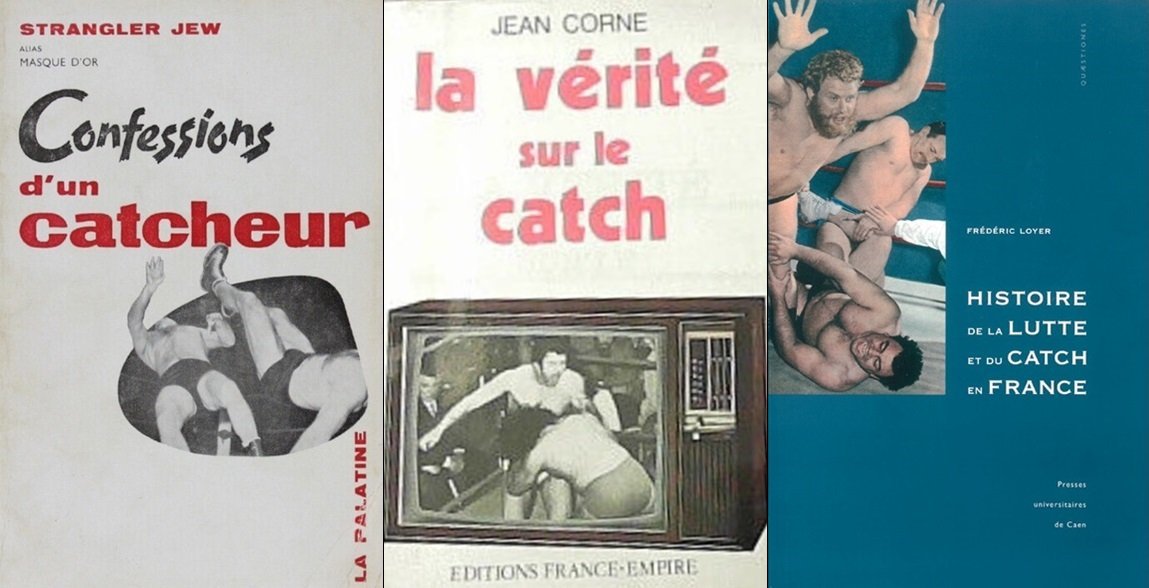
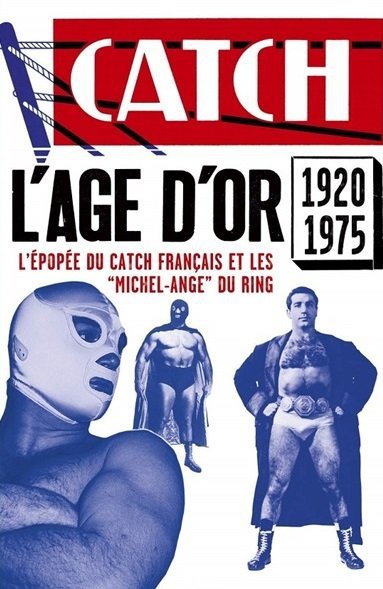
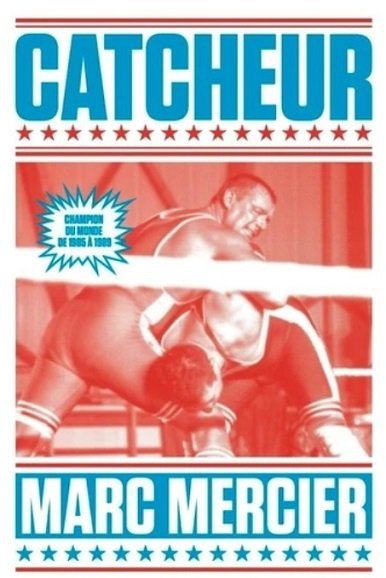
On an unrelated note, I recently got my hands on some French books about catch: On the left we have "The Confessions of a Wrestler" from 1960. The author Gilles Calou had a very brief pro wrestling career. In wrestling he went by Strangler Jew and Masque d'Or (Golden Mask). Then he went ahead and wrote this book, right when L'Ange Blanc and company were super popular in France. The book got a good deal of publicity back then too as it promised to expose the inner workings of catch. I had known about this book for a few years now, but finally gave in and got it the other week. I haven't looked through it properly yet, but it seems to be more so about training and how the matches were worked than anything else. On the right we have a book by Frédéric Loyer from 2009. It examines the history of pro wrestling in France and how it connects with amateur wrestling. A friend of mine sent me a copy just the other day so I have yet to go through it in detail, but it looks like a well-researched book, although more on the sporting side of things than on the business side of wrestling. And finally, in the middle we have the one I'm most excited about. "The Truth About Wrestling" by Jean Corne. Written in 1974. I only learned about this one yesterday and it's on its way to me now. My point in all of this being, once I eventually go through these books if anything interesting pops up, I will let you guys know. And I also thought I'd mention them in case anyone else might be interested in them. While on the subject of French catch books, "The Golden Age" one from 2016 is a favorite of mine. Information-wise it's pretty weak, but in terms of photos this is one of the best pro wrestling books you will find. It's just a beautiful book and features a lot of high quality wrestler and poster photos. If you like wrestling coffee table books, this one is an easy recommendation (even if you don't know any French). And finally, I see that wrestler-turned-promoter Marc Mercier's upcoming book is scheduled to come out in October this year. Should be an interesting read that hopefully reveals some new details about French catch.

-
Earlier today there was a bit of discussion over on Twitter about the decline of catch in France and that reminded me of something, which I don't think I've mentioned here before. Earlier on in this topic I had talked about the formation of the FFLP. Later on I found out about its end, but I haven't shared this here so here it goes. I'll start from the beginning. FFLP (Fédération Française de Lutte Professionnelle) was formed way back in 1922. This wasn't a wrestling promotion (though ironically later on there was a promotion by that name). This FFLP was a country-wide governing body for pro wrestling in France. FFLP was to pro wrestling what the French (Amateur) Wrestling Federation was to amateur wrestling, and FFLP was kind of an offshoot of the amateur federation, in fact. All of the rules and regulations for pro wrestling in France came down from FFLP and more importantly in order for a wrestler to wrestle professionally in France the wrestler needed to get a licence through FFLP. At one point in later years for rookies this meant having to pass an exam to get your licence. And if you did something more radical during a match that FFLP didn't approve of, they could take your licence too, which effectively banned you from wrestling in France. I'm not sure if this was the case earlier on too, but I know in the late 1930s wrestlers who wanted to teach catch (pro style) had to get a teacher's diploma through FFLP. FFLP also had a wrestler relief fund, where money would accumulate and go toward helping injured wrestlers. All the championship belts in France? Sanctioned by FFLP, which explains why in France there weren't multiple title claimants of the same title at the same time like there were in other countries. In short, FFLP was as legit a governing body as you could get in pro wrestling. And on top of that, like I've mentioned in the past, in 1928 a French pro wrestlers union was also formed to watch out for the rights and interests of the French pro wrestlers. FFLP was very much in control of things from the 1920s through the 1940s. They still were in the 1950s, but it seems things were beginning to loosen a bit and then in the early 1960s the French amateur federation decided to close down FFLP as a governing body and pro wrestling in France was left to its own devices, without any direct oversight like it had had for close to 40 years by that point. According to Bob Plantin, the FFLP closure happened in 1960, but I haven't been able to confirm that. Bob points to this as one of the major reasons for the eventual decline of catch. I'm paraphrasing here, but in his words now that wrestling was no longer as regulated as it had been in the past and wrestlers didn't require a FFLP licence anymore, any schmuck could become a pro wrestler and more incompetent promoters entered the business, which eventually led to a decline in both the quality of the workers and of the shows overall. And then as television evolved and other sports became easier to televise, those sports became more of a priority so catch lost its prominence on TV too. Obviously, this is just one veteran wrestler's opinion and there may be some "back in my day" bias too, but it all sounds very plausible to me and so I think we can add the closure of FFLP to the list of reasons for the eventual decline of catch. You take away the regulation from a business that's used to being regulated and chaos is bound to happen with all sorts of people, both old and new, trying to grab a piece of the pie. The loss of FFLP probably didn't help the TV situation either.
-
I believe the TV footage is from 1998-2000, to be more precise. About ten or so years ago the Bolivian giant Walter "Tataque" Quisbert randomly peaked my interest and I wanted to find out more about his pro wrestling career so I ended up looking into the Bolivian scene a bit. There wasn't detailed info available on the older stuff, but there was a blog that had a lot of photos and info on the current day scene. The scene at that point, however, seemed very cartoonish in terms of presentation and characters, i.e. so nothing like the video above. This is the blog in question: https://luchalibrebol.blogspot.com. It's no longer active, but the archives are still there. And then there was another blog, in English, which provided some info on the history of lucha libre in Bolivia: http://www.nellhaynes.com/fieldnotes/la-historia-el-mito-de-origenes + http://www.nellhaynes.com/fieldnotes/la-historia-la-epoca-dorada + http://www.nellhaynes.com/fieldnotes/a-brief-history-of-bolivian-lucha-libre. By the way, here's Tataque on the right. Next to him is Sombra Vangadora who was one of the top Bolivian stars back in the 1980s (not to be confused with the Mexican Sombra Vengadora - different guy). Two of the guys featured in the video that Jetlag shared, Sombra Vengadora Jr. and Vampiro Uno, are Sombra Senior's sons. LFX (Lucha Fuerta Xtrema), one of the YouTube channels in the original post, was their company. The other channel, Jaidercito, is mostly about Jaider Lee. In addition to being second-generation wrestlers (their father was Napoleon Simonini, better known as Medico Loco, another one of the top Bolivian stars from back in the day), Lee and his brother Kid Simonini used to run a company called LIDER. I'm not sure who's running it today, but the company is still around. And a quick glance at their Facebook page tells me that they're doing weekly shows and they've got a couple of third-generation Simoninis wrestling there.
-
With WWE's upcoming PLE in France POST Wrestling just published an article on the history of wrestling and WWE in France that I thought was pretty good. I thought I would share it here: https://www.postwrestling.com/2024/05/01/nearly-twenty-years-of-french-wrestling-history-surrounds-backlash-france/
-
He was indeed. However, he didn't get the Quasimodo gimmick in Spain. The Quasimodo gimmick was first introduced in France and then he took it around the world.
-
https://twitter.com/Phil_Lions/status/1742250666071072951 https://twitter.com/Phil_Lions/status/1742250670210638299 https://twitter.com/Phil_Lions/status/1742250673910218840 https://twitter.com/Phil_Lions/status/1742250677579989414 https://twitter.com/Phil_Lions/status/1742250681006981613
-
I don't think they're new and I don't think INA have added any new stuff since 2018-19 (which is when I last searched through the archive thoroughly). I just think we hadn't paid attention to the Kidd footage before. I know I hadn't as I was primarily focused on other wrestlers back then. I don't want to speak for them, but I also think the Segunda Caida crew only paid attention to the full matches and skipped over the highlight stuff, and there is a lot of footage in the archive that is just highlights of matches as opposed to full matches. Hence why the Kidd footage has only popped up now. Anyway, I just looked through the archive again to see if there's anything additional of Kidd's that I might have missed and it doesn't seem like there is. Just those three matches. I shared a few clips over on Twitter in case anyone wants to take a look:
-
Rene Ben Chemoul, Guy Laroche and someone listed as Dauveau. I don't think I've heard the name Dauveau before. At first I thought it might be Andre Chauveau misspelled, but the guy in the footage seems like a different guy.
-
At that same time Aledo was the World Lightweight and European Lightweight champion in Spain too. He continued to hold those claims there. I hadn't specifically searched for this before, but now that you've mentioned it I just did and it turns out INA does have highlights of three Kidd matches from 1952-53. About 8 minutes of footage altogether. EDIT - Actually, more like nine and half minutes in total.
-
Just a random poster I came across. Modesto Aledo (c) vs. George Kidd (billed as the European champion) for the World Lightweight Championship. Talk about a match that sounds great on paper.
-
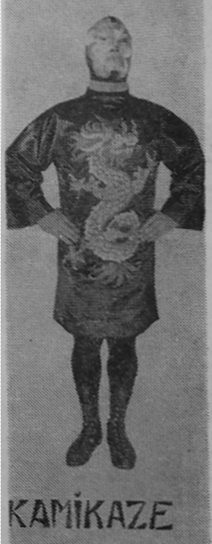
"The Japanese Suicide Wrestler" Kamikaze gimmick was first used in France in 1961. It was around as early as March 1961. It was brought over to Spain in the summer of 1963. It made its first appearance in England that summer too. This is the original French Kamikaze from 1961. Not sure who was under the hood then.
-
Actually, I might as well share these too since I have them in my files. February 18-22, 1998 Beirut, Lebanon Promoters: the Saade brothers The covers of Lebanese wrestling magazines from 1986-1988:
-
To be more precise: September 26-October 3, 1974 Beirut, Lebanon City Sports Hall I've previously come across a few newspaper photos of Danny Lynch, Prince Kumali and others in Lebanon around this time (could even be from the same tour): And speaking of Lebanon, the article is in Bulgarian but here you can check out some posters for wrestling shows in Lebanon and Syria in the 1930s and 1950s. This an article about a Bulgarian wrestler who wrestled there in those decades. Some of his personal belongings have been preserved at a museum in Bulgaria.
-
I think for me Cuba may be the most interesting of the bunch and the one I'd like to see the most, if it were possible. Local wrestling aired on Cuban TV on and off from 1951 through 1959 and there was quite a lot of it in the early to mid 1950s. Not at the same time, but wrestling aired on four different networks there - Channel 4 (Union Radio Television), Channel 6 (CMQ Television), Channel 2 and Channel 7 (CMBF Television). Looking at the cards that I have there are a bunch of interesting names on those cards and those names could have potentially been on the TV shows too. I say potentially, because while shows were generally broadcast live on TV more than likely not all of matches aired on TV. Big stars from the U.S. passed through for a visit (Frank Sexton, Gorgeous George, Buddy Rogers, Lou Thesz, Antonino Rocca), Mexican stars did as well (Medico Asesino, Dientes Hernandez, Fernando Oses, etc.), other well-established names from the U.S. worked on some cards (Tony Olivas, Wally Dusek, Danny Dusek, Kola Kwariani, Ray Stern, Billy Darnell, Nell Stewart, Cora Combs, etc.) and of course there were also all the stars of the local scene such as The Red Menace (Pedro Godoy), El Chiclayano, Ramon Rivera, King Badu and others. In terms of influence Cuba seems to have been influenced the most by the Tampa office, but there was definitely a Mexican influence too which makes me quite curious what the general in-ring style might have been given the mix of influences. As for Lebanon, wrestling used to air on TV there in the 1970s on Channel 7. The Saade brothers were probably the biggest stars, but there were also international stars like Danny Lynch, Prince Kumali and Tsuneharu Sugiyama to name a few, who worked in Lebanon during this time too. Although to be fair I don't know which ones of the international guys worked the TV. I know they worked the big shows, but I don't know about the TV. If Cortez had returned to Spain after his AWA run was over he was headed straight to prison for a period of six years. More about that here: http://wrestlingclassics.com/.ubb/ultimatebb.php?ubb=get_topic;f=10;t=005490 Cortez was indeed quite popular in Spain and is probably the best remembered Spanish star today, but a lot of that was due to him having a segment on national TV in Spain in the mid 1960s where he would arm wrestle any and all comers, with the network offering to give 100,000 Spanish pesetas to whoever could beat him. And mind you this was at a time when, I believe, there was still only one television network in Spain. That television exposure gave Cortez a level of recognizability other Spanish stars simply couldn't obtain, because they weren't being featured on TV at all, let alone regularly. That said, while Cortez's star was rising the business in Spain in general was falling so ultimately even with Cortez in the mix I don't think demise of Spanish wrestling could have been slowed down much, if at all. And plus, in general information about attendance is limited so I don't know how well his TV fame translated to the box office during his prime in the mid to late 1960s. Definitely not the case. I'd have to check my Greek clippings to dig out the exact years, but I have seen several reports about Greek wrestlers working in Egypt in the 1940s. Maybe the 1950s too. And of course, speaking of the 1930s, it's worth mentioning Jim Londos worked a few matches in Egypt in 1937.
-
In terms of Continental Europe, I don't think there is one. I would love to see more Telecatch with Ted Boy Marino from 1960s Brazil, or a bunch of Cuban TV from the 1950s, or Lebanese TV with the Saade brothers and others from the 1970s. For me that would be some of the most interesting stuff, but sadly, I think the chances of any of those still existing are extremely slim.
-
No chance. Spanish wrestling wasn't televised. In terms of footage from the golden age of Spanish wrestling, the RTVE archive has only newsreel clips and that Cortez/Tarres one is actually the longest one. I shared them all a while back here: http://wrestlingclassics.com/.ubb/ultimatebb.php?ubb=get_topic;f=10;t=005285 That said, I don't think much is available in their online archive at the moment, but RTVE may have "Los Héroes del Xóndo" tucked away somewhere. That was the Spanish attempt at a "Titanes en el Ring" type of show. The show aired in 1978-79 and it didn't last long. There's some footage from 16:25 onward here:
-
This was of course years after SMW had shut down, although I would imagine the channel bought the tapes earlier, but I used to watch SMW via German TV back in 2000. It was so random. I'd go from watching Lance Storm holding three belts in WCW to seeing him team up with Jericho in SMW. The channel was called Premiere Sport 1 and it used to show nine hours of wrestling every day (well, in reality it was three hours, but they were airing the same content three times a day). They had WCW (live PPVs, old PPVs, Nitro, Thunder, one of the recap shows, old Nitros), ECW Hardcore TV, AAA and SMW. It was quite the eclectic mix and I loved it. Sidenote: Around this same time there was another German channel where I vividly remember seeing Tim Flowers' ICW promotion out of Canada. How random is that!
-
That theory about the Exbrayat/Esbrayat name definitely makes sense. Also, thanks for that book link. Had a quick look and this I found interesting: "Dans l’imaginaire télévisuel, on les associe volontiers à des héros de séries ou de feuilletons que l’on peut retrouver régulièrement, le week-end sur le petit écran : l’Ange Blanc, l’Homme Masqué, le Bourreau de Béthune, Chéri-Bibi, René Ben Chemoul, André Bollet, Gilbert Leduc, Pancho Farina..." A lot of the same names that I mentioned. I also like how Blanc/Farina is mentioned twice. The villain L'Homme Masque is another one that slipped my mind. He was actually the first masked man attraction that Goldstein introduced and then L'Ange Blanc was introduced as the hero to battle him and other villains. Had L'Homme Masque been a flop, there likely wouldn't have been a L'Ange Blanc. And people sometimes confuse L'Homme Masque with Bourreau de Béthune. Masque was Blanc's big rival during Blanc's masked period. Bethune was working for the rival promotion at the time and was introduced as their own version of Masque, more or less. Bethune did work with Blanc later on, but Blanc had already unmasked by that point.
-
A few notes from me: "French TV likewise made household names of wrestling stars like L'Ange Blanc, the Bourreau de Bethune, Chéri Bibi, Robert Duranton, Le Petit Prince and Flesh Gordon" - that is an interesting selection of names. It's not who I would've went with though. Blanc, Bethune, Delaporte, Bollet, Duranton, Andre Drapp, Rene Ben Chemoul and Gilbert Leduc are the first names that come to mind first and foremost if you were to ask me who were the most prominent names of the TV era. Bibi and Prince have a case too, I think. The correct surname seems to be Esbrayat, not Exbrayat. He's a guy I've always thought about researching, but haven't yet. I've always thought the correct spelling of the name was Exbroyat (which is how prof. Edmond Desbonnet spelled it), but I did quick search last night after I read your post and realized I was wrong. In the 1830s French press and beyond the name is spelled mostly as Esbrayat. More importantly though, even though he was a wrestler too, he's definitely better known as a promoter. It seems he was active as early as 1830, and perhaps even earlier. The part about him having single-handedly developed the Greco-Roman style I have my doubts about, but I can't confirm it one way or another until I've actually done some proper research. The claim that Esbrayat called the style "flat hand wrestling" I definitely do not buy. As early as 1833 you start to see the term "lutte romaine" (Roman wrestling) being used in the French press. I've seen it used in a bunch of adverts for Esbrayat shows. Rossignol-Rollin, the top French promoter of the 1800s, used it a lot too and I believe this was the official name of the Greco-Roman style in France. It was known mostly as French wrestling elsewhere until the 1870s when the term "Graeco-Roman" was adopted in places like the UK and the USA. "Lutte à main plate" ("flat hand wrestling") was a term that was used too, but seemingly from the late 1840s onward. I'm not sure whether lutte romaine and lutte à main plate were the same style. There was also something called "lutte d'hommes" (men's wrestling) that you can see being used in conjunction with pro wrestling too. I think was a similar style, but not exactly Greco-Roman, although later it may have been also used as a term for Greco-Roman. The "lutte d'hommes" term was around as early as the late 1810s. Anyway, this is what I can say for now based on my research, but like with Esbrayat himself, I haven't spent a lot of time digging into it. This is just surface level stuff. Advert from 1839 for "lutte romaine" and "lutte d'hommes" featuring Esbrayat/Exbrayat: Charles Rigoulot and Julien Duvivier had nothing to do with pro wrestling being introduced at Velodrome d'Hiver. Here's the timeline of it all. Paoli, Deglane and Dan Koloff traveled to Paris in December 1932 and pretty much announced the plans for upcoming shows then. The other two went back to the States and Paoli stayed in Paris to lay the groundwork for the September 1933 debut of the promotion (at Velodrome d'Hiver). Rigoulot joined the promotion in December and was its number three star. Deglane was the top star while Koloff was the number two star and Koloff was also bringing in some of the talent. I've spent a good amount of time researching the Paoli promotion and I've never heard the name Duvivier in relation to it. Perhaps he may have had some role in highlights of the matches being aired in cinemas, but I can't see him being involved beyond that. Another important name in the start of the promotion was the boxing promoter Jeff Dickson, who owned Velodrome d'Hiver. He may have been a partner in the Paoli promotion. I've seen such claims, but haven't been able to verify them. The part about Delaporte having bought FFCP from Paoli in 1960 and becoming the dominant promoter then is definitely not true. Paoli was the main Paris promoter and then in 1952 he formed a partnership with Alex Goldstein, who was one of his chief rivals. Paoli had the biggest venue, but Goldstein had the most venues in Paris so this partnership was very beneficial for both. The two would co-promote for the next few weeks. By 1958 Paoli was out of the picture and Goldstein was running the show himself. At that point Delaporte was one of Goldstein's top stars. Delaporte left the Goldstein promotion in 1961, but returned in 1963. Eventually, and I'm not sure when, Delaporte took over the shows at Elysée Montmartre. Elysée Montmartre wasn't a Raoli/Goldstein venue. The promoter there, before Delaporte took over, was Henri Chausson. I can't say for sure what happened to the Paoli-turned-Goldstein promotion and how it ended. Anyway, that came to mind while reading the wiki entry. Additional details are available in articles that I've written elsewhere. Some of these articles are older and need to be updated, but here you can find additional details about French pro wrestling: Article: The pro wrestling career of the Olympic gold medalist Robert Roth (1921-1925) (talks about the beginning of regulated catch style pro wrestling in France) Results: Shows at Palais des Sports in Paris (1933-1939) Results: Shows at Palais des Sports in Paris (1944-1959) Article: The masked hero L'Ange Blanc (1959-1961) Cards: Paris (1959) (here you can really get a sense of how the Paris scene was set up back then) French title lineages: the World Heavyweight and European Heavyweight Titles (1936-1969)
-
I had asked Zefy some follow-up questions and he just got back to me now. After I had questioned it, he corrected himself on the year - he says the Macedonian tour was in October 1996. And he also says that they went to Macedonia on their way back from a tournament in Congo. I believe EWF used to also air on TF1. As for the TF1 / Eurosport connection, Eurosport was originally owned by Sky, but then the TF1 group took ownership of the channel in 1991.
-
I figured out the promotional aspect of the Macedonian tour. I don't know why I didn't make the connection earlier, but it all makes sense now. You know how I was saying the Macedonian announcer mentioned "European Federation of Catheurs" and the match being under the rules of "New Catch International"? "European Federation of Catheurs" would be Fédération Européenne de Catch (FEC), also known as European Wrestling Federation (EWF). Founded in France in the mid 1980s and, apparently, lasted until 1996. They were the same company that had a TV deal with Eurosport and they shared the timeslot with Otto Wanz's CWA in the early 1990s. The Eurosport show was called... "New Catch". By 1996 they had been off Eurosport TV for a few years but I guess they were still using the "New Catch" name to an extent.
-
I'm still quite intrigued by this Macedonian tour. For what it's worth, Prince Zefy finally got back to me as well and his version of events is a bit different than Bernard Vandamme's. According to Zefy the tour was in 1998 and they did two shows - Skopje (which aired lived on TV) and Pristina. Like Vandamme, he says the crowds were good, but they never returned for a second tour. I don't know if I buy that though. Kosovo (where Pristina is) was in the middle of a war in 1998-99 and I'm having a hard time buying the idea of a wrestling show there during that time. The war officially broke out at the end of February 1998 so, perhaps if the show was earlier in the year, I guess it's possible, but still I'm more inclined to believe Vandamme's version of events. I've asked Zefy some follow-up questions, but he hasn't replied back. I've also reached out to a few other people from the tour, but no response yet.
-
I can't answer that. All I can say is that when I asked him whether this was an IWSF or EuroStars tour, Bernard told me this tour was before either one of those promotional names. He may be misremembering, I don't know. And besides, neither one of the promotions is mentioned in the footage. In the footage the Macedonian announcer mentions only "New Catch International" and "European Catch Federation" (or European Federation of Catheurs, if I am to translate what he said more literally).
-
I reached out to a few people about the Macedonian show and luckily Bernard Vandamme, who also wrestled on that tour, provided some details. According to him Flesh Gordon organized a tour of Macedonia in 1996 (so this was before IWSF/WS). They did shows in Bitola, Strumica, Kumanovo and Skopje. Not sure if this was the case for all of the events, but at least one aired on local TV. There were also plans to do shows in Bulgaria, Greece and Turkey, but the plans got cancelled. I think the match above is from Kumanovo, because I think I heard the Macedonian announcer mention Kumanovo at one point.
-
Macedonia back then doesn't strike me as a financially viable destination for an international tour, nor was it a place where I would have imagined anyone taping wrestling show. Hence my amazement at this. Yes, in the Balkan region Greece was the top spot for pro wrestling. Not always, but most of the time, and pro wrestling there lasted the longest. Yugoslavia used to have a tour-based scene into the late 1960s, maybe early 1970s. Turkey had a scene too that died around the same time. Romania's scene died out in the early 1940s while Bulgaria's lasted until the mid-to-late 1940s. In the past couple of decades there have been local indie promotions that have popped up in most of these countries as well as a few shows by international companies. Overall though, it's a very small scene today. A while back I posted a topic with a bunch of Greek footage (including the footage that you've posted). It's all here: