.jpg.7d3e39f714477dfc27c17e87b8c1524c.jpg)
Control21
-
Posts
974 -
Joined
-
Last visited
Control21's Achievements

Mentor (12/14)
-
 Rare
Rare
-

-

-

-

Recent Badges
-
News and Notes (10/7/1991-10/14/1991) The first round of the U-COSMOS Grand Prix on 9/25 in Sendai drew a sellout 7,000 for the WOWOW live broadcast and delivered on the hype. The show’s main selling point was Akira Maeda’s war with Yoshiaki Fujiwara, which turned into a total classic. Fujiwara hunted the arm all night, but Maeda came away with the win after a very even, tense match. It was the match of the night, and likely a contender for match of the year. The other big storyline was Nobuhiko Takada, coming off his main event win over Maeda in Kobe and openly gunning for Vader’s title, who kept his momentum alive by knocking out new tag champion Kazuo Yamazaki with a high kick after a knockdown from a body and head combination, in 14:11. Yamazaki's partner, Kiyoshi Tamura, advanced with a fluid cross-armbreaker over Yoji Anjo in 11:57, with Tamura looking better and better. Masakatsu Funaki scored a notable upset of Tatsumi Fujinami at 17:38 with a surprise arm triangle from the clinch. The match was tied 2-2 on points before Funaki’s conditioning took over, and it felt like a symbolic change of the guard. The rest of the card was a mix of the brutal and the competitive. Super Vader’s war with Salman Hashimikov was the night's most physical match. Hashimikov took Vader down in the first ten seconds and had him in trouble with a belly-to-belly suplex, and both men bled, but Vader finally landed a high-angle German suplex and finished with open-hand strikes for a 13:48 TKO. Wayne Shamrock took down his rival Minoru Suzuki, who was sharper than in their New Generation tournament semifinal and nearly caught Shamrock with a guillotine, but Shamrock ended it with a pinning combination at 12:41. Suzuki was visibly upset afterward. Volk Han submitted Dick Vrij with an Achilles hold at 12:22 in another of their entertaining style-clash matches, with a Han heel hook attempt drawing one of the loudest reactions of the night before Vrij powered out. The show’s one squash was Aleksandr Karelin’s destruction of Atsushi Onita in 2:11, which was exactly as ugly as expected. Karelin ragdolled Onita with a belly-to-belly suplex, showed off Muay Thai knees, then finished him with a violent spinning fireman's carry slam that had referee Motoyuki Kitazawa waving it off without a count. Onita was stunned and nearly out before the finish, so the whole thing felt more like a statement about Karelin’s credibility than a competitive match. All told, it was a strong opening night with a clear match-of-the-year candidate and several top-notch undercard matches, and the second round looks like a must-see. The second round will take place on October 31st at the Makomanai Ice Arena in Sapporo. The second round will feature some very interesting matchups, including Volk Han taking on Vader, and Kiyoshi Tamura going up against Aleksandr Karelin. (Wrestling Observer, 10/8/1991) It's been a newsworthy week for UWF, and perhaps for the first time in the company's history, it's not for the right reasons. Weekly Pro Wrestling published a report on October 4th saying tensions are rising between Akira Maeda and the executive hierarchy. Sources say Shinji Jin has privately expressed interest in working with SWS, a more "traditional" pro-wrestling group, including sending some UWF talent to appear on SWS' shows. Needless to say, this has angered Maeda, who has responded by demanding a meeting with Shinji Jin to review the company's books. The report says UWF's finances may not be entirely on solid ground, and Maeda has caught wind of it. It's unclear why, given UWF's outstanding business and gate numbers over the past three years. The magazine article also said that Yoshiaki Fujiwara has supported Shinji Jin's idea, as he wants to work under a less demanding style because of the wear and tear of the UWF style, and that working with SWS might create promotional opportunities. Another report from a less reputable tabloid was published this week, suggesting that Karl Gotch and Lou Thesz aren't fans of the Vader push and are upset that homegrown talent like Masakatsu Funaki are being overlooked. The Weekly Pro story will be worth keeping an eye on, especially as the U-COSMOS tournament heats up. (Wrestling Observer, 10/8/1991) Weekly Pro Wrestling learned that a meeting between Akira Maeda and UWF president Shinji Jin is scheduled for October 30th, following the magazine’s October 4th report on discord within the organization’s leadership. According to sources close to the company, the meeting was arranged after back-and-forth talks, and Maeda is expected to press for a full review of the promotion’s financial records, a request that Jin and several other executives are reluctant to entertain. Though no official statement has been issued, those familiar with the matter indicate that the agenda will extend beyond accounting to Jin’s reported interest in a working arrangement with SWS, including the possible loan of UWF personnel to that group’s events. Maeda’s main event victory over Yoshiaki Fujiwara last month, a match Fujiwara reportedly entered with considerable reservations about the physical demands of the UWF style, has only heightened attention on the relationship between the two veterans, who are understood to hold opposing views on the company’s direction. Company officials have declined to confirm the financial concerns, and the promotion’s recent attendance and television performance seem to argue against any urgent difficulty, leaving the source of Maeda’s apprehension unexplained. (Weekly Pro Wrestling, 10/14/1991)
-
Excited to see how your new territory plays out. I know you like to spread your wings a bit and move on after a while, but it would be interesting to see you develop this promotion from "Eastern Championship Wrestling" to "Extreme Championship Wrestling" over the next few years, if that's your taste.
-
I just find it odd that you think KENTA should be in, but not Fujiwara. What does KENTA offer that Fujiwara doesn't, objectively? Perhaps you'll remember the article I wrote for VOW: https://www.voicesofwrestling.com/2023/10/25/won-hof-2023-the-case-for-yoshiaki-fujiwara/
-
Why should KENTA be in if Yoshiaki Fujiwara isn't?
-
I enjoyed the match write-ups here. Curt Hennig and Steve Austin make a great pairing, and you did an excellent job building both up throughout the tournament. The tag team match was awesome. I think Shawn Michaels is on a clear upward trajectory in SMW despite the loss.
-
The Happening is a stacked event. I'm very happy to see fans in Alaska get a top-tier PPV. I think I said this before, but I like how you are building up Frank Andersson. He was someone I considered using in UWF earlier, and I think Gagne knows how to use him well. He was a bit underrated as a wrestler in real life, but that's mostly because WCW didn't use him properly.
-
If I were a betting man, I would say the Undertaker and Vader are on a collision course. That would definitely be a blockbuster match. Great show from the Omni. A very balanced show overall, and smart use of talent to keep things balanced across the card.
-
.thumb.jpg.367ae39d7bbf2fbc397a360aa0190988.jpg)
Universal Wrestling Federation (Herb Abrams)
Control21 replied to ErictheDragon's topic in Programming
Your use of Doink the Clown has been excellent so far, good stuff there. The Knock Down, Drag Out idea is really cool. It's a good way to get a few starts going, I think. Keep up the good work! -
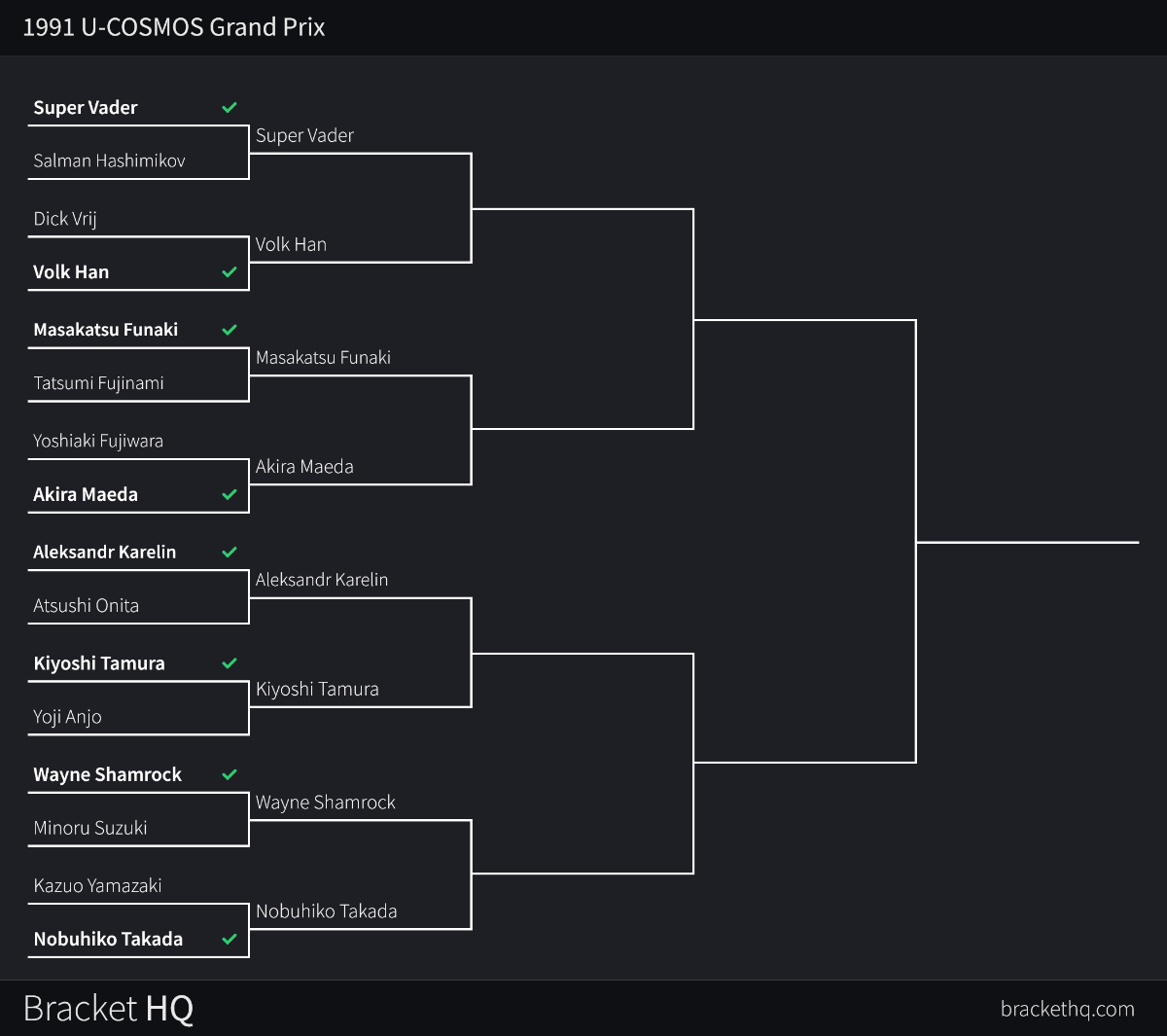
September 25th, 1991 Sendai City Gymnasium Sendai, Japan Attendance: 7,000 (sold out) Broadcast: WOWOW (live) Kiyoshi Tamura vs Yoji Anjo The first round of the U-COSMOS Grand Prix opened with a match between two men who knew each other well from sparring in the dojo. Anjo's craft gave him a foothold in the opening minutes. His experience helped him steer scrambles away from Tamura's most dangerous submission entries and force a rope break of his own with an opportunistic wristlock that briefly suggested Anjo might neutralize his opponent’s prodigious technical skill. Tamura's response was characteristically relentless; he quickened the pace beyond what Anjo could comfortably sustain, and his rapid transitions began to wear on Anjo. Tamura's determination to win became clear, and Anjo was probably a step too slow. A knockdown from a sharp Tamura kick combination opened up the mat work that proved decisive, and Anjo's scrambling became less coordinated under sustained pressure. Tamura eventually secured a cross-armbreaker from a transition so fluid that the tap came before the crowd had fully processed what had happened. Tamura defeats Anjo via submission (cross-armbreaker), 11:57 Dick Vrij vs Volk Han The stylistic contrast was stark, though this wasn’t the first time these two had met. Each time, the contrast provided a sensational foundation for highly entertaining matches. This time wouldn’t be any different. Vrij established his range, his low kick combinations precise and damaging, forcing Han to think carefully about every forward step. Han absorbed the early punishment while cataloging Vrij's timing, and his first genuine offensive sequence, a sudden drop to the legs that caught Vrij mid-combination, immediately produced a rope break and confirmed that the Dutchman’s striking would not be sufficient to keep Han at bay indefinitely. The match picked up during a tense middle stretch as Vrij's power and Han's ingenuity traded advantages in rapid succession, with a Han heel hook attempt drawing one of the night's loudest crowd reactions before Vrij powered free with brute strength. Han later baited Vrij into committing to a high kick that left him momentarily off-balance, and the Russian converted it by catching it, creating an opening into a dizzying sequence of transitions that ended with a tight Achilles hold locked in before Vrij could reach the ropes. Han defeats Vrij via submission (Achilles hold), 12:22 Wayne Shamrock vs Minoru Suzuki Their previous encounter ended with Shamrock's kneebar finishing Suzuki in the New Generation tournament semi-finals, and Suzuki arrived at the Grand Prix intending to prove the result wouldn't repeat so cleanly. The early going bore out that determination. Suzuki was sharper and more varied in his approach than in their prior meeting, mixing his leg-kick game with unexpected clinch entries that disrupted Shamrock's takedown timing and prevented the American from establishing the sustained top control that had worn Suzuki down before. Shamrock adapted with the confidence of a wrestler who had clearly processed their previous encounter as carefully as his opponent, using his superior strength to win the clinch exchanges and gradually applying the kind of pressure that made him most dangerous. Suzuki's guillotine attempt midway through was the match's most dangerous moment for Shamrock, drawing a sharp crowd reaction, but Shamrock powered out with the composure of someone beyond his years. The finish came when Shamrock timed a Suzuki kick entry perfectly, secured a powerful double-leg, and, rather than transitioning to a submission, kept his weight distributed into a tight pinning combination that Suzuki couldn't generate the leverage to escape. Suzuki was visibly upset by the defeat and had to be counseled by Shamrock. Shamrock defeats Suzuki via pinfall, 12:41 Kazuo Yamazaki vs Nobuhiko Takada With Takada riding the momentum of his main event win over Maeda in Kobe and openly targeting Vader's title, this first-round match against the newly crowned tag champion Yamazaki carried real weight. A stumble here would derail the post-Kobe momentum before the Grand Prix had barely begun. Yamazaki, emboldened by his tag title success, pressed the fight from the opening bell with a striking combination that immediately put Takada on notice, and the early exchanges were notably quite heated and ferocious in pace. Takada gradually settled into his preferred rhythm, using his kicking range to establish the distance he needed and finding consistent success with sharp middle kicks that damaged Yamazaki's midsection. Yamazaki's counter-grappling kept the match competitive through its middle stretch. A beautifully timed heel hook attempt forced Takada to the ropes. Briefly, it swung the points in Yamazaki's favor. Still, Takada's striking output kept building in volume and precision as the match progressed, and the gap between the two men's stand-up capabilities became increasingly difficult for Yamazaki to manage. A sustained combination from Takada targeting the body and head produced a knockdown. With Yamazaki's movement compromised, Takada pressed forward with a final high kick that landed clean enough to keep the tag champion on the canvas for the full ten count. Takada defeats Yamazaki via KO, 14:11 Masakatsu Funaki vs Tatsumi Fujinami The tournament's next match brought together two of the promotion's most tactically sophisticated performers, and the opening exchanges reflected that spirit almost immediately. Neither man reached for anything ambitious before establishing the positional read their styles demanded. Fujinami was the more patient of the two early on, circling carefully and using his catch-wrestling instincts to control grip exchanges and deny Funaki the underhook position the New Generation tournament winner preferred as a launching point for his leg attack. Unbothered, Funaki responded by targeting Fujinami's lead leg with precise, probing kicks meant to inflict structural damage and disrupt the footwork underpinning Fujinami's takedown defense. The first genuine exchange of consequence came when Fujinami timed a Funaki kick and turned it into a Dragon Screw takedown, then immediately transitioned into a kneebar attempt that Funaki had to navigate carefully before reaching the ropes. The next stretch was technically compelling, with both men operating at the highest level of their craft. Fujinami's suplex expertise threatened twice in succession. A German suplex attempt produced a near-fall that brought the Sendai crowd to its feet and briefly made a Fujinami win likely. After Funaki kicked out of the pinfall attempt, the younger wrestler changed the momentum with a well-timed double-leg takedown. Funaki's leg attacks grew more confident, and several mat scrambles led to rope breaks for Fujinami. A points exchange left both men at 2-2, but Funaki's conditioning advantage showed in sharper striking exchanges once they got back to their feet. Funaki had studied Fujinami for quite some time, and it paid off as he abandoned his usual leg-attack entry for a sudden arm triangle that materialized from the clinch before Fujinami could process the change in approach. The choke was locked in tight with Funaki's full body weight distributed to prevent any possibility of the reversal that Fujinami's mat intelligence might otherwise have produced. Fujinami knew that there was no escape, and he had no choice but to relent and acknowledge the ascendancy of UWF’s next young star. Funaki defeats Fujinami via submission (arm triangle choke), 17:38 Aleksandr Karelin vs Atsushi Onita Whatever Onita had prepared for this match, sharing the ring with Karelin made it largely academic within the first ninety seconds. Onita tried to establish distance with a palm-strike combination, which Karelin absorbed without visible reaction before closing the gap with terrifying speed. Karelin secured Onita with a waistlock grip and ragdolled him with a vicious belly-to-belly suplex. Karelin quickly went for the kill. After setting Onita up, a single Karelin lift deposited Onita at a height and angle that drew an involuntary gasp from the Sendai crowd, and the impact left Onita sufficiently stunned. Motoyuki Kitazawa's count reached nine and a half before Onita signaled his intention to continue. Karelin was immediately back on him. Karelin terrified the audience by showing Muay Thai proficiency, clinching Onita and striking him with several knees. The gold medalist then hoisted Onita across his shoulders with contemptuous ease, rotated violently, and drove his opponent face-first into the canvas with a force that seemed to compress the entire ring on impact. The crowd went into a frenzy at the Soviet grappler's brutality and the sheer force of the landing, and Kitazawa didn't bother completing the full count, waving the match off immediately as Onita lay motionless. Karelin defeats Onita via KO, 2:11 Super Vader vs Salman Hashimikov The opening exchanges between Vader and Hashimikov produced the kind of immediate impact that the Grand Prix bracket had promised from the moment this pairing was announced. Two of the most physically formidable wrestlers in the world collided with the barely contained force of men who had spent their entire careers dominating opponents through sheer physical superiority. Hashimikov met Vader's opening salvo of body shots with a sharp inside trip that deposited the big American on the canvas in the match's first ten seconds, drawing a stunned roar from the Sendai crowd and serving immediate notice that this would be no straightforward Vader showcase. Vader got to his feet without panic, and the two locked into a series of standing clinch exchanges that were extraordinary in their raw physical intensity. Neither man could establish clean control, and each grip exchange deteriorated into a contest of pure strength that the crowd followed with reverent attention. Hashimikov's freestyle credentials were fully on display. His leverage and timing matched Vader's power in a way no previous opponent had managed for this long, and a belly-to-belly suplex that deposited Vader heavily on the canvas produced the loudest reaction of the match's opening stretch and forced Kitazawa to begin a count that Vader beat with visible effort. The match continued with a punishing rhythm that both men seemed to embrace. Vader's body shots began to land, and Hashimikov's early burst of energy gradually took its toll. The American's open-hand strikes also drew increasingly visible responses from the Soviet wrestler. Vader’s striking seemed to be the ace up his sleeve. Hashimikov answered by closing the distance again, ignoring the punishment he just received, and taking Vader down with a well-timed single leg. Hashimikov quickly attempted to find a forearm choke, but Vader spotted the ropes in time and reached for a break. Later, both men scored knockdowns through the middle stretch in a breathless exchange that saw points accumulate on both sides. Vader landed a thunderous lariat that folded Hashimikov. Hashimikov responded with a sudden headbutt Vader clearly did not anticipate, leaving the American blinking and off-balance in a way that felt genuinely unscripted. At this point, both men were bleeding, Vader above his eye, Hashimikov from the bridge of his nose. The physical toll on both wrestlers was evident. Vader finally manufactured the separation he needed to uncork his most devastating offensive weapon. Hashimikov, increasingly fatigued, lunged forward into a clinch with a desperation that left him momentarily off-balance, and Vader caught him perfectly. Vader secured a deep waistlock and executed a high-angle German suplex of extraordinary elevation, driving the back of Hashimikov's head and shoulders into the canvas at a sickening angle. The crowd fell briefly silent at the impact, and Hashimikov lay motionless as Masami Soranaka began his count. Rather than waiting to see whether the count would end it, Vader dropped immediately into a ground-and-pound position and began delivering measured, deliberate open-hand strikes to Hashimikov's head. Hashimikov's defense grew increasingly uncoordinated, and Soranaka stepped in to wave off the match. Vader rose slowly, his own physical cost evident in the way he moved toward the center of the ring. Vader defeats Hashimikov via TKO, 13:48 Yoshiaki Fujiwara vs Akira Maeda The weight of history hung over this match in a way that the Grand Prix bracket's other first-round pairings could not match. Fujiwara and Maeda had been intertwined since the earliest days of the UWF movement, their professional relationship carrying a shared history, mutual respect, and competitive rivalry that would be difficult to explain to most. Maeda entered with a focus that made it evident he was here to re-establish himself as the top man in the promotion. Fujiwara, as always, was unreadable. His pre-match demeanor carried the same placid, almost amused composure he brought to every situation regardless of stakes. The opening exchanges were careful, both men circling with the patience of fighters who knew the first meaningful commitment would likely define the match's trajectory. Maeda's kicking range gave him the first real threat; a low kick combination sparked the first crowd reaction. Fujiwara absorbed it without visible concern and continued his methodical approach, parrying Maeda's entries with subtle shifts that redirected momentum without ever fully engaging on Maeda's terms. The match's first decisive sequence came when Fujiwara baited Maeda into a palm strike, then slipped inside with the timing of someone who had been reading the setup for several minutes. Fujiwara followed with a quick headbutt, which the fans loved. A front headlock from the clinch position gave Fujiwara leverage, and he used it to drag Maeda into a grinding mat exchange where his catch wrestling instincts flourished. Maeda's escape was technically impressive, converting a near-dangerous wristlock into a heel hook attempt of his own that forced Fujiwara's first rope break and reestablished the match's equilibrium. The crowd watched intently, fully aware that they were watching two of wrestling’s genuine masters operating at the height of their powers. The next several minutes rewarded that attention with a series of exchanges of incredible technical skill. Fujiwara materialized arm entanglements from positions that seemed to offer no such opportunity, and Maeda countered with leg attacks that showed his mat credentials were not to be minimized. A sustained Maeda striking sequence midway through produced the bout's first knockdown. A clean high kick landed flush on Fujiwara's jaw. Maeda pressed with the urgency that had defined his best performances, converting the momentum into another mat sequence that burned through two of Fujiwara's rope breaks in quick succession and opened a point gap at 2-1. Fujiwara absorbed the deficit without visible panic. He began steering the match back toward his preferred terrain with a subtle shift in his clinch positioning that denied Maeda the clean entries his kicking game required. A beautifully constructed sequence of arm work forced Maeda to burn another rope break, tying the match at 2-2 on points. The bout's climax produced the kind of intricate scrambling that only two men of this experience and intelligence could sustain. Fujiwara hunted constantly for the arm that his entire match strategy had been oriented around. Maeda navigated each attempt with the defensive awareness of someone who understood the trap being laid. He was determined not to provide the final opening. Fujiwara came agonizingly close on two consecutive attempts, his armbar nearly reaching full extension before Maeda's flexibility and awareness allowed him to stack and rotate free, and the crowd's reaction to each near-submission grew more urgent. Maeda’s conditioning seemed high, and Fujiwara, a bit older, was beginning to feel the deep waters. Next came the cold, targeted wrestling that defined Maeda's best mat work. Fujiwara, having maneuvered Maeda into a standing clinch exchange with evident intent to set up a double wristlock, committed fractionally too much weight to his forward pressure. Maeda, reading the shift in an instant, dropped his level and secured a Capture Suplex that lifted Fujiwara cleanly and deposited him hard on the canvas after a swift overhead motion. The impact left Fujiwara briefly stunned, and Maeda transitioned with practiced speed directly into a cross-armbreaker before the veteran's survival instincts could fully reassert themselves. Maeda extended the hold to full extension, angling Fujiwara's body away from the ropes. Fujiwara strained with everything he had left, but the position was perfect, and the tapout came next. Maeda celebrated for a moment, but quickly extended a hand to Fujiwara. The Sendai crowd's sustained ovation acknowledged a match that had delivered everything the Grand Prix's first round had promised and then some. Maeda defeats Fujiwara via submission (cross-armbreaker), 24:17

-
News and Notes (9/1/1991-9/14) UWF Newborn's "Battle Dimension: Kobe," held on 8/30 in Kobe Memorial Hall, was another legit sellout for the promotion, and their incredible three-year hot streak shows no sign of stopping anytime soon. With an announced crowd of 8,000, this was probably one of the best top-to-bottom shows in Japan this year. The undercard was pretty solid, with Nelson vs. Nagai and Benoit vs. Fujiwara both described as very good matches, and the latter in particular did a good job of making both guys look strong. The "New Generation" tournament concluded with Masakatsu Funaki getting a widely expected victory over Wayne Shamrock, cementing him as the promotion's top young star. The two had a lengthy conversation after the match, and it likely won't be the last time we see them lock up. The top half of the card featured two great tag matches. Tom Erikson and Vader defeated the Soviet duo of Salman Hashimikov and Victor Zangiev in a spectacular match featuring high-level power wrestling in the UWF style. Tamura and Yamazaki finally earned the tag belts by defeating the Koslowski brothers in another great match that let both teams play to their strengths. Takada vs. Maeda was the main event, and in a bit of a surprise, Takada came away as the winner. This will likely build him up more before the annual Grand Prix tournament starts, and Maeda having to claw his way back to the top sets up a pretty good story for him going into the tournament. WOWOW announced the Grand Prix bracketing live before the show ended, and the first-round matchups feature Vader vs. Salman Hashimikov, Tatsumi Fujinami vs. Masakatsu Funaki, Akira Maeda vs. Yoshiaki Fujiwara, and Kazuo Yamazaki vs. Nobuhiko Takada. (Wrestling Observer, 9/10/1991) Following up on the reported Shamrock/Funaki conversation from the Kobe show, it is said that Shamrock and Funaki have grown close over the past year and that, along with Minoru Suzuki, they consider themselves the "Three Musketeers" of the UWF. Both Shamrock and Funaki apparently feel they have earned a place in the top half of the UWF card, but an artificial ceiling is hindering their progress right now. While UWF sources downplay any major unhappiness, some American sources suggest they're frustrated with UWF's hierarchical system, which isn't unique to them, since every other major Japanese promotion uses a similar system. Although when you have a large roster of guys doing a very similar style, some conflict is bound to occur. I would expect all three guys to move up the card in due course, and it would be gross negligence if Funaki doesn't receive a title shot within the next year. There are also whispers that Funaki, Shamrock, and Suzuki are all developing a taste for legitimate shooting. (Wrestling Observer, 9/10/1991) UWF will open their 1991 U-COSMOS Grand Prix in Sendai on September 25th, with a full slate of first-round matches. UWF executives are excited about this year's tournament and believe strong matchups will keep tickets moving into the new year. The central question is whether anyone can stop Vader or Aleksandr Karelin, and a meeting between the two in the final feels inevitable. Of course, Akira Maeda could have something to say! (Weekly Pro Wrestling, 9/12/1991)
-
Christopher Daniels.....you are All-Pacific!
-
SummerSlam was well worth the wait and more! Fantastic job with the write-up. You did a very good job of conveying all the subtle details that a live WWF PPV would carry. Felt like I was transported back in time!
-
Universal Wrestling Federation (Herb Abrams)
Control21 replied to ErictheDragon's topic in Programming
This has been a very interesting twist on the UWF so far. By focusing on lesser-known talent, there are a lot of good angles and storylines playing out, which shows you don't always need a deep roster to spice things up. Bringing in Bruno Sammartino to add some legitimacy was a good call too, having a central figure that the rest of the roster orbits around is what makes these smaller territories tick, in my opinion. -
Winnipeg has been very fun to read about so far. The decision to focus a bit more on women this time is a great call! Might not be a bad idea to bring in some AJW stars from around this time period, especially someone like Aja Kong or Akira Hokuto.
-
I love how you are using Shinya Hashimoto. Pairing him with Tsuruta feels natural, and being a big player in AWA feels right, especially around this time. Kokina vs Bad News Brown is going to be a hell of a match, I bet!