.jpg.7d3e39f714477dfc27c17e87b8c1524c.jpg)
Control21
-
Posts
966 -
Joined
-
Last visited
Content Type
Profiles
Forums
Blogs
Everything posted by Control21
-
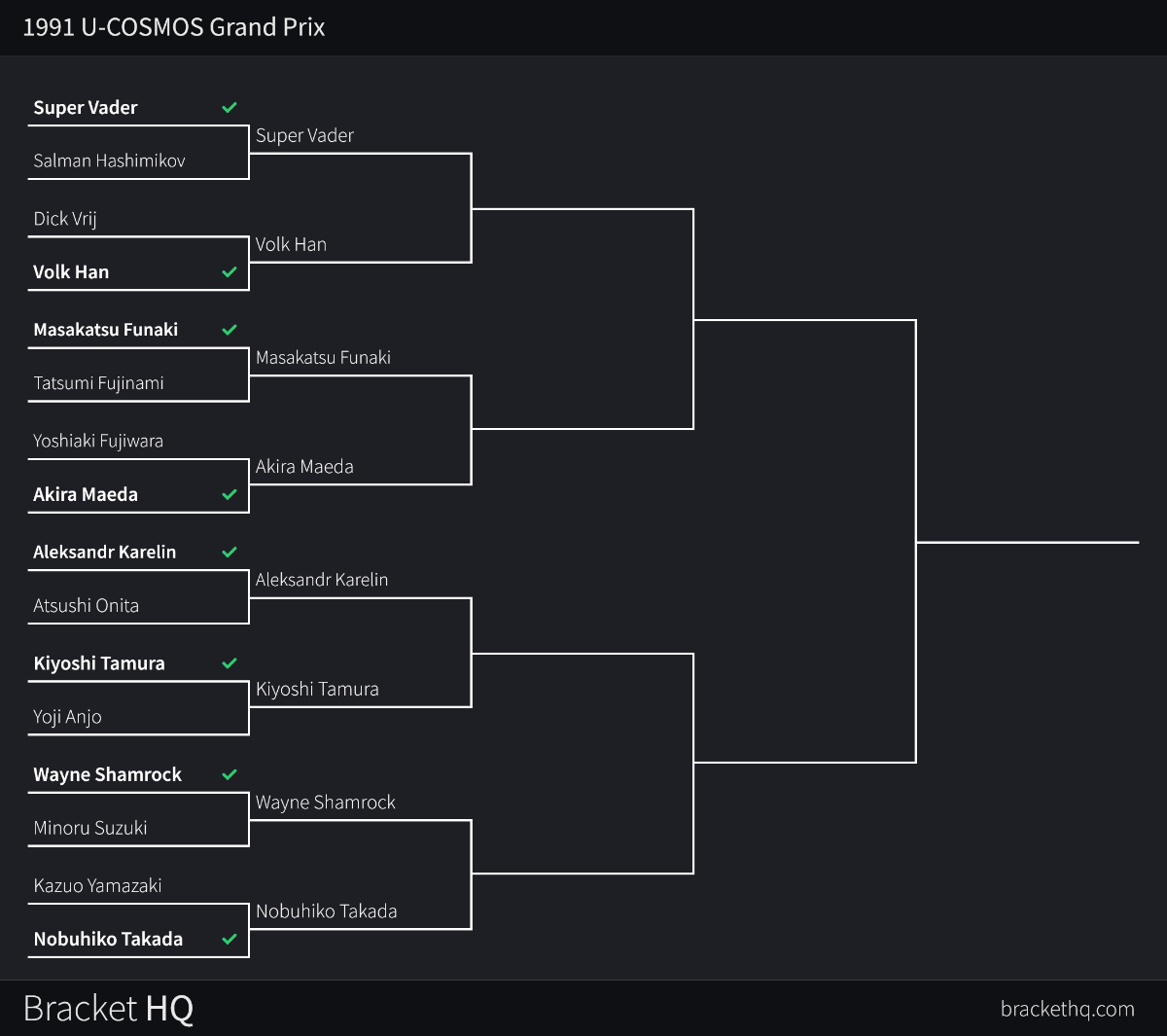
September 25th, 1991 Sendai City Gymnasium Sendai, Japan Attendance: 7,000 (sold out) Broadcast: WOWOW (live) Kiyoshi Tamura vs Yoji Anjo The first round of the U-COSMOS Grand Prix opened with a match between two men who knew each other well from sparring in the dojo. Anjo's craft gave him a foothold in the opening minutes. His experience helped him steer scrambles away from Tamura's most dangerous submission entries and force a rope break of his own with an opportunistic wristlock that briefly suggested Anjo might neutralize his opponent’s prodigious technical skill. Tamura's response was characteristically relentless; he quickened the pace beyond what Anjo could comfortably sustain, and his rapid transitions began to wear on Anjo. Tamura's determination to win became clear, and Anjo was probably a step too slow. A knockdown from a sharp Tamura kick combination opened up the mat work that proved decisive, and Anjo's scrambling became less coordinated under sustained pressure. Tamura eventually secured a cross-armbreaker from a transition so fluid that the tap came before the crowd had fully processed what had happened. Tamura defeats Anjo via submission (cross-armbreaker), 11:57 Dick Vrij vs Volk Han The stylistic contrast was stark, though this wasn’t the first time these two had met. Each time, the contrast provided a sensational foundation for highly entertaining matches. This time wouldn’t be any different. Vrij established his range, his low kick combinations precise and damaging, forcing Han to think carefully about every forward step. Han absorbed the early punishment while cataloging Vrij's timing, and his first genuine offensive sequence, a sudden drop to the legs that caught Vrij mid-combination, immediately produced a rope break and confirmed that the Dutchman’s striking would not be sufficient to keep Han at bay indefinitely. The match picked up during a tense middle stretch as Vrij's power and Han's ingenuity traded advantages in rapid succession, with a Han heel hook attempt drawing one of the night's loudest crowd reactions before Vrij powered free with brute strength. Han later baited Vrij into committing to a high kick that left him momentarily off-balance, and the Russian converted it by catching it, creating an opening into a dizzying sequence of transitions that ended with a tight Achilles hold locked in before Vrij could reach the ropes. Han defeats Vrij via submission (Achilles hold), 12:22 Wayne Shamrock vs Minoru Suzuki Their previous encounter ended with Shamrock's kneebar finishing Suzuki in the New Generation tournament semi-finals, and Suzuki arrived at the Grand Prix intending to prove the result wouldn't repeat so cleanly. The early going bore out that determination. Suzuki was sharper and more varied in his approach than in their prior meeting, mixing his leg-kick game with unexpected clinch entries that disrupted Shamrock's takedown timing and prevented the American from establishing the sustained top control that had worn Suzuki down before. Shamrock adapted with the confidence of a wrestler who had clearly processed their previous encounter as carefully as his opponent, using his superior strength to win the clinch exchanges and gradually applying the kind of pressure that made him most dangerous. Suzuki's guillotine attempt midway through was the match's most dangerous moment for Shamrock, drawing a sharp crowd reaction, but Shamrock powered out with the composure of someone beyond his years. The finish came when Shamrock timed a Suzuki kick entry perfectly, secured a powerful double-leg, and, rather than transitioning to a submission, kept his weight distributed into a tight pinning combination that Suzuki couldn't generate the leverage to escape. Suzuki was visibly upset by the defeat and had to be counseled by Shamrock. Shamrock defeats Suzuki via pinfall, 12:41 Kazuo Yamazaki vs Nobuhiko Takada With Takada riding the momentum of his main event win over Maeda in Kobe and openly targeting Vader's title, this first-round match against the newly crowned tag champion Yamazaki carried real weight. A stumble here would derail the post-Kobe momentum before the Grand Prix had barely begun. Yamazaki, emboldened by his tag title success, pressed the fight from the opening bell with a striking combination that immediately put Takada on notice, and the early exchanges were notably quite heated and ferocious in pace. Takada gradually settled into his preferred rhythm, using his kicking range to establish the distance he needed and finding consistent success with sharp middle kicks that damaged Yamazaki's midsection. Yamazaki's counter-grappling kept the match competitive through its middle stretch. A beautifully timed heel hook attempt forced Takada to the ropes. Briefly, it swung the points in Yamazaki's favor. Still, Takada's striking output kept building in volume and precision as the match progressed, and the gap between the two men's stand-up capabilities became increasingly difficult for Yamazaki to manage. A sustained combination from Takada targeting the body and head produced a knockdown. With Yamazaki's movement compromised, Takada pressed forward with a final high kick that landed clean enough to keep the tag champion on the canvas for the full ten count. Takada defeats Yamazaki via KO, 14:11 Masakatsu Funaki vs Tatsumi Fujinami The tournament's next match brought together two of the promotion's most tactically sophisticated performers, and the opening exchanges reflected that spirit almost immediately. Neither man reached for anything ambitious before establishing the positional read their styles demanded. Fujinami was the more patient of the two early on, circling carefully and using his catch-wrestling instincts to control grip exchanges and deny Funaki the underhook position the New Generation tournament winner preferred as a launching point for his leg attack. Unbothered, Funaki responded by targeting Fujinami's lead leg with precise, probing kicks meant to inflict structural damage and disrupt the footwork underpinning Fujinami's takedown defense. The first genuine exchange of consequence came when Fujinami timed a Funaki kick and turned it into a Dragon Screw takedown, then immediately transitioned into a kneebar attempt that Funaki had to navigate carefully before reaching the ropes. The next stretch was technically compelling, with both men operating at the highest level of their craft. Fujinami's suplex expertise threatened twice in succession. A German suplex attempt produced a near-fall that brought the Sendai crowd to its feet and briefly made a Fujinami win likely. After Funaki kicked out of the pinfall attempt, the younger wrestler changed the momentum with a well-timed double-leg takedown. Funaki's leg attacks grew more confident, and several mat scrambles led to rope breaks for Fujinami. A points exchange left both men at 2-2, but Funaki's conditioning advantage showed in sharper striking exchanges once they got back to their feet. Funaki had studied Fujinami for quite some time, and it paid off as he abandoned his usual leg-attack entry for a sudden arm triangle that materialized from the clinch before Fujinami could process the change in approach. The choke was locked in tight with Funaki's full body weight distributed to prevent any possibility of the reversal that Fujinami's mat intelligence might otherwise have produced. Fujinami knew that there was no escape, and he had no choice but to relent and acknowledge the ascendancy of UWF’s next young star. Funaki defeats Fujinami via submission (arm triangle choke), 17:38 Aleksandr Karelin vs Atsushi Onita Whatever Onita had prepared for this match, sharing the ring with Karelin made it largely academic within the first ninety seconds. Onita tried to establish distance with a palm-strike combination, which Karelin absorbed without visible reaction before closing the gap with terrifying speed. Karelin secured Onita with a waistlock grip and ragdolled him with a vicious belly-to-belly suplex. Karelin quickly went for the kill. After setting Onita up, a single Karelin lift deposited Onita at a height and angle that drew an involuntary gasp from the Sendai crowd, and the impact left Onita sufficiently stunned. Motoyuki Kitazawa's count reached nine and a half before Onita signaled his intention to continue. Karelin was immediately back on him. Karelin terrified the audience by showing Muay Thai proficiency, clinching Onita and striking him with several knees. The gold medalist then hoisted Onita across his shoulders with contemptuous ease, rotated violently, and drove his opponent face-first into the canvas with a force that seemed to compress the entire ring on impact. The crowd went into a frenzy at the Soviet grappler's brutality and the sheer force of the landing, and Kitazawa didn't bother completing the full count, waving the match off immediately as Onita lay motionless. Karelin defeats Onita via KO, 2:11 Super Vader vs Salman Hashimikov The opening exchanges between Vader and Hashimikov produced the kind of immediate impact that the Grand Prix bracket had promised from the moment this pairing was announced. Two of the most physically formidable wrestlers in the world collided with the barely contained force of men who had spent their entire careers dominating opponents through sheer physical superiority. Hashimikov met Vader's opening salvo of body shots with a sharp inside trip that deposited the big American on the canvas in the match's first ten seconds, drawing a stunned roar from the Sendai crowd and serving immediate notice that this would be no straightforward Vader showcase. Vader got to his feet without panic, and the two locked into a series of standing clinch exchanges that were extraordinary in their raw physical intensity. Neither man could establish clean control, and each grip exchange deteriorated into a contest of pure strength that the crowd followed with reverent attention. Hashimikov's freestyle credentials were fully on display. His leverage and timing matched Vader's power in a way no previous opponent had managed for this long, and a belly-to-belly suplex that deposited Vader heavily on the canvas produced the loudest reaction of the match's opening stretch and forced Kitazawa to begin a count that Vader beat with visible effort. The match continued with a punishing rhythm that both men seemed to embrace. Vader's body shots began to land, and Hashimikov's early burst of energy gradually took its toll. The American's open-hand strikes also drew increasingly visible responses from the Soviet wrestler. Vader’s striking seemed to be the ace up his sleeve. Hashimikov answered by closing the distance again, ignoring the punishment he just received, and taking Vader down with a well-timed single leg. Hashimikov quickly attempted to find a forearm choke, but Vader spotted the ropes in time and reached for a break. Later, both men scored knockdowns through the middle stretch in a breathless exchange that saw points accumulate on both sides. Vader landed a thunderous lariat that folded Hashimikov. Hashimikov responded with a sudden headbutt Vader clearly did not anticipate, leaving the American blinking and off-balance in a way that felt genuinely unscripted. At this point, both men were bleeding, Vader above his eye, Hashimikov from the bridge of his nose. The physical toll on both wrestlers was evident. Vader finally manufactured the separation he needed to uncork his most devastating offensive weapon. Hashimikov, increasingly fatigued, lunged forward into a clinch with a desperation that left him momentarily off-balance, and Vader caught him perfectly. Vader secured a deep waistlock and executed a high-angle German suplex of extraordinary elevation, driving the back of Hashimikov's head and shoulders into the canvas at a sickening angle. The crowd fell briefly silent at the impact, and Hashimikov lay motionless as Masami Soranaka began his count. Rather than waiting to see whether the count would end it, Vader dropped immediately into a ground-and-pound position and began delivering measured, deliberate open-hand strikes to Hashimikov's head. Hashimikov's defense grew increasingly uncoordinated, and Soranaka stepped in to wave off the match. Vader rose slowly, his own physical cost evident in the way he moved toward the center of the ring. Vader defeats Hashimikov via TKO, 13:48 Yoshiaki Fujiwara vs Akira Maeda The weight of history hung over this match in a way that the Grand Prix bracket's other first-round pairings could not match. Fujiwara and Maeda had been intertwined since the earliest days of the UWF movement, their professional relationship carrying a shared history, mutual respect, and competitive rivalry that would be difficult to explain to most. Maeda entered with a focus that made it evident he was here to re-establish himself as the top man in the promotion. Fujiwara, as always, was unreadable. His pre-match demeanor carried the same placid, almost amused composure he brought to every situation regardless of stakes. The opening exchanges were careful, both men circling with the patience of fighters who knew the first meaningful commitment would likely define the match's trajectory. Maeda's kicking range gave him the first real threat; a low kick combination sparked the first crowd reaction. Fujiwara absorbed it without visible concern and continued his methodical approach, parrying Maeda's entries with subtle shifts that redirected momentum without ever fully engaging on Maeda's terms. The match's first decisive sequence came when Fujiwara baited Maeda into a palm strike, then slipped inside with the timing of someone who had been reading the setup for several minutes. Fujiwara followed with a quick headbutt, which the fans loved. A front headlock from the clinch position gave Fujiwara leverage, and he used it to drag Maeda into a grinding mat exchange where his catch wrestling instincts flourished. Maeda's escape was technically impressive, converting a near-dangerous wristlock into a heel hook attempt of his own that forced Fujiwara's first rope break and reestablished the match's equilibrium. The crowd watched intently, fully aware that they were watching two of wrestling’s genuine masters operating at the height of their powers. The next several minutes rewarded that attention with a series of exchanges of incredible technical skill. Fujiwara materialized arm entanglements from positions that seemed to offer no such opportunity, and Maeda countered with leg attacks that showed his mat credentials were not to be minimized. A sustained Maeda striking sequence midway through produced the bout's first knockdown. A clean high kick landed flush on Fujiwara's jaw. Maeda pressed with the urgency that had defined his best performances, converting the momentum into another mat sequence that burned through two of Fujiwara's rope breaks in quick succession and opened a point gap at 2-1. Fujiwara absorbed the deficit without visible panic. He began steering the match back toward his preferred terrain with a subtle shift in his clinch positioning that denied Maeda the clean entries his kicking game required. A beautifully constructed sequence of arm work forced Maeda to burn another rope break, tying the match at 2-2 on points. The bout's climax produced the kind of intricate scrambling that only two men of this experience and intelligence could sustain. Fujiwara hunted constantly for the arm that his entire match strategy had been oriented around. Maeda navigated each attempt with the defensive awareness of someone who understood the trap being laid. He was determined not to provide the final opening. Fujiwara came agonizingly close on two consecutive attempts, his armbar nearly reaching full extension before Maeda's flexibility and awareness allowed him to stack and rotate free, and the crowd's reaction to each near-submission grew more urgent. Maeda’s conditioning seemed high, and Fujiwara, a bit older, was beginning to feel the deep waters. Next came the cold, targeted wrestling that defined Maeda's best mat work. Fujiwara, having maneuvered Maeda into a standing clinch exchange with evident intent to set up a double wristlock, committed fractionally too much weight to his forward pressure. Maeda, reading the shift in an instant, dropped his level and secured a Capture Suplex that lifted Fujiwara cleanly and deposited him hard on the canvas after a swift overhead motion. The impact left Fujiwara briefly stunned, and Maeda transitioned with practiced speed directly into a cross-armbreaker before the veteran's survival instincts could fully reassert themselves. Maeda extended the hold to full extension, angling Fujiwara's body away from the ropes. Fujiwara strained with everything he had left, but the position was perfect, and the tapout came next. Maeda celebrated for a moment, but quickly extended a hand to Fujiwara. The Sendai crowd's sustained ovation acknowledged a match that had delivered everything the Grand Prix's first round had promised and then some. Maeda defeats Fujiwara via submission (cross-armbreaker), 24:17

-
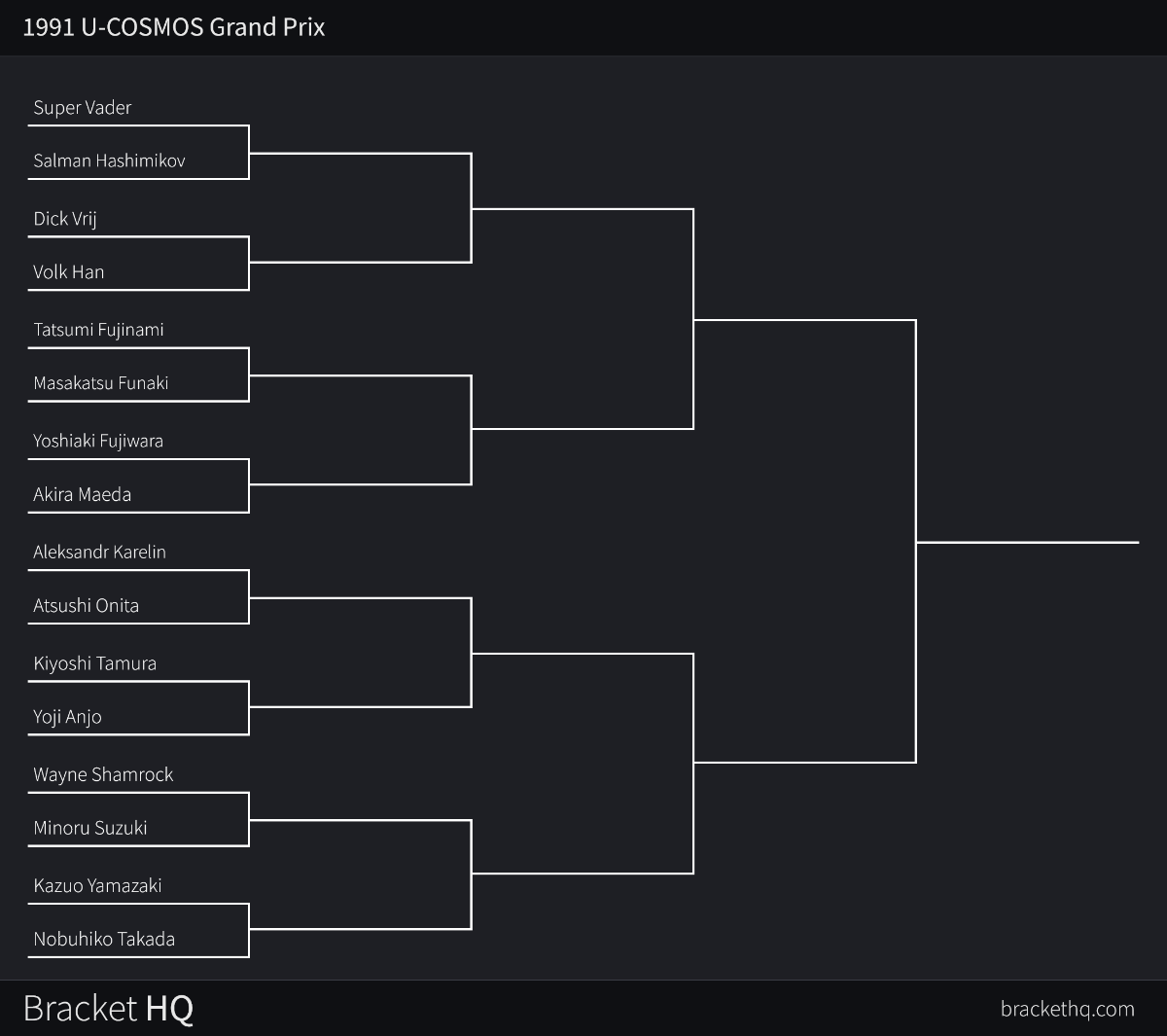
News and Notes (9/1/1991-9/14) UWF Newborn's "Battle Dimension: Kobe," held on 8/30 in Kobe Memorial Hall, was another legit sellout for the promotion, and their incredible three-year hot streak shows no sign of stopping anytime soon. With an announced crowd of 8,000, this was probably one of the best top-to-bottom shows in Japan this year. The undercard was pretty solid, with Nelson vs. Nagai and Benoit vs. Fujiwara both described as very good matches, and the latter in particular did a good job of making both guys look strong. The "New Generation" tournament concluded with Masakatsu Funaki getting a widely expected victory over Wayne Shamrock, cementing him as the promotion's top young star. The two had a lengthy conversation after the match, and it likely won't be the last time we see them lock up. The top half of the card featured two great tag matches. Tom Erikson and Vader defeated the Soviet duo of Salman Hashimikov and Victor Zangiev in a spectacular match featuring high-level power wrestling in the UWF style. Tamura and Yamazaki finally earned the tag belts by defeating the Koslowski brothers in another great match that let both teams play to their strengths. Takada vs. Maeda was the main event, and in a bit of a surprise, Takada came away as the winner. This will likely build him up more before the annual Grand Prix tournament starts, and Maeda having to claw his way back to the top sets up a pretty good story for him going into the tournament. WOWOW announced the Grand Prix bracketing live before the show ended, and the first-round matchups feature Vader vs. Salman Hashimikov, Tatsumi Fujinami vs. Masakatsu Funaki, Akira Maeda vs. Yoshiaki Fujiwara, and Kazuo Yamazaki vs. Nobuhiko Takada. (Wrestling Observer, 9/10/1991) Following up on the reported Shamrock/Funaki conversation from the Kobe show, it is said that Shamrock and Funaki have grown close over the past year and that, along with Minoru Suzuki, they consider themselves the "Three Musketeers" of the UWF. Both Shamrock and Funaki apparently feel they have earned a place in the top half of the UWF card, but an artificial ceiling is hindering their progress right now. While UWF sources downplay any major unhappiness, some American sources suggest they're frustrated with UWF's hierarchical system, which isn't unique to them, since every other major Japanese promotion uses a similar system. Although when you have a large roster of guys doing a very similar style, some conflict is bound to occur. I would expect all three guys to move up the card in due course, and it would be gross negligence if Funaki doesn't receive a title shot within the next year. There are also whispers that Funaki, Shamrock, and Suzuki are all developing a taste for legitimate shooting. (Wrestling Observer, 9/10/1991) UWF will open their 1991 U-COSMOS Grand Prix in Sendai on September 25th, with a full slate of first-round matches. UWF executives are excited about this year's tournament and believe strong matchups will keep tickets moving into the new year. The central question is whether anyone can stop Vader or Aleksandr Karelin, and a meeting between the two in the final feels inevitable. Of course, Akira Maeda could have something to say! (Weekly Pro Wrestling, 9/12/1991)
-
Christopher Daniels.....you are All-Pacific!
-
SummerSlam was well worth the wait and more! Fantastic job with the write-up. You did a very good job of conveying all the subtle details that a live WWF PPV would carry. Felt like I was transported back in time!
-
.thumb.jpg.367ae39d7bbf2fbc397a360aa0190988.jpg)
Universal Wrestling Federation (Herb Abrams)
Control21 replied to ErictheDragon's topic in Programming
This has been a very interesting twist on the UWF so far. By focusing on lesser-known talent, there are a lot of good angles and storylines playing out, which shows you don't always need a deep roster to spice things up. Bringing in Bruno Sammartino to add some legitimacy was a good call too, having a central figure that the rest of the roster orbits around is what makes these smaller territories tick, in my opinion. -
Winnipeg has been very fun to read about so far. The decision to focus a bit more on women this time is a great call! Might not be a bad idea to bring in some AJW stars from around this time period, especially someone like Aja Kong or Akira Hokuto.
-
I love how you are using Shinya Hashimoto. Pairing him with Tsuruta feels natural, and being a big player in AWA feels right, especially around this time. Kokina vs Bad News Brown is going to be a hell of a match, I bet!
-
I'm excited to see how Vader does once he gets some serious competition. I imagine Sting is looking over his shoulder each passing week.
-
I'm enjoying the new format. The focus on the commentators telling the action and the story makes transporting you to the place and time so much easier, especially for a show like SMW.
-
Pro Wrestling in the Final Days of the Soviet Union
Control21 replied to Phil Lions's topic in Pro Wrestling
Great stuff. This is a really interesting gap in wrestling history that rarely gets talked about -
UWF Newborn – “Battle Dimension: Kobe” August 30th, 1991 Kobe, Japan World Memorial Hall Attendance: 8,000 (sold out) Broadcast: WOWOW (live) Steve Nelson vs Mitsuya Nagai Both wrestlers dispensed with any prolonged feeling-out process in favor of direct grappling. Nelson's suplex-heavy offense gave him an early edge, and he used a powerful double-leg takedown to establish top position and begin testing Nagai's defensive awareness on the mat. Nagai showed more composure than in some of his recent outings, scrambling effectively and even threatening with a kneebar attempt that forced Nelson to the ropes, but his tendency to lose focus under sustained pressure resurfaced at critical moments, and Nelson was sharp enough to exploit it. A hard side suplex midway through the match produced a knockdown that swung the points in Nelson's favor, and though Nagai attempted to rally with a spirited striking sequence, Nelson weathered it and used the resulting scramble to drag Nagai back to the canvas where he was most comfortable. With Nagai tiring and his scrambles becoming less coordinated, Nelson secured a tight pinning combination off a belly-to-belly suplex that kept Nagai's shoulders down for the full count. Nelson defeats Nagai via pinfall, 10:14 Billy Scott vs Koji Kanemoto The early exchanges confirmed that this would be a competitive test rather than a showcase for either man. Kanemoto established his kicking range quickly, landing sharp low kicks that disrupted Scott's attempts to close the distance and initiate the grappling exchanges where the American was most dangerous. Scott adapted with the patience that had characterized his best performances, absorbing the early striking pressure without panic and timing his entries more carefully. This enabled Scott to eventually secure a takedown, forcing Kanemoto to burn his first rope break after a single-leg Boston crab attempt. The two traded points in a tense middle stretch, with Kanemoto's speed and Scott's mat fluency producing a series of scrambles that the crowd followed with real investment. Kanemoto's urgency ultimately worked against him in the final moments; a rushing takedown attempt gave Scott the opening he had been waiting for all match, and he converted it into a rolling double wristlock with fluid efficiency, wrenching the hold into full extension before Kanemoto could locate the ropes. Scott defeats Kanemoto via submission (double wristlock), 11:47 Yoji Anjo vs Jerry Flynn Flynn posed an early tough challenge for Anjo; his reach was far greater, and his kicking range bothered the veteran. His combination work in the opening minutes was sharp and well-timed, and Anjo found himself on the back foot early after eating a clean right hand that briefly disrupted his rhythm. Anjo's instincts kicked in quickly, however, and he began using feints and lateral movement to take the edge off Flynn's power shots while probing for the clinch entries that would allow him to drag the match toward more favorable terrain. Flynn's ground game proved to be the limiting factor once Anjo began initiating mat exchanges in earnest. The American was competent enough to avoid immediate danger but lacked the technical depth to match Anjo's craft in the scrambles, and each time the two hit the canvas, Anjo inched closer to a dominant position. A few lost points breaks from Flynn in a span of a few minutes told the story of Anjo's growing control, and with Flynn's striking output diminishing as his defensive workload on the mat increased, Anjo was able to manufacture a final takedown that deposited Flynn face-down on the canvas with no clear escape route. Anjo applied a full Boston crab with efficiency, and Flynn had no choice but to submit. Anjo defeats Flynn via submission (Boston crab), 10:33 Tatsuo Nakano & Shigeo Miyato vs Masahito Kakihara & Yusuke Fuke Nakano and Miyato worked in disciplined tandem to neutralize Kakihara's dangerous striking whenever he entered, while Kakihara and Fuke used rapid tagging to prevent Nakano from establishing the sustained striking pressure that made him most dangerous in singles competition. Fuke showed real resilience in his exchanges with Nakano, surviving several hard palm strikes through sheer determination and even forcing a rope break with a vicious heel hook attempt that drew a reaction from the crowd, but Miyato's quiet technical work behind the scenes proved to be the match's decisive element. He consistently found angles to attack limbs during scrambles that his opponents had not fully accounted for, and a string of rope breaks accumulated against Kakihara during one particularly sharp stretch of mat wrestling that gradually swung the points toward Nakano and Miyato. The finish came when Kakihara, attempting to manufacture a momentum shift with an aggressive striking flurry, was caught by Miyato during the resulting scramble. A heel hook was applied before Kakihara could orient himself toward the ropes, and the submission came quickly. Nakano & Miyato defeat Kakihara & Fuke via submission (heel hook), 13:08 Chris Benoit vs Yoshiaki Fujiwara Benoit's continued development in UWF had been one of the undercard's most compelling storylines, and a match against Fujiwara represented both a test of his progress to date and an opportunity to announce himself as something more than a promising prospect. Benoit approached the match with the calculated aggression that had defined his best performances, pressing the grappling early and looking to establish his grappling dominance before Fujiwara could settle into the patient, counter-based rhythm that made the veteran so dangerous. Fujiwara, characteristically unhurried, absorbed the early pressure with something approaching amusement, parrying Benoit's entries and using subtle weight shifts to steer each scramble away from the positions the Canadian was hunting. Benoit's persistence eventually yielded results. A well-executed double-leg takedown gave him a stretch of top control that led to a rope break, and his improving catch-wrestling fundamentals were evident in how he moved from limb to limb with increasing fluency. But each time Benoit threatened to truly impose himself, Fujiwara seemed to have a counter waiting, and the veteran's ability to make dangerous positions look comfortable suggested he was operating well within his limits even as Benoit pushed the pace. The match turned on a single moment of overconfidence from the younger man. Benoit, encouraged by his earlier success with leg attacks, reached for a heel hook from a position that gave Fujiwara just enough space to work, and the veteran needed nothing more than that. In one seamless motion, Fujiwara redirected Benoit's momentum, extended the arm that had been left momentarily exposed, and applied the Fujiwara armbar with the precision of someone who had been setting the trap for several minutes. Benoit's eyes told the story, the realization arriving a half-second too late that he had been led exactly where Fujiwara wanted him. He strained toward the ropes with desperation, but the grip was absolute, and the tap came shortly after. Fujiwara released the hold and rose with the demeanor of a craftsman satisfied with his work, while Benoit remained on the canvas for a moment, processing the lesson he had just received. Fujiwara defeats Benoit via submission (Fujiwara armbar), 15:22 Wayne Shamrock vs Masakatsu Funaki It was time for the final of the “New Generation” tournament, a tournament designed to crown the undisputed leader of UWF’s competitive youth movement. Both men had earned their place in this bout through performances that had defined them as two of the most dangerous wrestlers on the roster. Shamrock's power and athleticism had been the story of his tournament run, and he brought that same explosive physicality to the opening exchanges, pressing Funaki with hard entries and looking to establish the kind of smothering top control that had finished Suzuki in the semi-finals. Funaki, however, was a different proposition; his ability to read and counter takedown attempts was among the best on the roster, and he neutralized Shamrock's most aggressive entries with an efficiency that gradually shifted the match's balance. Shamrock's striking found occasional success, and one particularly hard combination briefly rocked Funaki and produced a tense moment that had the crowd on its feet. But the tournament's most dangerous finisher on the mat was never truly rattled, and his counter-grappling grew sharper and more purposeful as the match progressed, burning through Shamrock's rope breaks with a leg attack that targeted the same knee from multiple angles. After a competitive match, the finish arrived with the type of prodigal wrestling that most came to expect from Funaki. Shamrock’s earlier athleticism was now tempered by fatigue. Shamrock reached for a desperate takedown that left his lead leg momentarily exposed, the precise invitation Funaki had been engineering all match. The kneebar was locked in with devastating speed and precision, the transition so fluid that Shamrock had no realistic opportunity to locate the ropes before the hold reached full extension. The tap came quickly. Funaki had won, and Shamrock was left a little speechless. Shamrock took his time to recover as Funaki celebrated, but the two eventually shook hands and had a lengthy conversation in the middle of the ring. Funaki was later presented with a trophy and a plaque commemorating his victory. Funaki defeats Shamrock via submission (kneebar), 15:47 Super Vader & Tom Erikson vs Salman Hashimikov & Victor Zangiev The tag match between four of the most physically imposing wrestlers in the promotion was always going to be a collision defined by power. The opening exchanges delivered exactly that. Vader and Hashimikov immediately gravitated toward each other with the energy of two alpha bulls. Hashimikov's amateur credentials were as legitimate as anyone in the building, and he proved it by matching Vader's early physicality, hold for hold, in a series of clinch exchanges that the crowd followed with audible excitement, even briefly forcing Vader to the ropes with a sudden inside trip that drew genuine surprise. Zangiev and Erikson, meanwhile, later engaged with similar energy. The exchange had the intensity of two men who had spent their careers throwing around opponents. Their exchanges were more technically nuanced than the Vader-Hashimikov dynamic, but no less compelling for it, and Erikson's folkstyle base gave him enough of a foothold to keep Zangiev from establishing the dominance that had characterized the Soviet wrestler's previous appearances. The match's complexion shifted when Vader began to assert his singular physical gifts with more deliberate intent, targeting Zangiev directly after recognizing that the Soviet wrestler was the more vulnerable of the two opponents in striking exchanges. Zangiev defended, using his considerable grappling strength to make Vader work for every inch, but the American's body shots were simply too powerful to absorb indefinitely, and a sequence of hard open-hand strikes produced a knockdown that gave Vader's team a meaningful points advantage. Hashimikov was tagged in and responded with ferocity, going toe-to-toe with Vader and even landing a short belly-to-belly takedown that got Vader on his back, but Hashimikov had spent too much energy to drag the bigger man down, and Vader had the opportunity to stall enough to force the referee to order a clean reset. Later, with Zangiev and Erikson in the ring, Zangiev landed a clean side suplex on Erikson during a heated exchange that briefly threatened to swing the momentum, and for a stretch the match teetered in the balance. Both teams traded points through rope breaks and knockdowns as the crowd sustained its noise through a tense middle section that featured plenty of suplexes, throws, and takedowns. Eventually, the end of the match saw the overwhelming violence that Vader had dominated the professional wrestling scene with. Zangiev, attempting to re-enter the match with an aggressive clinch, was caught mid-motion by Vader, who hoisted the Soviet wrestler into a high-angle German suplex of stunning elevation that planted Zangiev at a sickening angle and left him momentarily motionless on the canvas. Rather than wait for the count, Vader dragged the barely-responsive Zangiev back to his feet with terrifying power and immediately delivered a powerslam of such force that the entire ring seemed to shudder on impact. Motoyuki Kitazawa waved the bout off without bothering to complete the count, and the crowd's reaction mixed genuine awe with the stunned quality that always accompanied Vader's most devastating performances. Vader & Erikson defeat Hashimikov & Zangiev via KO, 16:03 Kiyoshi Tamura & Kazuo Yamazaki vs Dennis Koslowski & Duane Koslowski Tamura and Yamazaki had been building toward this opportunity for months, and the Koslowski brothers had proven themselves formidable champions whose amateur wrestling pedigree presented a unique and difficult problem for any team in the promotion. The early going confirmed that difficulty immediately, as Dennis and Duane worked with the kind of intuitive coordination that only comes from a lifetime of shared training. They cut off Tamura's preferred angles and used their combined size advantage to bully Yamazaki in the clinch whenever the striking-based wrestler looked to initiate mat exchanges on his own terms. Tamura's response was to quicken the pace beyond what the brothers were comfortable sustaining; his rapid transitions and urgent scrambling style created a tempo that disrupted the champions' methodical approach and began to manufacture the kind of positional errors that a technician of Tamura's quality could exploit. A beautifully executed flying cross-armbreaker attempt from Tamura produced the first rope break of the match and served immediate notice that the champions were in for a serious challenge. Midway through, the match became a sustained battle for tempo control, with the Koslowskis repeatedly attempting to slow the pace through strength and positional grinding while Tamura and Yamazaki worked to keep the exchanges fast and unpredictable. Yamazaki's contribution proved invaluable in this phase. His counter-grappling intelligence complemented Tamura's urgency perfectly, and he neutralized several of Duane's most dangerous clinch sequences with the kind of efficient technique one would expect from someone who spent a lifetime training in catch wrestling with the likes of Satoru Sayama and Yoshiaki Fujiwara. Dennis accumulated rope breaks against both challengers through sheer physical insistence, and the points were moving in Tamura and Yamazaki's favor. A sharp kick combination from Tamura that produced a knockdown on Duane briefly threatened to end the match prematurely and sent the crowd into its loudest sustained noise of the bout. Dennis, growing increasingly frantic as the points deficit mounted, engaged with Tamura in a grappling exchang and the young sensation made his mark instantly, securing a single-leg that took Dennis by surprise. The frantic speed of Tamura’s grappling on the mat caught the American by surprise, going for the cross-armbreaker before Dennis could establish any defensive posture. The hold was locked in at full extension with nowhere near enough space between Dennis and the center of the ring for a rope break to save him, and the tap ended the match to a thunderous reception. Tamura and Yamazaki celebrated together as the new UWF Undisputed World Tag Team Champions, with Tamura's expression carrying the emotion of a man who felt his moment was coming. The Americans’ grip on the title had been released. Kiyoshi Tamura & Kazuo Yamazaki defeat Dennis & Duane Koslowski via submission (cross-armbreaker), 17:22 Akira Maeda vs Nobuhiko Takada Maeda entered with the controlled intensity of a former champion determined to begin his road back to the title with the most emphatic statement available to him, while Takada's bearing suggested someone who was eager to gain valuable momentum heading into the annual U-COSMOS Grand Prix. The opening exchanges were careful and deliberate in the way that only high-stakes matches between deeply familiar opponents can be. Each man read the other's moves with the accuracy of long familiarity, neither willing to commit to anything that left a meaningful opening. Maeda's kicking range gave him the early initiative, a sharp middle kick combination drawing the first genuine crowd reaction, and Takada's response, a single-leg takedown that transitioned smoothly into a heel hook attempt, forced the former champion's first rope break and immediately reestablished the match's competitive equilibrium. The match continued as both men began to take risks that the earlier caution had forestalled. Takada's striking grew sharper and more varied in the second phase, mixing head-level palm strikes with body kicks in combinations that kept Maeda's guard genuinely occupied and created the openings for takedown attempts that Maeda was forced to defend with increasing urgency. Maeda's mat work remained his greatest weapon, and he demonstrated it with a sustained stretch of leg attack that burned through two of Takada's rope breaks in quick succession and produced a points lead that momentarily seemed to shift the match's direction decisively. Takada's response to adversity, however, had always been one of his defining qualities; rather than tightening up under the pressure, he opened up offensively and produced a spinning heel kick that landed flush on Maeda's jaw and sent the former champion to the canvas for the first knockdown of the match. The crowd erupted, and Takada pressed the momentum with disciplined urgency, converting a subsequent scramble into a rear-naked choke attempt that Maeda only escaped by throwing himself toward the ropes with desperation. Down a new stretch, the match found a new balance, with both men trading rope breaks and narrow escapes through a grinding stretch that had the crowd fully locked in on every movement. Maeda's conditioning remained formidable, and he refused to allow Takada's momentum to translate into the kind of sustained control that would make the outcome feel inevitable. Each time Takada threatened to pull clear, Maeda manufactured a scramble or a striking counter that reset the match's balance. A beautifully timed German suplex from Maeda produced a knockdown that leveled the points and temporarily silenced Takada's growing section of the crowd, and the match entered its final stretch with neither man holding a clear advantage and both visibly operating on their last reserves. What separated the two men in the end was a single moment of timing from Takada. Maeda, reaching for a palm strike combination that had served him well earlier in the match, left his lead foot fractionally too far forward in the execution, and Takada, who had clearly been cataloguing that tendency all night, dropped underneath with a perfectly timed single-leg takedown that deposited Maeda squarely on his back. Rather than hunting for a submission, Takada immediately took Maeda’s back and secured a lock around his waist, lifting him for not one but two high-angle German suplexes. The last was enough to keep Maeda’s elbows to the mat as Takada bridged, and Masami Soranaka's count reached three. The Kobe arena went into a frenzy, and Maeda seemed a bit shell-shocked. Takada defeats Maeda via pinfall, 23:44 Maeda takes his time to recover, but acknowledges Takada before leaving the ring. Takada takes in the moment before grabbing a microphone and promises to take the title back from Vader, saying nothing will stop him from becoming the undisputed #1 in UWF and winning the Grand Prix. He thanks Maeda for the terrific match and thanks the fans for coming. And now, officially, here's the bracket for this year's U-COSMOS Grand Prix, starting next month!
-
Pancrash! 1 (1/19/1994) Yoshiki Takahashi vs Katsuomi inagaki Takahashi (with a fresh haircut) has no problem exerting control early. He easily takes Inagaki’s back and exerts control throughout the opening minute. Inagaki has to resort to somewhat desperate defense as Takahashi is in hunt mode, going from limb to limb to find an angle. To Inagaki’s credit, he does end up scrambling well to briefly gain top control, but they end up near the ropes, and the referee calls for a clean break. On their feet, Inagaki ends up throwing a few stiff strikes to give Takahashi something to think about, and times a hard kick just as Takahashi is jumping for a kick as well; Takahashi ends up flat on the canvas, but the referee calls it a trip. Takahashi seems just fine anyway. Takahashi dives in for a single-leg afterward and takes Inagaki down to the mat again. He quickly gains side control and hunts for a cross-armbar, but Inagaki realizes he is near the ropes and grabs the bottom rope for a rope escape. Takahashi gives no breathing space to Inagaki, and he quickly takes him down to the mat again after the reset. Takahashi appears to hunt for a rear-naked choke, but Inagaki does very well to defend and scrambles out of it to regain top control, and the crowd is quite impressed with that (I am too!). Inagaki tries to find something from side control, but Takahashi’s hand defense proves problematic, and Takahashi is quick to find Inagaki’s back as he gives it up to try and attack his legs. Another rear-naked choke attempt forces Inagaki to the ropes again. After the reset, Inagaki tries to catch Takahashi with a high kick, but Takahashi catches it and takes Inagaki down for another adventure on the canvas. This time, Takahashi takes control of his opponent’s legs and tries to hunt for a heel hook, but Inagaki’s boots prove problematic and give him enough protection to escape before he can lock one in. There’s another scramble, and Takahashi takes Inagaki’s back again. Danger is lurking as Inagaki stands up to try to scramble out, but Takahashi locks in his grip tight enough to keep control and takes him back to the mat. It’s locked in this time, and Inagaki passes out before he realizes he has nowhere to go. That was a very impressive performance from Takahashi, who gave Inagaki very little room outside of a few moments. Inagaki’s grappling skills are still quite raw (and may never improve), and Takahashi is just one step ahead of him in almost every facet, except maybe for striking. Still, we have to give Inagaki credit for putting up a decent fight and making his opponent work to earn the victory. ENTERTAINMENT VALUE: ***1/2 Andre Van Den Oetelaar vs Vernon "Tiger" White Oetelaar has a very weird way of preparing for his fight by facing all four cardinal directions while slapping his chest multiple times in a pattern. I suppose you have to go with whatever helps you! We are quickly underway again, and Vernon dives for a leg takedown, but Oetelaar dodges, and they end up on the mat with Oetelaar establishing side control. They end up near the ropes, and Oetelaar pressures Vernon enough to make him use a rope escape. After Vernon tries to use low kicks to keep Oetelaar honest, Oetelaar backs Vernon into a corner and hits him with a body shot to force the match back to the canvas. Oetelaar grabs side control again, but they are close to the ropes, and we get a clean reset. Back on his feet, Vernon hits a spinning roundhouse right near Oetelaar’s groin (that must have hurt), and the referee waives off a knockdown in favor of an errant low blow that gives both fighters a moment to take a breather. Vernon is way more active with his kicks now, and he gives Oetelaar something to think about before the Dutchman charges in and crowds his opponent into a turnbuckle, and they end up in a bit of a scramble on their feet, which causes another clean break from the referee since they are near the ropes. Vernon tries for another leg takedown, but Oetelaar defends well, and he pummels Vernon with closed fists to his back, earning some murmurs from the crowd (did he violate the Pancrase code of honor by using ground and pound? How dare he). Oetelaar establishes side control again and goes for his trademark shoulder lock, which is tight enough to force Vernon to go for another rope escape. Vernon is very active on his feet, but he can’t seem to land any major strikes, and Oetelaar is happy to close the distance or turn a kick into another takedown like he does here. Oetelaar’s strength is a major advantage in this bout so far, and he easily stuffs most takedown attempts from Vernon (Barnett notes that Vernon plays into Oetelaar’s hands by not creating enough distance)… and there’s another one. Oetelaar stalls a bit while trying to get something from the guillotine position, and the referee forces a clean reset. This match has a lot of pauses and resets! I think that plays into Oetelaar’s hands, as Vernon really can’t seem to get anything going, and Oetelaar is happy to take a breather whenever he can. Vernon offers up a few tentative strikes and attempts another leg takedown, but Oetelaar fends it off again, and he gains side control while locking in a forearm choke, which is enough to make Vernon tap! Oetelaar is your winner here. ENTERTAINMENT VALUE: *** Ryushi Yanagisawa vs James Matthews The representative from Shamrock’s Lion’s Den blocks a few early strikes from his opponent and tries to get a single-leg takedown on Yanagisawa, but the attempt is stuffed, and Yanagisawa uses his length to easily turn it into an Achilles hold, forcing Matthews to reach for the ropes desperately to break the hold. James Matthews already finds himself in a bit of a hole here, and Yanagisawa pressures him again with another high kick, which Matthews blocks. The American goes for another takedown attempt, and this time, he gets control of Yanagisawa’s back as he locks in a full-nelson. Yanagisawa doesn’t seem too bothered, though, and Matthews eventually changes his positioning to top control while going for a shoulder lock. Yanagisawa fights his way out of danger and sweeps Matthews to take top control. There’s some hand fighting as Yanagisawa attempts to find an angle, and Matthews manages to snatch Yanagisawa’s foot in the process, but Yanagisawa is wise to Matthews’ machinations, and he immediately positions himself back to Matthews’ side, where he snatches a cross-armbar easily. Matthews tries to get to the ropes, but is forced to tap before he can. Yanagisawa is your winner at 2:58! ENTERTAINMENT VALUE: *** Scott Bessac vs Yusuke Fuke Fuke immediately throws a low kick and goes for the double-leg, but Bessac stuffs it and gains top control on the mat. Bessac transitions from the full mount to side control and tries to lock in a shoulder hold, but Fuke defends well and makes him work as Bessac moves back to half guard and back to side control. They end up near the ropes and get a clean break from the referee. On their feet, Fuke tries to go for another takedown, but Bessac defends again. Bessac gains top control again while throwing a few palm strikes on the ground, violating the Pancrase Gentleman’s code. Fuke sweeps and gets a nice reversal on Bessac, establishing side control in the process. Fuke immediately hunts for the cross-armbar and gets it, forcing Bessac to go for the ropes quickly. After the reset, Fuke finally gets a leg takedown, this time with a single-leg, and Fuke wisely hunts for Bessac’s weakly defended leg. Fuke doesn’t waste much time locking in a painful heel hook, and that’s enough to get Bessac to tap! ENTERTAINMENT VALUE: ***1/2 Masakatsu Funaki vs Bas Rutten The bout opens with both measuring each other up, and Rutten makes the first move by attempting to catch Funaki with a hard low kick, but Funaki dodges and takes Rutten down to the mat. Robert Wu on the Asia TV version of this show notes that Rutten has the letter “R” drawn on his hand as a reminder to “relax.” That’s very interesting! Funaki has top control on Rutten and appears to be working for a shoulder lock. Rutten is trying to increase his leverage and limit the tightness of the hold, and seems to be successful so far. Funaki finally relents and tries to work for another hold, but Rutten’s hand defense is on point. Funaki continues to maintain control and keeps working for a new shoulder lock in half-guard. Funaki starts to work for a wrist lock, but Rutten fires back with a palm strike. This causes Funaki to move to Rutten’s ankle, and in the process, Rutten appears to throw a closed fist. That will certainly upset Funaki, as he viciously grabs a heel hook and forces Rutten to tap almost instantly. That was quick! As predicted, once Funaki got Rutten to the mat, he was in total control. ENTERTAINMENT VALUE: ***1/4 Minoru Suzuki vs Wayne Shamrock The bell sounds, and Shamrock immediately pressures Suzuki with a series of palm strikes. The crowd is HOT for this! Shamrock corners his opponent and tries to take Suzuki down to the mat after locking up with him, but is unable to do so. There is a very quick pace to this so far! They continue to lock up, and Shamrock finally manages to drag Suzuki to the canvas as he gets him in a rear-mount from side control. Suzuki turtles up and plays defense while Shamrock tries to crack the code. Shamrock attempts to apply pressure with his forearm, but Suzuki doesn’t relent. Shamrock is happy to take Suzuki’s back, though, and briefly tries to gun for a rear-naked choke, but Suzuki is quick to scramble out. Shamrock attempts to set up the triangle, but Suzuki plays it close and stuffs the attempt. Shamrock establishes a fairly basic guard on his back, and Suzuki engages in some hand fighting with Shamrock. Shamrock’s defense is very good as well, and Suzuki certainly doesn’t have an easy time here. Shamrock is happy to stay in guard here, as Suzuki struggles to break through the defensive posture. Finally, Suzuki gets the idea to shoot for side control, and he gets it and goes for a double wristlock, but as Barnett notes, Shamrock makes this very difficult too. Suzuki buys his time, but Shamrock is patient too, and this results in a bit of a stalemate before Suzuki shifts to a full-mount and attempts the shoulder lock. Shamrock easily sweeps Suzuki and gets rear control as Suzuki turtles up again. I am thoroughly enjoying this. There is a very good pace to this match, and the matwork has had very technical and tactical elements to it. Suzuki has looked very sharp, and the conditioning of these two is tremendous. Both have made each other work defensively, and the result has been some very nice, if not subtle, counter-grappling, especially in terms of the use of hands. Shamrock continues to maintain rear control, and Suzuki maintains his turtle position. Barnett notes that Suzuki is doing very well in this position, making Shamrock work for positioning and perhaps waiting for the right moment to exploit Shamrock on a defensive counter, such as a roll to attack the knee. Shamrock, perhaps aware of this, is a bit cautious. He attempts to snatch Suzuki’s ankle, perhaps as a way to make Suzuki work to defend, but lays off as he switches to the arm. There is a bit of a cat-and-mouse game here, as Rob Wu notes, and Shamrock attempts to secure a rear-naked choke from side control, but Suzuki’s defense continues to be impressive. Suzuki senses Shamrock is losing his position, so Suzuki moves to get half-guard and stands up, as he seems interested in attacking Shamrock’s leg. Suzuki gets Shamrock’s right leg, and Shamrock tries to switch to Suzuki’s free leg to counter, but Suzuki goes DEEP on Shamrock’s ankle and locks in a nasty heel hook that gets Shamrock to reach for the ropes to break it. He manages to do so, but Shamrock remains on the mat, and that heel hook clearly hurt Shamrock, as he remains motionless, and the referee calls off the match as Shamrock looks a bit shell-shocked. SUZUKI IS YOUR WINNER! HUGE UPSET! ENTERTAINMENT VALUE: ****1/4
-
News and Notes (8/17-8/21/1991) UWF's Rio show on 8/14 drew a claimed 20,000 to the Ginásio Gilberto Cardoso, which, if anywhere close to accurate, is a notable number for the company outside Japan and speaks to how far the UWF style's reputation has traveled via tape trading in the Brazilian scene. The undercard was stacked with local talent. Murilo Bustamante beating Fujiwara clean with a cross-armbreaker is the kind of result that is a bit shocking and makes me wonder what they have planned for the Brazilian, since Fujiwara doesn't do jobs like that for nobody. Maia/Ismail, Tadeu/Onita, and Erikson/Ogawa were competitive undercard matches, and each had their merits according to those who saw the taped broadcast in Japan. Karelin remains a total wrecking machine in this environment, and the Sayama match did the job of continuing to build him as basically unbeatable. Takada got back to business with a clean win, no real notes there. Maeda's return match, his first since the Vader loss, was the emotional center of the undercard, and the crowd reaction to his entrance suggests this promotion's reach in Brazil is legitimately bigger than I would've guessed going in; the Yamazaki match itself was solid, well-worked stuff, and having him win clean off a suplex pin was the correct call to stop the bleeding after Yokohama. Main event is really the story of the show, though. Ruas beating Fujinami via rear-naked choke, in his home country, in front of a crowd that was clearly still sore about the decision loss last year, is as good a hometown angle as this promotion's run all year, and by most accounts the live heat for the finish was enormous. Whether the tape holds up well and captures the spirit of the main event is something I'd want to revisit, but as a piece of business, running Ruas over Fujinami cleanly in Rio is smart booking, and this was a strong overall card for a company that continues to find ways to expand its footprint. (Wrestling Observer, 8/20/1991) UWF is back in Japan on 8/30 at Kobe with a card that on paper looks like one of the stronger ones of the year, and the buildup so far suggests the promotion knows exactly what it's got. The tag titles are on the line with the champion Koslowski brothers defending against the red-hot pairing of Kazuo Yamazaki and Kiyoshi Tamura. Vader gets an interesting tag outing with newcomer Tom Erikson against the Soviet duo of Hashimikov and Zangiev in a match that should be an interesting power vs. power style clash and gives Vader a chance to stay featured on the card without immediately running back another world title defense. The "New Generation" tournament final between Funaki and Shamrock is the one serious wrestling fans should circle, since both guys have looked like the future of the promotion all year and a tournament final between them should be one of the best matches in this style all year. But the top of the card belongs to Maeda vs. Takada, a match that's been teased for a long time and finally seems to be happening at a moment when it means the most. Maeda is coming off the Vader loss and needs a signature win, and Takada has something to prove after an up-and-down year of his own. (Wrestling Observer, 8/20/1991) Sources close to UWF's front office indicate that the 1991 U-COSMOS Grand Prix will open on September 25th in Sendai. Rumored, and perhaps obvious, names for the bracket include Vader, Akira Maeda, Nobuhiko Takada, and Aleksandr Karelin. The tournament has been confirmed to be a 16-man field, and the international flavor that was a hallmark of previous tournaments is expected to be maintained. An official announcement of the bracket is expected at UWF's next event in Kobe. (Tokyo Sports, 8/18/1991)
-
Oiwa vs Uemura was a modern day Thesz vs Gagne. All-time match. The battle over simple holds and reversals.....*chefs kiss*
-
UWF Newborn –“Brazil Martial Arts Festival” August 14th, 1991 Rio de Janeiro, Brazil Ginásio Gilberto Cardoso Attendance: 20,000 (sold out) Broadcast: WOWOW (taped) Denilson Maia vs Wallid Ismail The opening bout gave the Brazilian crowd exactly what they came to see, with two of their own countrymen competing under the UWF ruleset, and the partisan atmosphere inside the Ginásio Gilberto Cardoso was immediately evident. Maia's Luta Livre background made him a credible grappling threat, and he established his ground game early by shooting for takedowns with technical precision and forcing Ismail to work from defensive positions that suited Maia's preferred style. Ismail, having a similar background, was no stranger to mat combat and proved to be a stubborn, physical presence whenever Maia threatened to take control. Ismail powered through scrambles with the kind of relentless pressure that slowly shifted the match's momentum away from Maia. Ismail's strength advantage became increasingly relevant as the bout progressed, and he began to impose himself in the clinch with enough force to disrupt Maia's takedown attempts before they could develop fully. Two rope breaks apiece kept the match competitive deep into its second half, but Ismail's physicality eventually created the opening he needed. Ismail caught Maia's leg during a takedown attempt and leveraging his body weight into a tight heel hook that Maia had no realistic hope of escaping. Ismail defeats Maia via submission (heel hook), 11:33 Yoshiaki Fujiwara vs Murilo Bustamante Fujiwara's reputation as one of the most dangerous wrestlers in the world preceded him, but Bustamante arrived with credentials of his own and showed immediately that he had no intention of being overawed by the Japanese veteran's mystique. The early exchanges were a fascinating study in contrasting mat philosophies. Fujiwara's instinctive and defensive catch-based approach met Bustamante's more structured Luta Livre and Brazilian jiu-jitsu game in a series of intricate scrambles that the knowledgeable crowd appreciated deeply. Fujiwara threatened with his trademark arm entanglements on two occasions, coaxing a rope break out of Bustamante with a wristlock that seemed to materialize from an impossible position, but the Brazilian demonstrated impressive defensive awareness and was never fully caught out by the veteran's trickery. As the match progressed, Bustamante began to assert a positional authority that even Fujiwara's considerable guile could not fully neutralize. His top control was methodical and suffocating, and each time Fujiwara looked to create the scrambling chaos that suited his style, Bustamante shut it down with calm, efficient base. A final transition from side control to full mount left Fujiwara with diminishing options, and Bustamante isolated the arm with practiced precision before extending into a clean cross-armbreaker that left the veteran no room to maneuver. Bustamante defeats Fujiwara via submission (cross-armbreaker), 12:09 Eugenio Tadeu vs Atsushi Onita While Onita received a firm welcome from the fans due to his time in Brazil, the crowd saved some of its loudest enthusiasm for Tadeu, whose flamboyant fighting style and Brazilian roots made him a natural fan favorite in Rio, and he did not disappoint in the early going. His capoeira-influenced footwork and sudden Muay Thai striking combinations gave Onita an immediate problem to solve, as the unconventional angles and movement made it genuinely difficult to time entries or predict where the next attack was coming from. Onita, ever the tough and adaptable brawler, absorbed a stiff elbow strike early that briefly rocked him and fell behind on points after Tadeu's flashy offensive outbursts produced a knockdown that delighted the crowd. But Onita's durability and streetwise instincts began to pay dividends as the match continued. He weathered Tadeu's most explosive sequences without panic, clinching whenever the Brazilian's striking became too dangerous and grinding the pace down toward something more favorable. Tadeu's Luta Livre background made him competent on the mat, but Onita had similar training under Marco Ruas, of course, and he began to funnel the match into positions where Tadeu's showmanship became a liability rather than an asset. With Tadeu momentarily caught admiring his own footwork following a flashy spinning strike attempt, Onita shot in low and secured a tight leg entanglement, wrenching a knee scissors into full extension before Tadeu could locate the ropes. Onita defeats Tadeu via submission (knee scissors), 13:17 Tom Erikson vs Naoya Ogawa In an interesting style contrast, the new arrival, Erikson, had to contend with one of the most promising young prospects on the UWF roster. The early exchanges quickly justified the anticipation from the crowd; both men immediately recognized a kindred physicality in the other and dispensed with the usual feeling-out process in favor of direct, high-intensity grappling from the opening bell. Ogawa's judo instincts gave him early momentum, as his explosive hip throws and powerful grip work created several threatening positions that forced Erikson to dig deep into his amateur wrestling toolkit to survive. Erikson's folkstyle base proved invaluable in those moments. Erikson’s ability to scramble back to neutral from seemingly bad positions was a genuine revelation against someone of Ogawa's throwing power, and more than once he converted a near-throw into a top position of his own that had Ogawa scrambling. The match seesawed through a tense middle section, with both men trading rope breaks and neither able to sustain meaningful control for long, until Erikson began to exploit his raw strength advantage in the clinch with increasing effectiveness. A massive double-leg takedown from Erikson drove Ogawa into the canvas with enough force to briefly stun him, and before the judo prodigy could recover his bearings, Erikson had transitioned into a tight cradle that pinned both shoulders to the mat for the full count. Erikson defeats Ogawa via pinfall, 13:49 Nobuhiko Takada vs Marcelo Mendes Takada entered this match with something to prove following an up-and-down 1991 so far. Mendes, another Ruas Luta Livre student, was a legitimate grappling threat and not a mere showcase opponent. Mendes pressed his case immediately by shooting for takedowns with real conviction and forcing Takada into several defensive scrambles that kept the Japanese star from establishing his preferred kicking range in the early minutes. Takada's technical quality on the mat was evident in how he navigated those moments. Where a less experienced wrestler might have panicked, Takada worked systematically through Mendes' attacks and began to manufacture openings of his own, forcing a rope break with a heel hook attempt that signaled his confidence on the ground. Back on their feet, Takada's striking quickly became the defining factor. The combination work was sharp and purposeful, and Mendes, despite his grappling credentials, found no reliable answer for the sustained kicking attack that Takada now unleashed with increasing intensity. A high kick landed flush on the side of Mendes' head and dropped him for the first knockdown, and though the Brazilian rose with visible determination. Mendes attempted to get back into the match, but Takada’s catch wrestling skills gave Mendes a lot of trouble, despite Mendes being able to gain control on the mat at times. Takada, defensively, was on top of his game. Later, Takada pressed forward with a sharp palm strike combination that produced another knockdown before Mendes could establish any defensive posture. Motoyuki Kitazawa reached ten before Mendes could find his footing, and Takada's fist was raised to the disappointment of the crowd. Takada defeats Mendes via KO, 14:54 Aleksandr Karelin vs Satoru Sayama Karelin's continued evolution as a UWF competitor has been one of the promotion's most compelling storylines, and by this point in his tenure the Soviet had developed into something genuinely fearsome. Karelin was no longer simply an amateur phenomenon testing himself in a new environment, but a polished hybrid grappler whose SAMBO instincts had merged seamlessly with his Greco-Roman foundation to produce a style that had no clean counter in the promotion's existing playbook. Sayama, the former champion and one of the most technically gifted wrestlers on the roster, represented a very credible test for Karelin, at least his first since last year’s U-COSMOS tournament, and the early exchanges suggested this would be no straightforward exercise. Sayama's striking and mat intelligence gave him a genuine foothold in the opening minutes; his ability to create angles and attack from unconventional positions drew two early rope breaks out of Karelin that surprised the crowd and briefly unsettled the Russian's characteristic composure. Karelin recalibrated with efficiency, however, adjusting his grip, fighting to cut off Sayama's favorite entries and beginning to impose the kind of relentless upper body pressure that had made him untouchable in amateur competition. Sayama's attempts to drag the match toward a faster, more scrambling pace were neutralized, and the former champion found himself being steered into Karelin's preferred range with an inevitability that grew more pronounced as the match progressed. The decisive sequence arrived when Sayama, growing increasingly desperate to disrupt Karelin's control, reached for a wrist to initiate a standing scramble, the precise moment Karelin had apparently been waiting for. In one explosive motion, the Soviet secured a deep waistlock and executed a Karelin lift of stunning power and height, arching Sayama over and driving him into the canvas with a force that drew a collective gasp from the crowd. Sayama was momentarily stunned from the impact, and Karelin wasted no time exploiting the opening. The rear-naked choke was locked in before Sayama could fully process what had happened, and despite the former champion's considerable survival instincts, the position was airtight and the grip unbreakable. Sayama's hand tapped the canvas. Karelin defeats Sayama via submission (rear-naked choke), 7:37 Akira Maeda vs Kazuo Yamazaki Maeda's return to the ring following his devastating title loss to Vader carried an emotional weight that the crowd inside the Ginásio Gilberto Cardoso responded to immediately, and the former champion's entrance drew a reception that suggested the Brazilian audience had done their homework on UWF's hierarchy. Yamazaki, one of the promotion's most reliable performers, earned his place in this slot through consistent performances and arrived with a genuine game plan to exploit whatever vulnerabilities Maeda's recent punishment might have left behind. The early exchanges were defined by caution, with both men probing carefully and neither willing to overcommit, until Yamazaki landed a sharp kick combination that briefly rocked Maeda and served notice that he intended to test the former champion. Maeda absorbed the shot with the composure of a veteran and responded by pressing the grappling, using his superior mat credentials to assume control of the match's tempo. A tense stretch of leg lock hunting forced Yamazaki into burning two consecutive rope breaks, and the crowd's appreciation for the technical quality on display was evident as the match settled into a rhythm that favored the former champion. The match's second phase saw the momentum swing decisively in Yamazaki's direction. A sustained striking sequence produced a clean knockdown that drew the loudest reaction of the bout to that point, and Yamazaki pressed his advantage intelligently rather than chasing the finish recklessly. Maeda beat the count without apparent difficulty but the damage was real, and Yamazaki's confidence visibly grew as he began to find consistent success with his middle kicks in a way he had been unable to earlier. The former champion's response was to drag the match back toward the mat at every opportunity, grinding through scrambles with the patient tenacity of someone who understood that Yamazaki was getting the better of him when it came to striking. Another rope break from Yamazaki off a tight heel hook attempt shifted the momentum back in Maeda's favor, and the match entered its final stretch with both men visibly worn and the outcome genuinely uncertain. With the points level and both wrestlers operating on dwindling reserves, the decisive moment arrived. Yamazaki, growing impatient and sensing that time was working against him, reached for a high kick that Maeda had been anticipating. The former champion ducked cleanly underneath and converted the momentum into a powerful Capture Suplex that drove Yamazaki hard into the canvas. Maeda immediately went for the cover. Masami Soranaka’s count reached three to a warm reception from the Brazilian crowd, and Maeda rose with some relief. Maeda defeats Yamazaki via pinfall, 17:03 Marco Ruas vs Tatsumi Fujinami The main event brought the Ginásio Gilberto Cardoso to its loudest sustained noise of the evening. Ruas, the hometown hero, entered the arena with the crowd's ferocious support for their countryman, giving the match an atmosphere that transcended the usual main event electricity. Fujinami, characteristically composed, showed no outward sign of being affected by the hostile partisan environment as he made his entrance, and his deliberate, unhurried pre-match preparation suggested a man who had thought carefully about what Ruas would bring. The opening minutes validated that preparation. Fujinami refused to be drawn into the kind of explosive early exchanges that Ruas preferred, instead working the perimeter patiently and using his grappling range to test Ruas' reactions without fully committing. Ruas was sharp enough to recognize the strategy and matched Fujinami's patience with his own, and the result was a tense, chess-match opening that the knowledgeable crowd watched with hushed appreciation before Ruas broke the deadlock with a sudden low kick combination that caught Fujinami flat-footed and earned the first genuine reaction of the night. From that opening exchange forward, Ruas began to establish his striking credentials in earnest. His low kick game was precise and relentless, targeting Fujinami's lead leg with the kind of systematic intent that suggested a fighter who had studied his opponent's defense carefully. Fujinami adjusted admirably, shifting his weight distribution and beginning to use underhook entries to smother Ruas' kicking range whenever the Brazilian committed too fully to a combination. The mat exchanges that resulted from those clinches were among the match's highlights. Fujinami's catch wrestling fluency gave Ruas genuine trouble whenever the two hit the canvas, and he forced two consecutive rope breaks from Ruas with a kneebar and a subsequent hammerlock that demonstrated why his grappling reputation was so well established. Ruas, however, was no novice on the ground, and his vale tudo background had prepared him for the kind of uncomfortable positions Fujinami was creating. The Brazilian navigated each threat with enough technical competence to escape without serious damage, and his striking output remained a constant, credible danger whenever both men returned to their feet. The match's pivotal stretch arrived around the halfway point, when a sustained Ruas low kick sequence finally produced the structural damage he had been targeting all match. Fujinami's ability to generate the kind of explosive takedown entries that had defined his earlier control of the bout began to diminish noticeably. Ruas smelled the shift and pressed his advantage with increasing urgency, mixing his low kicks with sharp body punch combinations that kept Fujinami's guard occupied and prevented him from re-establishing the clinch work that had been his most effective weapon. A right palm strike that slipped through Fujinami's guard produced a knockdown that sent the crowd into delirium, and though Fujinami beat the count with characteristic grit, the momentum had shifted in a way that felt definitive. Two more rope breaks followed as Ruas hunted for a finish on the mat. Fujinami was starting to suffer a lot of wear and tear from Ruas’ physical approach. Fujinami summoned one final stretch of resistance that temporarily silenced the crowd's celebrations. A clinch entry produced a beautiful Dragon suplex that landed flush and kept Ruas momentarily stunned, and the arena collectively held its breath as Fujinami scrambled to capitalize. A few moments later, Fujinami caught one of Ruas’ low kicks for a surprise Dragon leg screw. Fujinami wanted to capitalize again, but the accumulated leg damage had taken too much from his mobility, and he couldn't secure the follow-up position quickly enough before Ruas recovered and dragged a limping Fujinami down with a beautiful double-leg takedown. From there, Ruas worked with methodical precision, passing through Fujinami's defensive guard in stages and eventually establishing the back position that his entire match strategy had been building toward. The rear-naked choke was locked in tight, and Fujinami had no remaining answer. His tap brought the Ginásio Gilberto Cardoso to the loudest eruption of the night, and Ruas rose to acknowledge the crowd that just went into a huge frenzy. After a controversial decision last year, Ruas was certainly sending the crowd home happy this time. Later after the match, Ruas and Fujinami exchanged pleasantries and closed the show with an award presentation from Brazilian government officials, along with UWF executives. Ruas defeats Fujinami via submission (rear-naked choke), 20:15
-
Card Announcement: UWF Newborn –“Brazil Martial Arts Festival” August 14th, 1991 Rio de Janeiro, Brazil Ginásio Gilberto Cardoso Denilson Maia vs Wallid Ismail Yoshiaki Fujiwara vs Murilo Bustamante Eugenio Tadeu vs Atsushi Onita Tom Erikson vs Naoya Ogawa Nobuhiko Takada vs Marcelo Mendes Aleksandr Karelin vs Satoru Sayama Akira Maeda vs Kazuo Yamazaki Marco Ruas vs Tatsumi Fujinami
-
News and Notes (8/3-8/7/1991) UWF blew the roof off Yokohama Arena on 7/30, drawing a legit sellout of 17,000 for the promotion's third anniversary show, and the answer to "can they top last year" turned out to be an emphatic yes. The undercard was loaded with people who are going to matter a lot going forward. Benoit continues to look like a guy who can hang with anybody in that ring, and his win over Flynn was competitive in a way that tells you UWF trusts him with real matches now. Taktarov/Vrij was a straight-up worked shoot war that boiled over into a legit heated scene after the ref stoppage, with the corners having to be separated. That angle isn't cooling off, and it seems they are going all in on the Dutch fighters vs Taktarov angle due to the controversy stemming from the Amsterdam show earlier in the year. In the “New Genration” tournament, which is designed to anoint the top young talent in the promotion, Masakatsu Funaki continued his hot streak by defeating Kiyoshi Tamura, and Wayne Shamrock topping Suzuki in the other semi, continues to point toward those four as the future of the promotion. Fujinami's win over Sayama was a very good semi-main event, with Fujinami earning a chance to take on Marco Ruas at UWF’s show in Rio de Janeiro. But nothing on this show, or arguably in company history, matters more than what happened in the main event. Vader beating Maeda clean via TKO for the undisputed title is the single biggest result in UWF's three years of existence, and it's not particularly close. This was Vader's night from bell to bell. Maeda had his moments, including a knockdown off a high kick that had the building fully convinced a miracle was happening, but Vader's power was simply too much, and the finish (a sustained beating that forced Soranaka to step in over Maeda's objections) was about as decisive as you can book a title change while protecting the top guy. Whatever you think about the wisdom of taking the strap off your top native star in his home country, the crowd reaction with stunned silence turning into a Maeda ovation on his way out, then Vader getting a hero's ceremony with Thesz, Robinson, and Gotch bringing the belt to the ring tells you this was presented as a monumental, business-altering moment, and it drew that way too. Where Maeda goes from here, and how quickly (or whether) UWF gives him his win back, is now the biggest story in Japanese wrestling. Vader, for the moment, looks like the most dangerous heavyweight on the planet. It is likely Vader will be participating in the annual U-COSMOS tournament later this year. Whether anyone can stop him remains to be seen. (Wrestling Observer, 8/6/1991) UWF has confirmed that their show in Rio de Janeiro will take place on August 14th. Tatsumi Fujinami vs Marco Ruas has been announced as the main event, and the card will also feature Aleksandr Karelin and a few other big names, including Tom Erikson. Despite the loss against Karelin, UWF officials still see Erikson as a major player in the coming months. Marco Ruas will be promoting the event in Brazil, and the card is expected to feature several Brazilian names like last year. The Gracies, who made a bit of a stink last time, have kept quiet this year. The feeling is that their stunt didn’t go over well, and they are focused on other ventures at the moment. Despite this, there is still some contention in the Brazilian press over the value of “fake fighting,” especially since Vale Tudo is increasingly seen as mainstream. (Wrestling Observer, 8/6/1991) UWF announced that this year’s edition of the U-COSMOS tournament will start in September, and will feature 16 competitors instead of the usual 24. The company wants a more streamlined tournament with even bracketing throughout, and there is hope that the smaller tournament will allow UWF to focus on the company's top stars without anything superfluous. The current belief is that Vader will defend his title in the tournament, as is customary. (Weekly Pro Wrestling, 8/4/1991)
-
UWF Newborn – “Third Anniversary” July 30th, 1990 Yokohama, Japan Yokohama Arena Attendance: 17,000 (sold out) Broadcast: WOWOW (live) Chris Benoit vs Jerry Flynn Benoit has been building a lot of momentum at UWF over the past several months. He has made it more than clear that he can handle himself in the style, and poses a legitimate danger to anyone who wants to test him. Jerry Flynn made Benoit work tonight, establishing a lead on points early after scoring an early knockdown by catching Benoit with a combination of kicks. The Canadian grappler was quick to shake off the setback, though, and quickly found a way to frustrate his opponent by reducing distance through agility and cleverly timed takedowns and counters. When Benoit was able to get Flynn on the mat, he had no trouble establishing dominance. Flynn could hold his own on the ground, but he much preferred to be on his feet. Benoit tied things up after forcing Flynn to go for the ropes twice in the span of a few minutes with committed submission wrestling. Flynn scored another knockdown a few minutes later to re-establish momentum, but Benoit remained sharp and focused. Eventually, the Canadian put away the American by countering a palm-strike combo attempt with an armdrag takedown, followed by a rear-naked choke for the submission victory. Benoit defeats Flynn via submission (rear-naked choke), 11:01 Koji Kanemoto & Yoji Anjo vs Mitsuya Nagai & Tatsuo Nakano Kanemoto and Anjo made for an interesting pairing, with Kanemoto’s raw talent combined with Anjo's veteran experience. They would need every advantage against the pair of the physically imposing Nakano and the scrappy Nagai, whose palm strike-based attack gave their team a genuine threat on the feet that neither man could take lightly. Nakano set the tone early by landing hard strikes on Anjo that briefly put the veteran on the back foot, but Anjo was too experienced to be rattled for long, using his catch wrestling knowledge to steer exchanges towards the ground and tagging out smartly whenever Nakano's power threatened to overwhelm him. Kanemoto flourished in that role, resetting the distance with sharp low kicks and forcing an early rope break out of Nagai with a snug heel hook attempt, while Anjo systematically targeted Nakano's legs to wear down his striking base and neutralize the team's most dangerous weapon. Nagai attempted to compensate by initiating more mat exchanges, but his inexperience showed against the savvier Anjo, who tied him up repeatedly and forced two consecutive rope breaks to take a commanding points lead. With Nakano increasingly neutralized on the feet and Nagai running out of answers on the mat, Anjo seized on a poor defensive decision from Nagai to lock in a tight double wristlock that he wrenched into full extension before Nagai could think to reach for the ropes. Nagai had no choice but to tap. Kanemoto & Anjo defeat Nagai & Nakano via submission (double wristlock), 13:44 Oleg Taktarov vs Dick Vrij Dick Vrij finally got a chance to get his hands on Taktarov, who had pissed off the Dutch UWF contingent during his match with Gerard Gordeau in February at the show in Amsterdam. Taktarov got on Vrij’s nerves early, using the Dark Arts of SAMBO to gain cheap leverage on his opponent, and Vrij quickly got annoyed by this strategy and decided to launch very hard palm strikes and knee shots to the body in return. Taktarov fired back with hard closed fists to Vrij’s abdomen, and the match started to devolve into a straight-up brawl. It looked like both wrestlers refused to hold anything back, and they did everything that was both legal and illegal, including Taktarov knocking Vrij down with a closed fist to the head. Ryogaku Wada warned Taktarov with a yellow card, and Dick Vrij immediately answered back with a low-blow knee strike. This earned Dick Vrij a yellow card as well, and the match continued to get extremely heated with tons of action and striking exchanges. Oleg Taktarov ignored his strength on the ground and continued to fight Vrij on his terms. The crowd was eating it up, and Vrij established a lead on points after catching the Soviet SAMBO expert with a hard right kick to the head. Taktarov needed time to recover, but he got back on his feet, and the two resumed the wild brawl. Taktarov took down Vrij with a double-leg, and secured a full mount before lashing into Vrij with repeated headbutts on the ground. Vrij was in trouble and started to bleed from the left eyebrow. The match was quickly turning into a chaotic mess, and Vrij’s blood loss earned the attention of the ringside doctor, who checked him for a minute or two. While the crowd wanted the match to continue, the ringside doctor decided to call off the match because the cut was too deep. Vrij and Taktarov were both pissed and had to be separated by their cornermen after the bell sounded, who also got into a bit of a shouting and shoving fight. It looks like this Taktarov/Dutch feud is only heating up. Taktarov defeats Vrij via referee stoppage, 9:45 Kiyoshi Tamura vs Masakatsu Funaki Tamura's emergence as one of the promotion's most complete young talents made this semi-final matchup compelling, but Funaki's unbeaten streak and growing reputation as the roster's most dangerous all-around threat made him a favorite. Tamura came out with his customary urgency, looking to establish his kicking range and force the kind of high-tempo scrambles where his athleticism shines brightest, but Funaki proved far more difficult to unsettle than any opponent Tamura had faced to this point by absorbing the early pressure without panic and methodically working his way into advantageous positions whenever the two hit the mat. Tamura's rope break attempts told the story of Funaki's mat superiority, as each scramble seemed to end with Funaki one step ahead, cutting off escape routes and attacking limbs with a precision that left Tamura burning through his energy faster than he could afford. A brief flurry from Tamura produced a knockdown that briefly threatened to shift the match's momentum, and the crowd responded with genuine excitement at the prospect, but Funaki recovered quickly and seemed almost more focused afterward, dissecting Tamura's takedown attempts with crisp counter-grappling and eventually catching a tired Tamura reaching for a leg lock of his own. Funaki reversed the position smoothly and sank in a heel hook of his own that left Tamura no angle of escape, and the tap came shortly after. Funaki defeats Tamura via submission (heel hook), 15:22 Wayne Shamrock vs Minoru Suzuki The second semi-final pitted Shamrock's power and improving technical game against Suzuki's sharp catch wrestling instincts and characteristic willingness to trade strikes at close range, and the result was a very intense match at a physical level. Suzuki wasted no time going to leg kicks, looking to chip away at Shamrock's base and create the kind of scrambled, off-balance exchanges where his quickness and leverage could compensate for the size disadvantage. Shamrock absorbed the early punishment better than expected and began timing Suzuki's entries with increasing confidence, stuffing two takedown attempts in succession and briefly dragging Suzuki into a rear waistlock that forced the first rope break of the match. Suzuki recalibrated and became more elusive, slipping in and out of range and threatening with a guillotine choke attempt that genuinely rattled Shamrock and drew a loud reaction from the crowd. But Shamrock's strength proved the decisive variable as the match wore on. Every time Suzuki looked to convert a scramble into a submission, Shamrock muscled his way back into neutral position, and his sustained top control eventually began to visibly drain Suzuki's energy reserves. The match was tied 1-1 on points with Suzuki slowing and his early sharpness fading. Shamrock caught him in a powerful double-leg takedown and transitioned directly into a kneebar before Suzuki could establish any defensive posture, and the submission came quickly. Shamrock defeats Suzuki via submission (kneebar), 14:58 Duane Koslowski & Dennis Koslowski vs Yoshiaki Fujiwara & Nobuhiko Takada The twin brothers from Minnesota were determined to keep hold of their titles, and their increasingly refined submission wrestling skills would be dangerous for a pairing even as experienced and decorated as Fujiwara and Takada. Dennis established early that the Koslowskis had no intention of being bullied on the mat, matching Fujiwara hold for hold in the opening exchanges and frustrating the veteran with sheer physicality whenever Fujiwara attempted to slow the pace and impose his usual methodical strategy. Takada fared better in his exchanges with Duane, using his striking range to keep the American honest and forcing a rope break with a sharp kneebar attempt that briefly suggested the Japanese team would find their footing, but the Koslowskis' constant pressure and seamless tagging kept Takada and Fujiwara from ever settling into a sustained rhythm. Fujiwara's ring intelligence remained a constant threat as he coaxed two rope breaks out of Dennis with catch wrestling finesse, but the veteran's ability to dictate tempo was repeatedly disrupted by the kind of blunt, relentless physicality that his technical wizardry had no clean answer for. With Takada forced to tag out after eating a hard German suplex, Duane caught a fatigued Fujiwara attempting to work back to his feet and drove him down with a powerful double-leg takedown. Duane then quickly rolled into a pinfall combination that kept the veteran's shoulders on the mat for the full three count before Fujiwara could kick out. It was a huge victory for the twins from Minnesota, and it was clear now they would be a threat to continue their firm grip on the tag team titles. Duane & Dennis Koslowski defeat Fujiwara & Takada via pinfall, 16:37 Before the next match, UWF officials are at ringside, including Lou Thesz, while the UWF American recruits are introduced to the Japanese audience. All of them receive good receptions from the crowd. It is announced that they will commence training at the UWF dojo next month. Tom Erikson and several American Olympic wrestling officials are brought to the ring for introductions and an award presented by Lou Thesz recognizing their accomplishments. Aleksandr Karelin vs Tom Erikson Karelin's return after his hiatus was one of the more anticipated moments on the card, and the Yokohama crowd made their appreciation clear from the moment he stepped out to Metallica’s “For Whom the Bell Tolls,” and the question heading in was simply whether the rust of time away would show against a legitimate heavyweight opponent in Erikson. The answer, delivered fairly quickly, was no. Dressed in a blue singlet, Erikson's folkstyle instincts pushed him toward leg-based attacks that Karelin, with a red singlet, stonewalled with almost contemptuous ease, the Soviet’s extraordinary upper body strength rendering Erikson's takedown attempts essentially academic and drawing audible reactions from a crowd that appreciated just how physically imposing Karelin looked against another large, credible grappler. Erikson refused to be demoralized, fighting back to neutral position on several occasions through sheer determination and managing a brief stretch of top control that the crowd acknowledged respectfully, but Karelin's ability to reverse from seemingly indefensible positions. One moment occurred where Karelin dramatically delivered a near-instantaneous counter of an Erikson double-leg that deposited the American unceremoniously on his back. That served as a reminder that the hiatus had done nothing to diminish his gifts. Karelin grew more assertive as the bout progressed, deploying his signature reverse bodylifts to systematically exhaust Erikson's remaining resistance, and with the American visibly spent, Karelin took him to the mat with quiet authority and sank in a rear-naked choke that ended the exhibition with time remaining. Karelin defeats Erikson via rear-naked choke, 10:03 Tatsumi Fujinami vs Satoru Sayama Sayama came out with his familiar rhythm, darting in and out of range with feints and low kicks designed to keep Fujinami guessing. Fujinami, characteristically unhurried, refused to chase and instead worked to neutralize Sayama's angles through careful footwork and deliberate clinch entries. The opening exchanges were largely inconclusive, with both men testing rather than committing, until Fujinami timed a Sayama palm strike in the clinch and used the momentum to plant him with a clean double-leg takedown. From there, Fujinami hunted patiently for a kneebar, and though Sayama's flexibility and awareness kept him from fully locking it in, the attempt was enough to force the first rope break of the match. Sayama responded quickly, using his superior speed to manufacture a scramble that ended with a heel hook attempt of his own, and Fujinami was forced to the ropes in turn. The point exchange was even, but the early narrative favored Fujinami. Sayama's kicking game had not yet found purchase, and the challenger's calm, deliberate approach was visibly disrupting the former champion's preferred pace. The middle stretch saw Sayama begin to find his footing offensively, mixing in body jabs and feints to create the openings his kicks required. A sharp combination rocked Fujinami momentarily and produced a clean knockdown that gave Sayama a 2-1 lead on points, and the crowd responded with genuine excitement as the former champion pressed forward. But Fujinami's composure under pressure remained his greatest asset, and he absorbed the momentum shift without panic, retreating briefly before reasserting control through wrist work and underhook positioning in the clinch. A beautifully timed German suplex planted Sayama hard and transitioned into a rear-naked choke attempt that burned another rope break, and a second suplex sequence shortly after earned Fujinami a knockdown of his own to even the score. The pattern continued in a tense, grinding stretch that saw both men trade rope breaks and narrow escapes, the fatigue beginning to show in both wrestlers as the match pushed past the seventeen-minute mark with points level. In the final phase, Fujinami's timing proved to be the decisive factor. Sayama, growing increasingly urgent, began to overcommit on his entries, and Fujinami read him with the quiet patience he had displayed all match. A flush palm strike from Sayama grazed Fujinami's jaw but failed to generate the knockdown the former champion needed, and Fujinami answered by slipping behind and delivering a German suplex that he immediately chained into a Dragon suplex, bridging high and tight. Sayama kicked out, but the effort had visibly drained him. Fujinami stayed close, suffocating Sayama's attempts to reset and maintaining relentless positional pressure. With Sayama's movement compromised, Fujinami timed one final clinch entry, wrenching Sayama into a Dragon suplex from a standing position and bridging beautifully into a pin. Masami Soranaka's count reached three before Sayama could generate the hip escape, sending a loud reaction through the arena. Fujinami defeats Sayama via pinfall (Dragon suplex), 19:33 Akira Maeda vs Super Vader The main event for the undisputed world heavyweight championship brought the capacity crowd to a fever pitch, and the atmosphere inside the arena was unlike anything the promotion had generated in 1991. Maeda entered first to a thunderous reception, Lou Thesz’s belt around his waist gleaming under the lights as he made his way to the ring. The champion appeared focused and measured, showing none of the outward emotion that the crowd was expressing on his behalf. Vader followed, and his presence immediately shifted the energy in the building in a way that few wrestlers in the world could manage, and the crowd seemed to collectively grasp the difficulty of what Maeda was being asked to do. Soranaka completed his pre-match checks and called for the bell, and both men sized each other up with the kind of careful patience that only comes from two fighters who genuinely respect the danger in front of them. Maeda's early strategy was immediately apparent. He had no intention of allowing Vader into close quarters if he could help it, and he used his reach advantage to pepper the big American with sharp middle kicks and probing palm strikes designed to establish distance and test Vader's reactions. Vader absorbed the early punishment with something approaching indifference, raising his guard intelligently and marching forward with methodical pressure that forced Maeda to keep moving. When Vader finally closed the distance, he made Maeda pay for a half-second's hesitation with a devastating closed fist body shot that doubled the champion over and sent a murmur through the crowd. Maeda recovered and redoubled his commitment to movement, finding real success with low kicks to Vader's lead leg that visibly affected the big man's footwork, and a particularly sharp combination briefly rocked Vader's head back and drew the arena to its feet. But Vader's response was characteristically brutal; he caught Maeda reaching on a palm strike, clinched violently, and deposited the champion on the canvas with a short-range throw that transitioned immediately into a crude but effective shoulder lock attempt. Maeda scrambled to the ropes for his first escape, and Vader was on the board. The match entered a physical stretch in which Vader's raw power began to assert itself in increasingly undeniable ways. Maeda continued to fight intelligently, timing his kick combinations to coincide with Vader's advances and occasionally finding the angles to execute leg takedowns that briefly threatened to drag the bigger man into Maeda's preferred grappling range. On one such occasion, Maeda managed to secure top position and hunted for a cross armbar that had the crowd briefly daring to believe, but Vader's extraordinary strength allowed him to power back to his feet in a manner that seemed to defy the basic physics of the situation. Vader's retaliation was severe, a sequence of hard open-hand strikes backed Maeda into the ropes, and a thunderous high-angle German suplex near the center of the ring left the champion face-up on the canvas as Soranaka began a count. Maeda beat it by seven, but the toll was visible. Two more rope breaks followed in quick succession as Vader demonstrated his ability to wrestle simply, but smartly, on the mat. Maeda was hurt, and Vader took advantage by pressing the champion with a forearm choke, followed a few minutes later by an attempt at a kneebar. The points had mounted to a worrying 3-1 deficit for the champion as the match crossed the fifteen-minute mark. Maeda was in serious trouble, and the crowd knew it. What followed was one of the most dramatic stretches UWF had produced. Maeda, bleeding now from his nose due to Vader's strikes, reached deep and produced a sustained offensive rally that briefly threatened to overturn the match's entire narrative. A low kick combination targeting Vader's right knee found repeated purchase, drawing genuine grimaces from the big man and sending the crowd into a frenzy as Vader briefly stumbled. Maeda pressed the advantage with everything he had, landing a high kick that snapped Vader's head sideways and produced a knockdown that brought the arena to a standing ovation. Soranaka began his count, and Vader labored back to his feet at eight, the first time all night he had been genuinely hurt. For a brief, electric moment it seemed as though the champion's resilience and fighting spirit might carry the day. But Vader, to his enormous credit, absorbed the moment and responded with the savagery that had defined not only his UWF tenure, but his dominating stretch since the turn of the decade. He launched himself at Maeda with a running lariat that nearly took the champion off his feet entirely, followed by a sequence of body shots so powerful that each one drew an audible reaction from the crowd. A knockdown from a straight palm strike to the jaw pushed Maeda to his final point, and the arena fell into an anxious hush With both men exhausted and the championship hanging by a thread, Vader proved why he had bulldozed through the wrestling world. Maeda summoned one final burst of energy, throwing kicks with urgency born of desperation, but his movement had slowed enough that Vader could read his entries with increasing confidence. A last low kick attempt was met by a crushing counter body shot that dropped Maeda to his knees, and Vader followed with a relentless barrage of open-hand strikes and overhead fists that Maeda could no longer intelligently defend against. Soranaka stepped in as Maeda slumped against the ropes, and despite the champion's protests, the referee had seen enough. The bell rang, and for a long moment the arena was in audible shock. The weight of what had just happened settled over seventeen thousand people simultaneously. Vader stood in the center of the ring as the new undisputed world heavyweight champion, while Maeda was attended to at ringside. A new champion was crowned. Super Vader defeats Maeda via TKO, 22:41 Vader celebrates in the ring as the crowd digests perhaps the biggest shock in the UWF's three-year history. The audience is stunned as Maeda recovers, with Vader jumping on a turnbuckle to take the moment in. Maeda takes some time to get on his feet, and he eventually shakes Vader's hand to acknowledge his triumph. The two exchange short bows before Maeda leaves the ring, clearly disappointed in himself. The fans embrace him nonetheless, and they chant his name while he marches to the back. Lou Thesz, Billy Robinson, and Karl Gotch enter the ring afterward, and they present Vader with the belt. Vader cuts a short promo by thanking the fans for attending the show and says that he loves wrestling in the UWF and that Japan has always treated him well. He says UWF is the undisputed leader in Japan for a reason, and that they present wrestling as it should be. Vader then brings his wife and son into the ring to celebrate with him. Vader poses for pictures with Lou Thesz, Billy Robinson, and Karl Gotch. With the title now strapped around Vader's waist, everyone who was a UWF fan was now thinking, "What's next?" Vader had conquered the UWF, and seemingly, the entire wrestling world as well. Can anyone stop him?
-
Card Announcement: UWF Newborn – “Third Anniversary” July 30th, 1990 Yokohama, Japan Yokohama Arena Chris Benoit vs Jerry Flynn Koji Kanemto & Yoji Anjo vs Mitsuya Nagai & Tatsuo Nakano Oleg Taktarov vs Dick Vrij New Generation Tournament Semi-Final Kiyoshi Tamura vs Masakatsu Funaki New Generation Tournament Semi-Final Minoru Suzuki vs Wayne Shamrock Undisputed World Tag Team Championship: Duane Koslowski & Dennis Koslowski(c) vs Yoshiaki Fujiwara & Nobuhiko Takada 15-minute Grappling Exhibition: Aleksandr Karelin vs Tom Erikson Satoru Sayama vs Tatsumi Fujinami Undisputed World Heavyweight Championship: Akira Maeda(c) vs Super Vader News and Notes (7/20-7/24/1991) Promotion for UWF's anniversary show next week has been in full swing in Tokyo, with giant billboards promoting the highly anticipated match between Akira Maeda and Vader on display in downtown Tokyo, prime advertising real estate. Vader has been in Japan the past week, doing interviews with various magazines and news outlets, and has even landed an interview on a popular variety show in a prime-time slot. Vader is seen as a hot commodity in Japan due to his dominance in both North American and Japanese pro wrestling, and his run as one of the best wrestlers in the world is pretty much undisputed at this point. He has been working a very difficult schedule, and is flying back and forth between Japan and the US, especially with Great American Bash on the horizon. Despite this, Vader has promised to walk away as champion, although most expect Akira Maeda to retain. (Wrestling Observer, 7/23/1991) While UWF planned on having the American brotherly duo of Dennis Koslowski and Duane Koslowski defend their tag titles against Kazuo Yamazaki and Kiyoshi Tamura this month for the anniversary event, the scheduling for the New Generation tournament has changed plans, and that match is now scheduled for August. The Americans will defend their titles against Nobuhiko Takada and Yoshiaki Fujiwara instead in a special challenge match. (Tokyo Sports, 7/20/1991) The match between Aleksandr Karelin and American wrestling heavyweight Tom Erikson has been confirmed for the big event in Yokohama. Tom Erikson, the reigning World Cup gold medalist in men's superheavyweight freestyle wrestling, signed a contract with UWF last week. The match will be taking place under special grappling rules, with no striking allowed. UWF's newest recruits from the United States will also be in attendance for the show, and plans are being made for them to start dojo training next month. (Baseball Magazine, 7/23/1991)
-
Yes, We Are Hybrid Wrestlers IV (12/8/1993) Katsuomi Inagaki vs Yusuke Fuke We open the proceedings with Katsuomi Inagaki vs Yusuke Fuke. Inagaki has ditched his hair gel, apparently, and Fuke is back with his shiny red trunks (someone alert Kiyoshi Tamura). We’re cutting right to the chase here as the bell rings shortly after the ring introductions. Fuke goes for a high jump kick, but misses, and Inagaki is quick to follow him to the ground. Establishing side control, Inagaki works for a headlock, but Fuke makes it difficult with his grappling defense. There’s a nice scramble after Fuke escapes, and Fuke attempts to take his opponent’s back, but Inagaki reaches for the ropes with his foot. They engage in light striking after the reset, and both test each other with hard low kicks. Inagaki manages to close the distance and attempts a wasitlock takedown, but Fuke reverses this into a double armdrag/underhook takedown, which earns an impressed reaction from the crowd. Fuke and Inagaki fight for positioning, and Fuke gets the better of Inagaki after taking control of his back. He quickly attempts a rear-naked choke, but Inagaki leverages his body and avoids the worst of it. This allows Inagaki to scramble out and gain top control while fighting for a toe hold, but Fuke is wise to this. Fuke manages to take Inagaki’s back again while they scramble on the mat. Another rear-naked choke attempt is stopped by Inagaki, who has good defense so far. A bit of a mat battle emerges here as both Fuke and Inagaki jockey for position. Fuke is more active offensively so far, and he continues to work. This time, he tries for an armbar position, but Inagaki rolls with the attempt and stays active defensively. Inagaki earns top control in the process, and he works to break Fuke’s defense to no avail. Fuke continues to give Inagaki a lot of trouble when it comes to grappling, earning side control as Inagaki fights to defend. Fuke has Inagaki’s back, however, and he quickly senses he has an opportunity for a rear-naked choke. Inagaki struggles to fend it off, and Fuke locks it in. They are near the ropes, and Inagaki has a chance to break this… but he passes out before he can, and the referee calls for the bell. Fuke is your winner! That was quite enjoyable overall from a pure grappling perspective. Inagaki probably didn’t measure up to Fuke’s more refined submission skills, but he didn’t make it easy for him. I’m loving Inagaki’s scrappy approach in his matches. He knows he is outgunned, but he tries hard anyway, and in terms of pro wrestling spirit, he is truly one of those defiant jobbers that make life difficult for their opponents while knowing they are going to lose. Inagaki is 1-3 in Pancrase so far, with his sole win coming over Joop van de Ven. Yusuke Fuke is 2-2 and has held his own despite coming across the likes of Wayne Shamrock and Bas Rutten. ENTERTAINMENT VALUE: ***1/2 Vernon "Tiger" White vs Ryushi Yanagisawa Vernon quickly catches Yanagisawa with a sharp kick to the abdomen, followed by a palm strike. Yanagisawa goes to the ground, and the referee pats him on the back, perhaps to help shake off the cobwebs. I expect that will be counted as a down, but I don’t see the score graphic to indicate a lost point. Not sure what happened there; did Yanagisawa get a freebie? The referee resumes the fight, and Yanagisawa catches Vernon with a stiff palm strike of his own after Vernon attempts a jumping kick. Vernon goes down to the ground, and the referee doesn’t hesitate to call a knockdown here. Vernon beats the ten count easily. Yanagisawa senses his opportunity and pressures Vernon after the reset, and he gets a guillotine hold on Vernon, taking him down to the ground. The two engage in light grappling on the mat, with Vernon managing to take Yanagisawa’s back in the process. Vernon hunts for a rear-naked choke, but Yanagisawa’s turtle defense gives him trouble. They continue to fight for positioning on the mat, and Yanagisawa finds a good angle to attempt a kneebar after some hesitation. Vernon is happy to buy his time, though, as he doesn’t feel much pressure from the attempt. Yanagisawa works for a heel hook in the process and snags one eventually, forcing Vernon to go for the ropes, which costs him a second point. After the reset, Yanagisawa unleashes his arsenal and starts throwing several high kicks. One of them makes Vernon trip over himself, and the referee is happy to allow him to get back up without calling for a ten count. Yanagisawa and White both mistime their strikes afterwards, and this causes Yanagisawa to trip over himself as well, allowing Vernon to pounce and establish top control on the ground. Vernon struggles to break Yanagisawa’s defense, allowing Yanagisawa to go for a sweep and reverse positioning in the process. With side control, Yanagisawa hunts to secure one of Vernon’s arms for a submission attempt, but Vernon’s defense pays off. They end up near the ropes, and the referee forces a clean break. This has been a relatively measured affair so far. The grappling defense from both has forced a slower pace on the ground, and Yanagisawa hasn’t managed to land any of his heavy strikes yet. This changes after the reset, though, and Yanagisawa pummels Vernon with several hard palm strike shots near a turnbuckle. Yanagisawa wrestles Vernon to the ground with a side headlock and attempts a shoulder lock on the ground, forcing Vernon to break the hold quickly with a rope break. Vernon is down to his final two points now. Yanagisawa senses he has his opponent right where he wants him, and keeps the pressure on. They end up in a scramble near the center of the ring, and Yanagisawa locks in another heel hook attempt. Vernon has no choice but to break the hold with another rope break, and now he’s down to his final point. Yanagisawa doesn’t give Vernon much breathing room after the reset, hitting him with several palm strikes near another turnbuckle. Yanagisawa manages to wrestle Vernon down to the ground again, and another scramble on the canvas leads to Yanagisawa securing Vernon’s back for a rear-naked choke attempt. It almost looks successful, but Vernon scrambles out at the last second. Yanagisawa is happy to hunt for another angle, though, and picks one of Vernon’s legs for a final heel hook attempt. That’s enough to cause Vernon to break the hold again with the ropes, which exhausts his last and FINAL point. Yanagisawa is your winner via TKO! I think Vernon had a bit of a mismatch there with Yanagisawa’s size. Despite his strengths when it comes to striking, Yanagisawa had better reach and strength, and this caused Vernon several problems, both on their feet and on the ground. The opening of the match, with Yanagisawa not being deducted a point despite being knocked down by clean strikes, was a bit weird. I don’t know what happened there, but I don’t think it mattered. Yanagisawa was pretty much in control after that. ENTERTAINMENT VALUE: ***1/2 James Matthews vs Minoru Suzuki James Matthews has a tough task ahead, since Minoru Suzuki will be his opponent in the next bout. I was going to say that I’d like to see Matthews put up a better fight here than he did in his debut, but against Minoru Suzuki…that’s probably too much to ask. Matthews and Suzuki check each other with a variety of kicks before Matthews pulls Suzuki to the ground with a guillotine hold after Suzuki chooses to lock up with him. Suzuki has no problem escaping the hold on the ground and establishes side control. Of course, Suzuki immediately starts hunting for a submission, and he sees one pretty quickly. He takes Matthew’s arm and snaps it out for a vicious straight armlock. Matthews immediately taps. Welp, that didn’t last long! One downside to early Pancrase is that when we had total mismatches like this, it was very evident. Suzuki’s catch wrestling was too advanced for people like Matthews, who were just getting started with training in the art and couldn’t defend against a hunter like Suzuki’s caliber. Suzuki is now 3-1 in Pancrase, while James Matthews falls to 0-2. ENTERTAINMENT VALUE: *** Wayne Shamrock vs Andre Van Den Oetelaar Shamrock gets straight to business by taking down Oetelaar with a double-leg. Oetelaar attempts to defend with a guillotine hold, but Shamrock escapes quickly and takes Oetelaar’s back after a brief scramble. Oetelaar turtles up and locks his arms, which prevents Shamrock from going for an arm submission. No matter, though; Shamrock changes course and starts hunting for the legs. Oetelaar rolls after realizing this and tries to grab the ropes to prevent Shamrock from dragging him, but the referee tells him to let go. Shamrock quickly grabs the kneebar and extends the leg, which makes Oetelaar tap out. Another quick match! Shamrock meant business there, and Oetelaar probably was no match for Shamrock in any aspect. You could tell Oetelaar knew it as well! Afterwards, Oetelaar looks upset that the referee didn’t call for a rope break after he grabbed the ropes. Wayne Shamrock improves to 4-0 in his Pancrase record, while Oetelaar is now 1-1. ENTERTAINMENT VALUE: **3/4 Masakatsu Funaki vs Yoshiki Takahashi Funaki is hot off his convincing victory over Maurice Smith, and while Takahashi has looked impressive at times in his early Pancrase career so far, I’m expecting Funaki to keep with the theme and take this one pretty quickly. Funaki stares down Takahashi while the referee makes his checks, and the crowd picks up on it and cheers. With the bell sounding, Takahashi attempts to catch Funaki with several palm strikes, but Funaki dodges. Funaki fires back with his own, and this turns into a wild striking contest in the early stages. The crowd is loving it! I’m loving it too. Funaki decides to slow things down a bit by taking Takahashi down to the ground with a single-leg, although Takahashi makes it as difficult as possible for Funaki. They are near the ropes, and Takahashi tries to secure a guillotine hold, but Funaki fights fairly easily. Funaki buys his time with top control, but this allows Takahashi to scramble out and sweep Funaki. With side control, Takahashi tries for the straight armbar, but Funaki defends, and Takahashi switches to the head and neck. There is a bit of a pause in the action, and both seem content with taking a breather here, so the referee stands both back up. With the reset, Takahashi takes the initiative again and attempts to pressure Funaki, but Funaki has none of it, and corners his opponent near a turnbuckle. He delivers several knee strikes and palm strikes, and that’s enough to put Takahashi down for good as the referee initiates a ten count and calls it off after Takahashi is slow to respond. A very chippy match, but I don’t think Funaki was ever in real danger there, and you have to tip your hat to Takahashi for giving Funaki a couple of things to think about. I don’t think this is the best example of it, but there was definitely an element of “give and take” in this match, with both guys wanting to put on a good fight for the crowd. With a little bit more seasoning, perhaps Takahashi could give Funaki an even tougher challenge next time. ENTERTAINMENT VALUE: ****
-
Championship Wrestling has really made West Virginia its own. As always, your roster really shines in this environment, and you do a tremendous job of using everyone to their full potential. It really does seem like I'm reading about a small independent territory in real life. That's a credit to your writing and imagination.
-
WCW is doing a great job of building towards Bash, which looks like a potential show of the year contender at the moment. I love how you are using Paul E. Dangerously this year; he's clearly one of the top operators in the business right now.
-
WWF has been looking quite strong over the past month. I'm really looking forward to Flair/Lawler vs Funk/Santana. That's a very cool matchup on paper. I also love the behind-the-scenes stuff you are doing; keep it up!
-
Wow, the WWF/Smoky Mountain crossover is a really cool idea. It's going to be interesting to see how that plays out. Another solid night of television for SMW. Dutch seems a little loco, and I wouldn't want to be him in the locker room....
-
Definitely looking forward to Wrestle Rock as well. AWA has been building to this in a lot of interesting ways this year, and I can't wait to see the payoff.