
Control21
-
Posts
979 -
Joined
-
Last visited
Content Type
Profiles
Forums
Blogs
Everything posted by Control21
-
Well, for one, you did those shows before I entered the game. Second, here's rule #4: No one else is running a Japanese promotion right now, so any activity there should be seen as within my domain, out of courtesy. Even if you think Japan is too large to be my "territory," I have "Tokyo, Japan" listed as my primary location. Follow Spaldoni's example and ask before rolling up here. Third, I run a major Tokyo Dome show as my year-end special every year. Running another Tokyo Dome show before that would be like me running a show in San Diego right before your major year-end special. You really are dense.
-
Whatever happened to the whole thing about not running shows in other people's territories? At least @spaldoni was kind enough to ask me what venues he should avoid first. Also, Koji Kanemoto is on my roster
-
Even shoot-style promotions had plenty of drama in real life. The backstage politics were craazzyyyy.
-
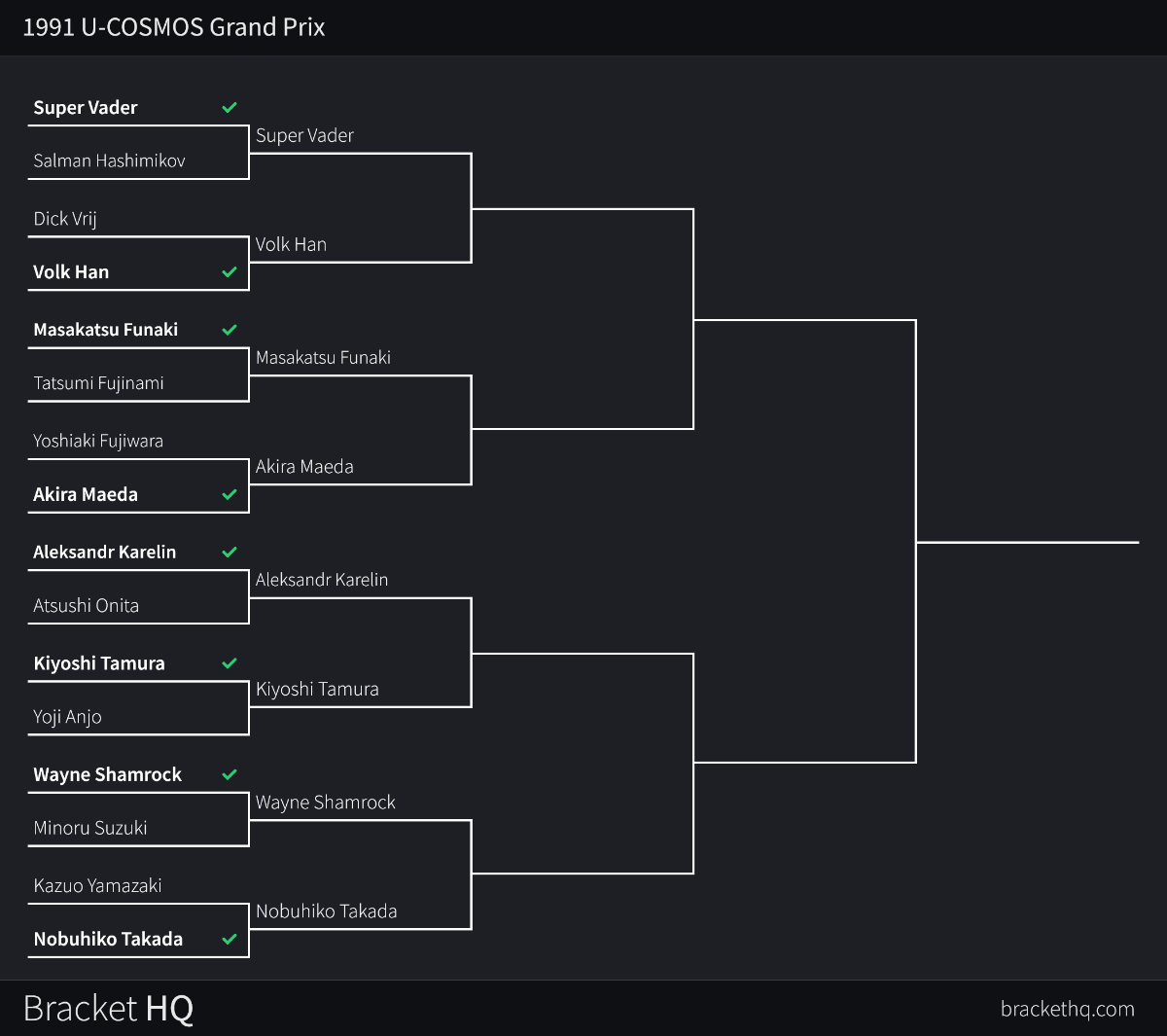
News and Notes (11/1/1991-11/15/1991) Akira Maeda and UWF president Shinji Jin met for nearly three hours on 10/30, and while no one is describing the result as a resolution, Maeda will not be suspended as rumored and remains scheduled for his U-COSMOS Grand Prix semi-final against Super Vader on 11/29 in Osaka. Sources say the meeting began with Maeda demanding the company’s financial records, and Jin refused to hand over the full books, offering instead a summary prepared by his financial team. Maeda reportedly rejected that outright, noting he has never seen the actual numbers behind a company he co-owns. The sides agreed on one thing. Maeda’s accountant and attorney will be allowed to review an agreed-upon set of documents, though neither would confirm which ones. The SWS issue was the most heated part of the discussion. Jin reportedly acknowledged that Hachiro Tanaka, the sponsor who has paid the penalty fees on Masakatsu Funaki’s and Minoru Suzuki’s New Japan contracts in 1988, expects something in return, and that UWF talent appearing on SWS shows is “under discussion.” Maeda’s response was said to be blunt: if a UWF wrestler appears on an SWS show, the company’s credibility is finished. Nobody close to the situation expects the talks to end here. Weekly Pro reports the UWF Board of Directors will meet in early December, after the semi-finals in Osaka. (Wrestling Observer, 11/5/1991) A giant bombshell was dropped in the Japanese press this week. Multiple sources say Shinji Jin informed UWF's co-founders, Akira Maeda, Nobuhiko Takada, Kazuo Yamazaki, and Yoshiaki Fujiwara, that the company’s current sponsorship arrangement with Hachiro Tanaka and other financiers runs through 12/31, and that no new dates will be announced past that point until the financial questions are settled. Jin has not said the promotion will stop operating, and no one has even entertained the idea of the promotion folding. But the practical effect is that every wrestler on the roster is now looking at a schedule that effectively ends at year's end. The U-COSMOS Grand Prix finals are set for 12/31, which means the last show under the current arrangement may be the biggest in the company's history. Karl Gotch, rumored to be unhappy with the Vader push, is said to have told people in the company that the situation will end badly. Lou Thesz has also expressed discomfort about UWF's future to confidants in the U.S. and has been doing damage control with his amateur wrestling network, since some high-level Olympic athletes are currently training in the UWF dojo with an eye on a potential debut in December. The business remains strong, with the Sapporo show drawing the company's largest gate in Hokkaido and the tournament drawing the promotion’s best television numbers since the agreement with WOWOW was signed a few years ago. That makes the timing odd, and several people in the company believe the revenue has not been properly reflected in what Maeda was shown. (Wrestling Observer, 11/12/1991) The most interesting development outside the Maeda-Jin conflict is a private meeting in Tokyo in the days after Sapporo between Masakatsu Funaki, Minoru Suzuki, Kiyoshi Tamura, and Wayne Shamrock. Japanese press caught all four leaving Funaki's house in Tokyo. The four are described as the “next generation” of the UWF, and the discussion reportedly focused less on leaving than on what they would want to do if no company was left to work for. According to sources close to the group, Funaki led the conversation, and the idea that surfaced most was a promotion built around genuine competition, with no connection to the UWF or the traditional wrestling world, and with a ranking system and rules designed to make every match a real contest. Shamrock, who has been vocal about wanting to fight in real competition, is said to have been the most enthusiastic. Tamura, the group’s youngest member, reportedly listened more than he spoke and hasn't committed to anything, but he and Funaki are said to have a close relationship dating back to Tamura's days as a UWF dojo trainee. Suzuki, still tied to Hachiro Tanaka through the New Japan penalty payments, was described as cautious, though he has developed a very close relationship with both Funaki and Shamrock. No one involved has confirmed anything on record, and Funaki’s only comment was that “the wrestlers need to think about what they want to do.” But Funaki, Suzuki and Shamrock have all been seen together repeatedly since the meeting. (Wrestling Observer, 11/12/1991) The tension around Yoshiaki Fujiwara is growing. Fujiwara, who is still understood to support Shinji Jin’s idea of working with SWS, has not attended any meeting with Akira Maeda and, according to sources, is a bit frustrated with how the situation has played out. He has reportedly received a separate offer from someone connected to the SWS side, and while he has not responded, he has declined to be seen with either Maeda or any other co-founder. Takada and Yamazaki have been staying close to Maeda, and both have said privately that they will not accept any arrangement that compromises the company’s style. Whether they would align with Akira Maeda if the UWF collapses, or with someone else, is entirely unclear. The Vader-Maeda semi-final on 11/29 now carries even more weight than it did before, and with the finals landing on the sponsorship deadline, the winner of the tournament may end up as the champion of a company that doesn’t exist in 1992. (Tokyo Sports, 11/14/1991)
-
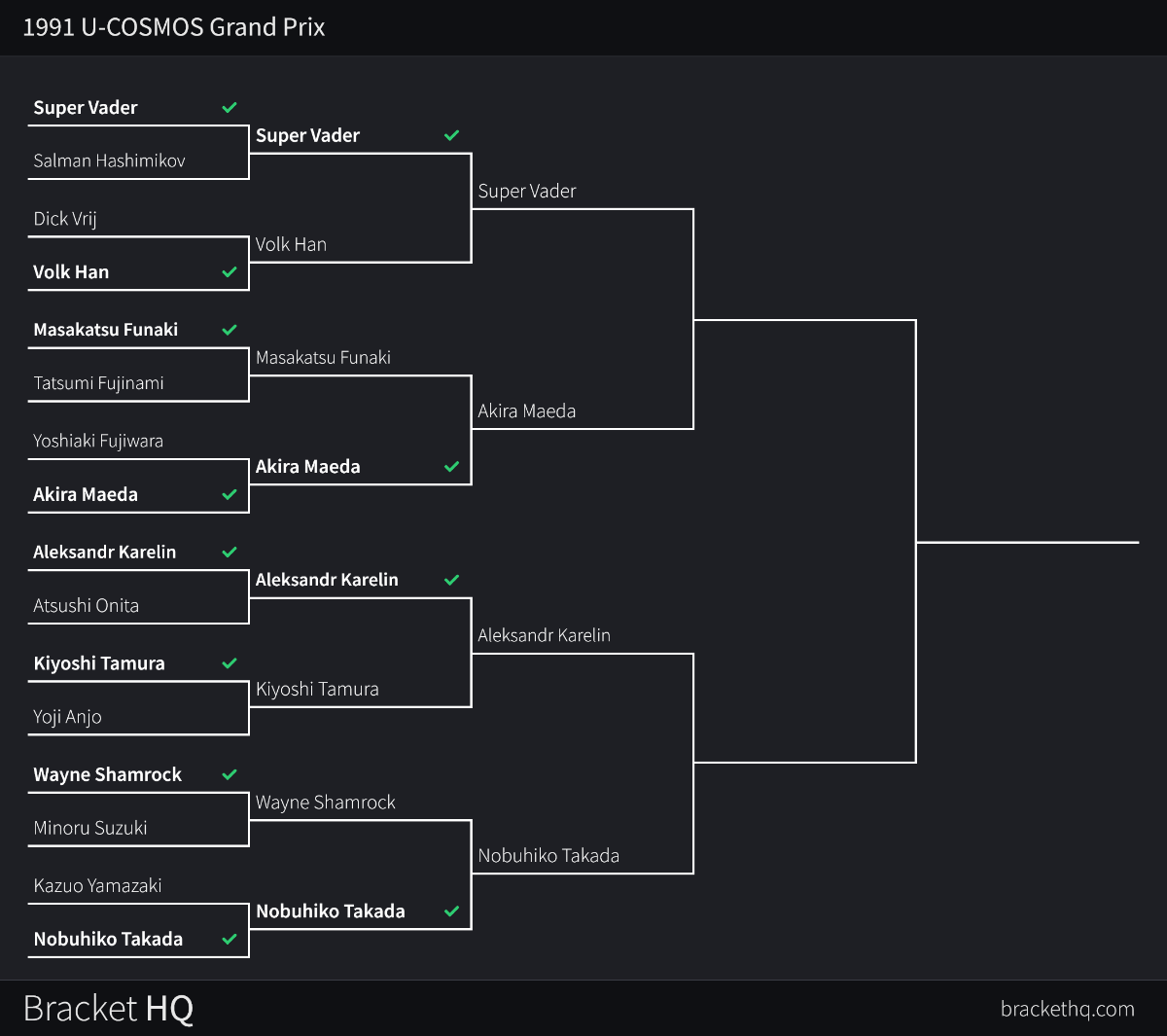
UWF Newborn – “U-COSMOS Grand Prix 1991: Second Round” October 31st, 1991 Makomanai Ice Arena Sapporo, Japan Attendance: 11,500 (sold out) Broadcast: WOWOW (live) Mitsuya Nagai vs Koji Kanemoto Nagai arrived in Sapporo with little to lose, and Kanemoto’s recent momentum made him the clear favorite. That helped Nagai, because he wrestled with a looseness he rarely showed. Kanemoto quickly established his kicking range, and his low kicks forced Nagai into a defensive shell early. But Nagai, who fans and magazines had criticized for losing focus under pressure, stayed disciplined and kept his entries simple. He used a double-leg takedown to turn the match into a grappling contest and denied Kanemoto the space his striking needed. Kanemoto’s urgency started to work against him as the match went on, and a rushed kick attempt gave Nagai the opening he had been waiting for. Nagai caught the leg, drove Kanemoto to the canvas, and flipped him over into a full Boston crab. Kanemoto clawed toward the ropes, but he was too far, and Nagai kept his weight sunk in. The tap came after several agonizing seconds, and Nagai had a big win on the big stage. Nagai defeats Kanemoto via submission (Boston crab), 10:36 Naoki Sano vs Grom Zaza This was a clash of Naoki Sano’s aggressive catch wrestling and Grom Zaza’s creative offense. The early exchanges were tactical. Sano’s quickness made him hard to pin down, and he forced Zaza to burn a rope break with a sharp ankle pick. Zaza, whose unorthodox timing had given Benoit problems earlier in the year, stayed patient and used his leverage to scramble out of trouble whenever Sano threatened to take control. The match turned when Sano overcommitted to a rolling takedown, and Zaza reversed it, landing in top position with Sano’s legs tangled beneath him. A series of rope breaks followed as Grom Zaza established dominance on the mat. Zaza’s pressure never let up, and the points moved his way steadily. Sano attempted one last scramble to his feet and tried to kick out of Grom Zaza’s knee, but Zaza caught the kick and returned the favor with a brutal takedown, kicking Sano’s knee out from under him. The Georgian grappler torqued the heel hook into full extension before Sano could reach the ropes. Sano tapped quickly, and Zaza earned another win early in his UWF career. Zaza defeats Sano via submission (heel hook), 14:11 Chris Benoit vs Shigeo Miyato Benoit entered this match with real confidence, riding a run of strong performances. The early exchanges reflected Benoit’s confidence. Both men targeted limbs in tight, methodical scrambles. Miyato used smart angles to force Benoit to the ropes twice, but Benoit stayed calm and adapted, tightening his defense. A hard German suplex midway through the match produced a knockdown and shifted the points in Benoit’s favor, and Miyato’s usual composure started to fray. Miyato attempted a comeback midway through the match and knocked Benoit down with a hard high kick. Benoit stayed patient, though. Later, the Canadian secured a waistlock and took Miyato’s back as he tried to stand. He slid his arm under the chin and locked in a rear-naked choke, cinching it tight with his legs wrapped around Miyato’s body. Miyato fought the grip for several seconds, but with nowhere to go, he was forced to tap. Benoit defeats Miyato via submission (rear-naked choke), 13:03 Oleg Taktarov vs Chris Dolman Taktarov’s feud with the Dutch wing of the UWF has been heating up, and Chris Dolman was eager to teach the Russian grappler a lesson. The match began as a strong test of Taktarov’s striking. Dolman looked to close the distance and take it to the mat, where he was most comfortable, and he forced a rope break from Taktarov with a tight kneebar attempt early on. Taktarov, however, quickly proved his danger as a striker, and his palm strikes and body kicks began to wear down the Dutchman’s guard. A clean knockdown put Taktarov ahead on points, and Dolman’s takedown attempts became more desperate as he tried to avoid the standing exchanges. Taktarov sprawled out of one such attempt and countered with a hard knee to the body that doubled Dolman over. A follow-up head kick landed flush and sent Dolman crashing to the canvas, where he couldn't beat the ten count. The crowd in Sapporo gave Taktarov a loud ovation as he raised his arms, and the referee and his cornermen helped Dolman to his feet. After the match, Taktarov got in a shoving match with Dick Vrij, who took a cheap shot at the Russian. Taktarov responded by attempting a right hook, but Vrij dodged. A bit of kerfuffle occurs as Taktarov’s cornermen and the Dutch cornermen start getting physical. The crowd jeers as the Dutch team leaves the ring. Taktarov defeats Dolman via KO, 11:52 Wayne Shamrock vs Nobuhiko Takada Shamrock arrived in Sapporo as a dark horse contender. Takada came in with the opposite narrative: the man who had pinned Maeda in Kobe, knocked out Yamazaki in Sendai, and promised to take the title back from Vader. The opening minutes were a study in range control. Shamrock pressed forward with hard entries, looking to bully Takada into the clinch, but Takada stayed on the outside with sharp low kicks and palm strikes, circling away from the takedowns and making Shamrock pay for every step. Shamrock’s first real breakthrough came when he timed a middle kick and drove Takada to the canvas with a powerful double-leg, forcing the first rope break of the match and drawing a loud reaction from the Sendai crowd. Takada’s composure on the mat helped him in the next phase. Shamrock’s top control was suffocating, and he threatened with a rear waistlock that nearly became a choke. Still, Takada had clearly studied Shamrock’s earlier performances and refused to panic, using his hips to create space and forcing the rope break before the position could fully develop. When they returned to their feet, Takada’s striking began to find its range. A spinning heel kick caught Shamrock flush and produced a knockdown that evened the points, and Shamrock, rattled for the first time in the tournament, started to fire back with wilder, less disciplined combinations that left him open to counters. Takada picked him apart with a sustained attack on the body and legs, and Shamrock’s explosiveness began to fade as the fatigue set in. Takada's kneebar attempt forced yet another rope break, and the points swung in the Japanese star’s favor. Shamrock, desperate to change the momentum, shot in for a single-leg that Takada had been waiting for all night. Takada sprawled, trapped Shamrock’s far arm as the American went to the mat, and rolled through into a tight cross-armbreaker before Shamrock could get his bearings. Shamrock tried to stack and roll out, but Takada kept his hips high, and his knees pinched, extending the arm until tapping was the only option. The crowd erupted as Takada released the hold. A minute later, Shamrock, in a show of sportsmanship, bowed to the winner before leaving the ring. Takada defeats Shamrock via submission (cross-armbreaker), 17:42 Aleksandr Karelin vs Kiyoshi Tamura The pairing was as unique a contrast as the Grand Prix could produce: Karelin, the Soviet machine who destroyed Onita in under three minutes and was widely regarded as the tournament favorite, against Tamura, the young sensation who had won the tag titles and was threatening to break out as a singles star. Tamura wasted no time in telling the Sapporo crowd how he intended to fight. From the opening bell, he ducked in and out of range, firing hard low kicks at Karelin’s lead leg and moving away before the Soviet could get his hands on him. Karelin stalked him with the expressionless patience of a man who had never been in real danger, absorbing the early kicks and advancing. Tamura kept at it, and the thud of each kick echoing through the arena began to draw the crowd’s attention. Then came the stretch that had the building on its feet. A series of low kicks to the same spot visibly affected Karelin’s movement, and Tamura followed with a sharp high kick that caught the Soviet on the jaw and dropped him to a knee for the first knockdown of the match. The Makomanai Ice Arena exploded. Tamura pressed his advantage immediately, hammering the leg again and slipping in a quick takedown attempt that forced the Soviet monster to reach for the ropes, even if Tamura hadn’t taken him down entirely, and for a few electric minutes it genuinely felt like Goliath might fall. Karelin didn’t show much shock, but he favored his leg, and Tamura, fully committed to the upset, kept firing kicks and darting away as the points tilted in his favor. The sense that the youngster was about to pull off the biggest win of his career filled the arena. Another big moment came when Karelin stumbled to the mat after more low kicks, and Tamura immediately seized on the opportunity to lock in a kneebar around Karelin's massive right leg. Karelin easily grabbed the ropes and didn't seem concerned about Tamura's heroic attempt to end the match. It would take more to beat Karelin, though, and he had only been waiting for one clean grip. Tamura, perhaps emboldened by his success, stayed in range one kick too long, and Karelin trapped the leg and closed the distance with startling speed, locking his hands around Tamura’s waist. The Karelin Lift was breathtaking in its violence, hoisting Tamura high into the air before driving him down onto the back of his head and shoulders. Tamura lay motionless as Motoyuki Kitazawa began the count, and there was never any doubt about the outcome. The referee waved off the match at seven, and a hush fell over Sapporo as Karelin stood in the ring without a hint of emotion, the heavy tread of his injured leg the only evidence Tamura had hurt him at all. Karelin defeats Tamura via KO, 10:26 Super Vader vs Volk Han Han entered the Makomanai Ice Arena calmly to his "Second Rendez-vous" theme, and Vader, fresh off his TKO of Hashimikov in Sendai, seemed to sense this would be a different kind of fight. The opening bell brought the usual Vader charge, but Han refused to stand in front of it. He slipped to the outside, flicked a low kick at the thigh, and spun away before the big man could grab him. Vader’s first body shots found only air, and the champion’s frustration began to show. When he finally trapped Han against the ropes and fired a closed fist to the ribs, Han went limp and dropped to the canvas, pulling Vader down with a surprise double wristlock into a position Vader clearly hadn't planned for. Han scrambled behind him, hooked a leg, and cranked a heel hook that forced Vader to lunge for the ropes. Han’s strategy against the larger man was a masterclass in using leverage. Every time Vader tried to bull forward, Han dropped his weight, trapped an arm or leg, and forced the champion to burn energy getting free. A sweeping ankle pick put Vader on his back, and Han flowed straight into a kneebar that sent Vader scrambling to the ropes again, putting Han up 1-0 on points. The champion looked slower and more bewildered than UWF fans had ever seen, and when Han ducked under a swinging open-hand strike and dumped him with a rolling single-leg, the building erupted. Vader grabbed the ropes once more to escape an ankle lock, and for a few minutes the Russian looked like he might dismantle the WCW superstar piece by piece. But Vader’s greatest asset had always been iron will. After a fourth rope break left him down 2-0, he stopped chasing the match and decided that the match should come to him instead. With Han’s confidence at its highest, the Dagestani shot in for another leg takedown. Vader sprawled, pinned him to the mat with his weight, and pounded a closed fist into the ribs. The sound echoed through the arena. A second shot, then a third, and Han’s breathing visibly changed. Vader rose and dragged him to his feet, and a flurry of body punches folded the Soviet in the middle for a knockdown that Han barely beat at eight. A hard open-hand strike earned a second knockdown, and the points were tied 2-2, with Han fighting to keep his hips away from Vader’s grip while the crowd screamed itself hoarse. The finish came when Han, still dangerous, attempted a spinning backfist and Vader caught him in a front waistlock. He hoisted the Dagestani off the mat and unleashed a massive German suplex, planting Han on the back of his head and shoulders with a crash that rattled the ring. Han tried to get on his feet. Vader met him with another series of closed fists to the body that sent him collapsing to the canvas. Masami Soranaka waved the match off after finishing the ten count. Vader stood over his fallen opponent, breathing heavily, aware that he had survived the most creative challenge of his reign. Vader defeats Han via KO, 17:51 Akira Maeda vs Masakatsu Funaki The second-round meeting of master and student carried more emotional weight than any other match on the Sapporo card. Maeda, who had submitted Fujiwara in Sendai, faced the New Generation champion. Funaki was eager to make a statement tonight, and backstage rumors about his unhappiness had to fall to the wayside. Funaki bowed to his mentor before the bell, then immediately made it clear he hadn't come to be respectful. He opened with a hard low kick that snapped Maeda’s leg back, followed by a quick shot at the ankle that forced Maeda to scramble. Maeda answered with a sharp middle kick and a palm strike that put Funaki on the defensive, and the two settled into an inspired back-and-forth striking exchange. Neither wrestler found a breakthrough right away. The first real moment went Funaki’s way. He caught a Maeda high kick, spun him to the mat, and went to work on the leg with a kneebar that forced Maeda to the ropes. Maeda recovered quickly and countered with a dumping leg takedown, followed by a heel hook that forced Funaki to the ropes, and the exchange earned a loud ovation from the crowd. A beautifully timed palm strike from Funaki sent Maeda to the canvas for a knockdown, and the New Generation champion was suddenly ahead 1-0 on points. Maeda beat the count at six, shook off the shot, and returned to the mat with Funaki after an extended grappling exchange. Maeda found another point soon after, using a guillotine forearm choke to force Funaki to grab another rope break. The next phase was a struggle for both, with Funaki and Maeda trading limb attacks and escapes in a sequence that kept the crowd on edge. Funaki slipped out of a Maeda armbar attempt and answered with a rear-naked choke that nearly ended the match, forcing Maeda to lunge for the ropes with visible desperation. Maeda responded with a stiff kick to the ribs that rocked Funaki, and the two traded knockdowns in a breathless stretch where neither man could hold the advantage for more than a minute. Funaki’s conditioning, built over years of hard training, kept him on even terms with the veteran, and the points shifted back and forth until Maeda found himself down to his last point with the arena roaring. Funaki led 4-3 on points, and Maeda seemed in trouble after a vicious palm-strike combo. However, Maeda showed why he remained the promotion's top dog. He stopped taking risks, shut down Funaki’s leg entries with calm, patient defense, and began wearing him down with precise thigh kicks. Funaki pressed hard, desperate to finish the match, and nearly got it when he trapped Maeda’s arm, took him down, and wrenched a cross-armbreaker that had the crowd rising to its feet. Maeda, near the ropes, got his foot to the bottom strand for a rope break that had sent him to the very edge of defeat, and the escape drew an enormous reaction. Funaki’s eyes lit up, but he knew deep down he might need to finish the match right then and there with a straight submission. After a tense back-and-forth striking exchange where neither landed a clean hit, Funaki rushed in for a surprise double leg. Maeda sprawled, trapped Funaki’s head and arm, and in a sudden burst of strength, secured Funaki’s leg and lifted him into a capture suplex, driving him hard onto the back of his shoulders. Funaki’s elbows stayed on the mat, and Maeda went for the pin, holding the position as Soranaka counted to three. The Makomanai Ice Arena erupted as Maeda jumped up in celebration. Funaki was frozen in his corner as Nobuyuki Furuta made the result official. After a brief moment, Maeda walked over and offered Funaki a hand, and Funaki bowed his head in respect. Maeda patted him on the shoulder, and the two embraced before the New Generation champion left the ring. Funaki tried to bottle up his emotions, but the look on his face made it clear something wasn’t right. Maeda defeats Funaki via pinfall, 26:38

-
News and Notes (10/7/1991-10/14/1991) The first round of the U-COSMOS Grand Prix on 9/25 in Sendai drew a sellout 7,000 for the WOWOW live broadcast and delivered on the hype. The show’s main selling point was Akira Maeda’s war with Yoshiaki Fujiwara, which turned into a total classic. Fujiwara hunted the arm all night, but Maeda came away with the win after a very even, tense match. It was the match of the night, and likely a contender for match of the year. The other big storyline was Nobuhiko Takada, coming off his main event win over Maeda in Kobe and openly gunning for Vader’s title, who kept his momentum alive by knocking out new tag champion Kazuo Yamazaki with a high kick after a knockdown from a body and head combination, in 14:11. Yamazaki's partner, Kiyoshi Tamura, advanced with a fluid cross-armbreaker over Yoji Anjo in 11:57, with Tamura looking better and better. Masakatsu Funaki scored a notable upset of Tatsumi Fujinami at 17:38 with a surprise arm triangle from the clinch. The match was tied 2-2 on points before Funaki’s conditioning took over, and it felt like a symbolic change of the guard. The rest of the card was a mix of the brutal and the competitive. Super Vader’s war with Salman Hashimikov was the night's most physical match. Hashimikov took Vader down in the first ten seconds and had him in trouble with a belly-to-belly suplex, and both men bled, but Vader finally landed a high-angle German suplex and finished with open-hand strikes for a 13:48 TKO. Wayne Shamrock took down his rival Minoru Suzuki, who was sharper than in their New Generation tournament semifinal and nearly caught Shamrock with a guillotine, but Shamrock ended it with a pinning combination at 12:41. Suzuki was visibly upset afterward. Volk Han submitted Dick Vrij with an Achilles hold at 12:22 in another of their entertaining style-clash matches, with a Han heel hook attempt drawing one of the loudest reactions of the night before Vrij powered out. The show’s one squash was Aleksandr Karelin’s destruction of Atsushi Onita in 2:11, which was exactly as ugly as expected. Karelin ragdolled Onita with a belly-to-belly suplex, showed off Muay Thai knees, then finished him with a violent spinning fireman's carry slam that had referee Motoyuki Kitazawa waving it off without a count. Onita was stunned and nearly out before the finish, so the whole thing felt more like a statement about Karelin’s credibility than a competitive match. All told, it was a strong opening night with a clear match-of-the-year candidate and several top-notch undercard matches, and the second round looks like a must-see. The second round will take place on October 31st at the Makomanai Ice Arena in Sapporo. The second round will feature some very interesting matchups, including Volk Han taking on Vader, and Kiyoshi Tamura going up against Aleksandr Karelin. (Wrestling Observer, 10/8/1991) It's been a newsworthy week for UWF, and perhaps for the first time in the company's history, it's not for the right reasons. Weekly Pro Wrestling published a report on October 4th saying tensions are rising between Akira Maeda and the executive hierarchy. Sources say Shinji Jin has privately expressed interest in working with SWS, a more "traditional" pro-wrestling group, including sending some UWF talent to appear on SWS' shows. Needless to say, this has angered Maeda, who has responded by demanding a meeting with Shinji Jin to review the company's books. The report says UWF's finances may not be entirely on solid ground, and Maeda has caught wind of it. It's unclear why, given UWF's outstanding business and gate numbers over the past three years. The magazine article also said that Yoshiaki Fujiwara has supported Shinji Jin's idea, as he wants to work under a less demanding style because of the wear and tear of the UWF style, and that working with SWS might create promotional opportunities. Another report from a less reputable tabloid was published this week, suggesting that Karl Gotch and Lou Thesz aren't fans of the Vader push and are upset that homegrown talent like Masakatsu Funaki are being overlooked. The Weekly Pro story will be worth keeping an eye on, especially as the U-COSMOS tournament heats up. (Wrestling Observer, 10/8/1991) Weekly Pro Wrestling learned that a meeting between Akira Maeda and UWF president Shinji Jin is scheduled for October 30th, following the magazine’s October 4th report on discord within the organization’s leadership. According to sources close to the company, the meeting was arranged after back-and-forth talks, and Maeda is expected to press for a full review of the promotion’s financial records, a request that Jin and several other executives are reluctant to entertain. Though no official statement has been issued, those familiar with the matter indicate that the agenda will extend beyond accounting to Jin’s reported interest in a working arrangement with SWS, including the possible loan of UWF personnel to that group’s events. Maeda’s main event victory over Yoshiaki Fujiwara last month, a match Fujiwara reportedly entered with considerable reservations about the physical demands of the UWF style, has only heightened attention on the relationship between the two veterans, who are understood to hold opposing views on the company’s direction. Company officials have declined to confirm the financial concerns, and the promotion’s recent attendance and television performance seem to argue against any urgent difficulty, leaving the source of Maeda’s apprehension unexplained. (Weekly Pro Wrestling, 10/14/1991)
-
Excited to see how your new territory plays out. I know you like to spread your wings a bit and move on after a while, but it would be interesting to see you develop this promotion from "Eastern Championship Wrestling" to "Extreme Championship Wrestling" over the next few years, if that's your taste.
-
I just find it odd that you think KENTA should be in, but not Fujiwara. What does KENTA offer that Fujiwara doesn't, objectively? Perhaps you'll remember the article I wrote for VOW: https://www.voicesofwrestling.com/2023/10/25/won-hof-2023-the-case-for-yoshiaki-fujiwara/
-
Why should KENTA be in if Yoshiaki Fujiwara isn't?
-
I enjoyed the match write-ups here. Curt Hennig and Steve Austin make a great pairing, and you did an excellent job building both up throughout the tournament. The tag team match was awesome. I think Shawn Michaels is on a clear upward trajectory in SMW despite the loss.
-
The Happening is a stacked event. I'm very happy to see fans in Alaska get a top-tier PPV. I think I said this before, but I like how you are building up Frank Andersson. He was someone I considered using in UWF earlier, and I think Gagne knows how to use him well. He was a bit underrated as a wrestler in real life, but that's mostly because WCW didn't use him properly.
-
If I were a betting man, I would say the Undertaker and Vader are on a collision course. That would definitely be a blockbuster match. Great show from the Omni. A very balanced show overall, and smart use of talent to keep things balanced across the card.
-

Universal Wrestling Federation (Herb Abrams)
Control21 replied to ErictheDragon's topic in Programming
Your use of Doink the Clown has been excellent so far, good stuff there. The Knock Down, Drag Out idea is really cool. It's a good way to get a few starts going, I think. Keep up the good work! -
September 25th, 1991 Sendai City Gymnasium Sendai, Japan Attendance: 7,000 (sold out) Broadcast: WOWOW (live) Kiyoshi Tamura vs Yoji Anjo The first round of the U-COSMOS Grand Prix opened with a match between two men who knew each other well from sparring in the dojo. Anjo's craft gave him a foothold in the opening minutes. His experience helped him steer scrambles away from Tamura's most dangerous submission entries and force a rope break of his own with an opportunistic wristlock that briefly suggested Anjo might neutralize his opponent’s prodigious technical skill. Tamura's response was characteristically relentless; he quickened the pace beyond what Anjo could comfortably sustain, and his rapid transitions began to wear on Anjo. Tamura's determination to win became clear, and Anjo was probably a step too slow. A knockdown from a sharp Tamura kick combination opened up the mat work that proved decisive, and Anjo's scrambling became less coordinated under sustained pressure. Tamura eventually secured a cross-armbreaker from a transition so fluid that the tap came before the crowd had fully processed what had happened. Tamura defeats Anjo via submission (cross-armbreaker), 11:57 Dick Vrij vs Volk Han The stylistic contrast was stark, though this wasn’t the first time these two had met. Each time, the contrast provided a sensational foundation for highly entertaining matches. This time wouldn’t be any different. Vrij established his range, his low kick combinations precise and damaging, forcing Han to think carefully about every forward step. Han absorbed the early punishment while cataloging Vrij's timing, and his first genuine offensive sequence, a sudden drop to the legs that caught Vrij mid-combination, immediately produced a rope break and confirmed that the Dutchman’s striking would not be sufficient to keep Han at bay indefinitely. The match picked up during a tense middle stretch as Vrij's power and Han's ingenuity traded advantages in rapid succession, with a Han heel hook attempt drawing one of the night's loudest crowd reactions before Vrij powered free with brute strength. Han later baited Vrij into committing to a high kick that left him momentarily off-balance, and the Russian converted it by catching it, creating an opening into a dizzying sequence of transitions that ended with a tight Achilles hold locked in before Vrij could reach the ropes. Han defeats Vrij via submission (Achilles hold), 12:22 Wayne Shamrock vs Minoru Suzuki Their previous encounter ended with Shamrock's kneebar finishing Suzuki in the New Generation tournament semi-finals, and Suzuki arrived at the Grand Prix intending to prove the result wouldn't repeat so cleanly. The early going bore out that determination. Suzuki was sharper and more varied in his approach than in their prior meeting, mixing his leg-kick game with unexpected clinch entries that disrupted Shamrock's takedown timing and prevented the American from establishing the sustained top control that had worn Suzuki down before. Shamrock adapted with the confidence of a wrestler who had clearly processed their previous encounter as carefully as his opponent, using his superior strength to win the clinch exchanges and gradually applying the kind of pressure that made him most dangerous. Suzuki's guillotine attempt midway through was the match's most dangerous moment for Shamrock, drawing a sharp crowd reaction, but Shamrock powered out with the composure of someone beyond his years. The finish came when Shamrock timed a Suzuki kick entry perfectly, secured a powerful double-leg, and, rather than transitioning to a submission, kept his weight distributed into a tight pinning combination that Suzuki couldn't generate the leverage to escape. Suzuki was visibly upset by the defeat and had to be counseled by Shamrock. Shamrock defeats Suzuki via pinfall, 12:41 Kazuo Yamazaki vs Nobuhiko Takada With Takada riding the momentum of his main event win over Maeda in Kobe and openly targeting Vader's title, this first-round match against the newly crowned tag champion Yamazaki carried real weight. A stumble here would derail the post-Kobe momentum before the Grand Prix had barely begun. Yamazaki, emboldened by his tag title success, pressed the fight from the opening bell with a striking combination that immediately put Takada on notice, and the early exchanges were notably quite heated and ferocious in pace. Takada gradually settled into his preferred rhythm, using his kicking range to establish the distance he needed and finding consistent success with sharp middle kicks that damaged Yamazaki's midsection. Yamazaki's counter-grappling kept the match competitive through its middle stretch. A beautifully timed heel hook attempt forced Takada to the ropes. Briefly, it swung the points in Yamazaki's favor. Still, Takada's striking output kept building in volume and precision as the match progressed, and the gap between the two men's stand-up capabilities became increasingly difficult for Yamazaki to manage. A sustained combination from Takada targeting the body and head produced a knockdown. With Yamazaki's movement compromised, Takada pressed forward with a final high kick that landed clean enough to keep the tag champion on the canvas for the full ten count. Takada defeats Yamazaki via KO, 14:11 Masakatsu Funaki vs Tatsumi Fujinami The tournament's next match brought together two of the promotion's most tactically sophisticated performers, and the opening exchanges reflected that spirit almost immediately. Neither man reached for anything ambitious before establishing the positional read their styles demanded. Fujinami was the more patient of the two early on, circling carefully and using his catch-wrestling instincts to control grip exchanges and deny Funaki the underhook position the New Generation tournament winner preferred as a launching point for his leg attack. Unbothered, Funaki responded by targeting Fujinami's lead leg with precise, probing kicks meant to inflict structural damage and disrupt the footwork underpinning Fujinami's takedown defense. The first genuine exchange of consequence came when Fujinami timed a Funaki kick and turned it into a Dragon Screw takedown, then immediately transitioned into a kneebar attempt that Funaki had to navigate carefully before reaching the ropes. The next stretch was technically compelling, with both men operating at the highest level of their craft. Fujinami's suplex expertise threatened twice in succession. A German suplex attempt produced a near-fall that brought the Sendai crowd to its feet and briefly made a Fujinami win likely. After Funaki kicked out of the pinfall attempt, the younger wrestler changed the momentum with a well-timed double-leg takedown. Funaki's leg attacks grew more confident, and several mat scrambles led to rope breaks for Fujinami. A points exchange left both men at 2-2, but Funaki's conditioning advantage showed in sharper striking exchanges once they got back to their feet. Funaki had studied Fujinami for quite some time, and it paid off as he abandoned his usual leg-attack entry for a sudden arm triangle that materialized from the clinch before Fujinami could process the change in approach. The choke was locked in tight with Funaki's full body weight distributed to prevent any possibility of the reversal that Fujinami's mat intelligence might otherwise have produced. Fujinami knew that there was no escape, and he had no choice but to relent and acknowledge the ascendancy of UWF’s next young star. Funaki defeats Fujinami via submission (arm triangle choke), 17:38 Aleksandr Karelin vs Atsushi Onita Whatever Onita had prepared for this match, sharing the ring with Karelin made it largely academic within the first ninety seconds. Onita tried to establish distance with a palm-strike combination, which Karelin absorbed without visible reaction before closing the gap with terrifying speed. Karelin secured Onita with a waistlock grip and ragdolled him with a vicious belly-to-belly suplex. Karelin quickly went for the kill. After setting Onita up, a single Karelin lift deposited Onita at a height and angle that drew an involuntary gasp from the Sendai crowd, and the impact left Onita sufficiently stunned. Motoyuki Kitazawa's count reached nine and a half before Onita signaled his intention to continue. Karelin was immediately back on him. Karelin terrified the audience by showing Muay Thai proficiency, clinching Onita and striking him with several knees. The gold medalist then hoisted Onita across his shoulders with contemptuous ease, rotated violently, and drove his opponent face-first into the canvas with a force that seemed to compress the entire ring on impact. The crowd went into a frenzy at the Soviet grappler's brutality and the sheer force of the landing, and Kitazawa didn't bother completing the full count, waving the match off immediately as Onita lay motionless. Karelin defeats Onita via KO, 2:11 Super Vader vs Salman Hashimikov The opening exchanges between Vader and Hashimikov produced the kind of immediate impact that the Grand Prix bracket had promised from the moment this pairing was announced. Two of the most physically formidable wrestlers in the world collided with the barely contained force of men who had spent their entire careers dominating opponents through sheer physical superiority. Hashimikov met Vader's opening salvo of body shots with a sharp inside trip that deposited the big American on the canvas in the match's first ten seconds, drawing a stunned roar from the Sendai crowd and serving immediate notice that this would be no straightforward Vader showcase. Vader got to his feet without panic, and the two locked into a series of standing clinch exchanges that were extraordinary in their raw physical intensity. Neither man could establish clean control, and each grip exchange deteriorated into a contest of pure strength that the crowd followed with reverent attention. Hashimikov's freestyle credentials were fully on display. His leverage and timing matched Vader's power in a way no previous opponent had managed for this long, and a belly-to-belly suplex that deposited Vader heavily on the canvas produced the loudest reaction of the match's opening stretch and forced Kitazawa to begin a count that Vader beat with visible effort. The match continued with a punishing rhythm that both men seemed to embrace. Vader's body shots began to land, and Hashimikov's early burst of energy gradually took its toll. The American's open-hand strikes also drew increasingly visible responses from the Soviet wrestler. Vader’s striking seemed to be the ace up his sleeve. Hashimikov answered by closing the distance again, ignoring the punishment he just received, and taking Vader down with a well-timed single leg. Hashimikov quickly attempted to find a forearm choke, but Vader spotted the ropes in time and reached for a break. Later, both men scored knockdowns through the middle stretch in a breathless exchange that saw points accumulate on both sides. Vader landed a thunderous lariat that folded Hashimikov. Hashimikov responded with a sudden headbutt Vader clearly did not anticipate, leaving the American blinking and off-balance in a way that felt genuinely unscripted. At this point, both men were bleeding, Vader above his eye, Hashimikov from the bridge of his nose. The physical toll on both wrestlers was evident. Vader finally manufactured the separation he needed to uncork his most devastating offensive weapon. Hashimikov, increasingly fatigued, lunged forward into a clinch with a desperation that left him momentarily off-balance, and Vader caught him perfectly. Vader secured a deep waistlock and executed a high-angle German suplex of extraordinary elevation, driving the back of Hashimikov's head and shoulders into the canvas at a sickening angle. The crowd fell briefly silent at the impact, and Hashimikov lay motionless as Masami Soranaka began his count. Rather than waiting to see whether the count would end it, Vader dropped immediately into a ground-and-pound position and began delivering measured, deliberate open-hand strikes to Hashimikov's head. Hashimikov's defense grew increasingly uncoordinated, and Soranaka stepped in to wave off the match. Vader rose slowly, his own physical cost evident in the way he moved toward the center of the ring. Vader defeats Hashimikov via TKO, 13:48 Yoshiaki Fujiwara vs Akira Maeda The weight of history hung over this match in a way that the Grand Prix bracket's other first-round pairings could not match. Fujiwara and Maeda had been intertwined since the earliest days of the UWF movement, their professional relationship carrying a shared history, mutual respect, and competitive rivalry that would be difficult to explain to most. Maeda entered with a focus that made it evident he was here to re-establish himself as the top man in the promotion. Fujiwara, as always, was unreadable. His pre-match demeanor carried the same placid, almost amused composure he brought to every situation regardless of stakes. The opening exchanges were careful, both men circling with the patience of fighters who knew the first meaningful commitment would likely define the match's trajectory. Maeda's kicking range gave him the first real threat; a low kick combination sparked the first crowd reaction. Fujiwara absorbed it without visible concern and continued his methodical approach, parrying Maeda's entries with subtle shifts that redirected momentum without ever fully engaging on Maeda's terms. The match's first decisive sequence came when Fujiwara baited Maeda into a palm strike, then slipped inside with the timing of someone who had been reading the setup for several minutes. Fujiwara followed with a quick headbutt, which the fans loved. A front headlock from the clinch position gave Fujiwara leverage, and he used it to drag Maeda into a grinding mat exchange where his catch wrestling instincts flourished. Maeda's escape was technically impressive, converting a near-dangerous wristlock into a heel hook attempt of his own that forced Fujiwara's first rope break and reestablished the match's equilibrium. The crowd watched intently, fully aware that they were watching two of wrestling’s genuine masters operating at the height of their powers. The next several minutes rewarded that attention with a series of exchanges of incredible technical skill. Fujiwara materialized arm entanglements from positions that seemed to offer no such opportunity, and Maeda countered with leg attacks that showed his mat credentials were not to be minimized. A sustained Maeda striking sequence midway through produced the bout's first knockdown. A clean high kick landed flush on Fujiwara's jaw. Maeda pressed with the urgency that had defined his best performances, converting the momentum into another mat sequence that burned through two of Fujiwara's rope breaks in quick succession and opened a point gap at 2-1. Fujiwara absorbed the deficit without visible panic. He began steering the match back toward his preferred terrain with a subtle shift in his clinch positioning that denied Maeda the clean entries his kicking game required. A beautifully constructed sequence of arm work forced Maeda to burn another rope break, tying the match at 2-2 on points. The bout's climax produced the kind of intricate scrambling that only two men of this experience and intelligence could sustain. Fujiwara hunted constantly for the arm that his entire match strategy had been oriented around. Maeda navigated each attempt with the defensive awareness of someone who understood the trap being laid. He was determined not to provide the final opening. Fujiwara came agonizingly close on two consecutive attempts, his armbar nearly reaching full extension before Maeda's flexibility and awareness allowed him to stack and rotate free, and the crowd's reaction to each near-submission grew more urgent. Maeda’s conditioning seemed high, and Fujiwara, a bit older, was beginning to feel the deep waters. Next came the cold, targeted wrestling that defined Maeda's best mat work. Fujiwara, having maneuvered Maeda into a standing clinch exchange with evident intent to set up a double wristlock, committed fractionally too much weight to his forward pressure. Maeda, reading the shift in an instant, dropped his level and secured a Capture Suplex that lifted Fujiwara cleanly and deposited him hard on the canvas after a swift overhead motion. The impact left Fujiwara briefly stunned, and Maeda transitioned with practiced speed directly into a cross-armbreaker before the veteran's survival instincts could fully reassert themselves. Maeda extended the hold to full extension, angling Fujiwara's body away from the ropes. Fujiwara strained with everything he had left, but the position was perfect, and the tapout came next. Maeda celebrated for a moment, but quickly extended a hand to Fujiwara. The Sendai crowd's sustained ovation acknowledged a match that had delivered everything the Grand Prix's first round had promised and then some. Maeda defeats Fujiwara via submission (cross-armbreaker), 24:17
-
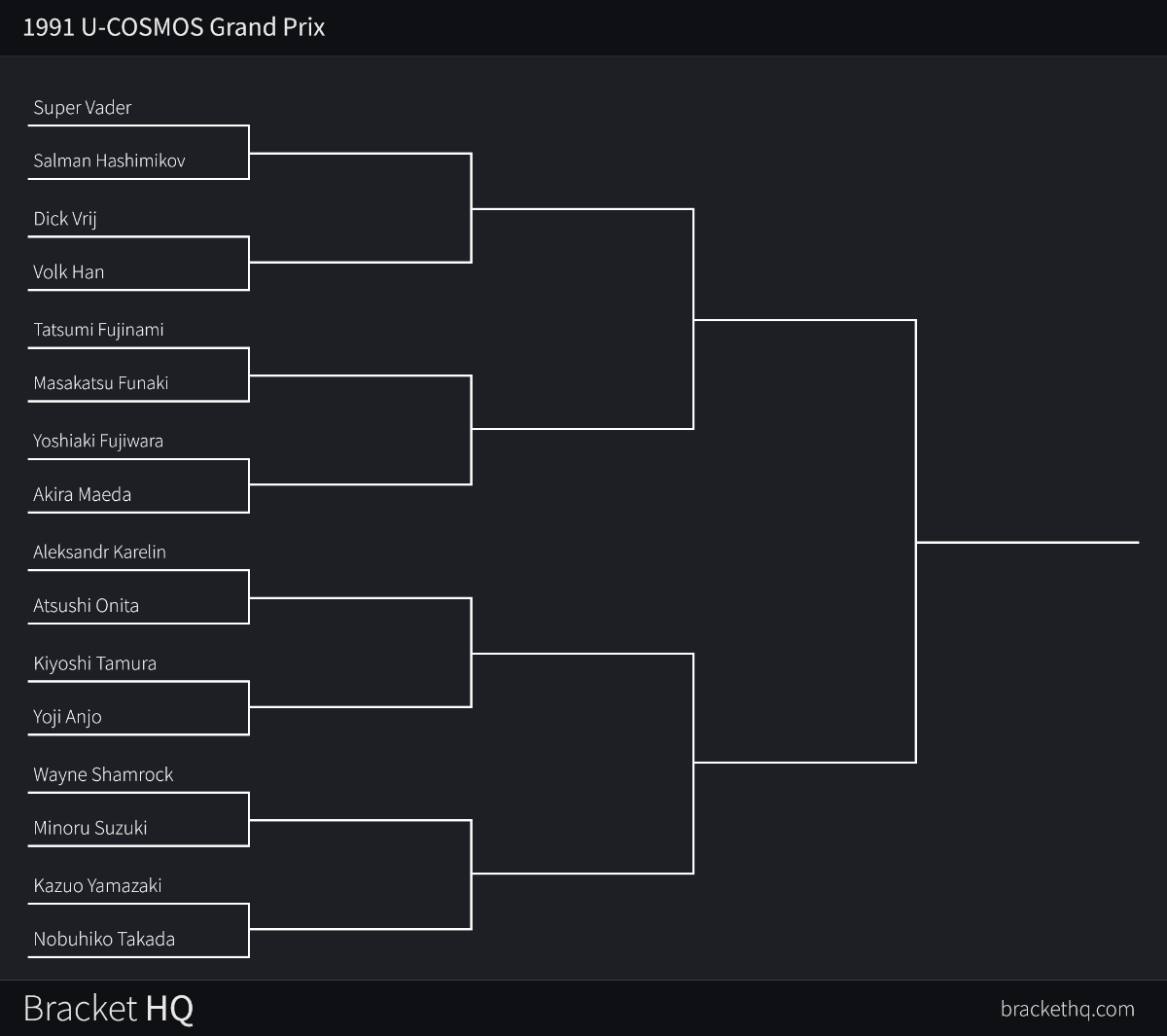
News and Notes (9/1/1991-9/14) UWF Newborn's "Battle Dimension: Kobe," held on 8/30 in Kobe Memorial Hall, was another legit sellout for the promotion, and their incredible three-year hot streak shows no sign of stopping anytime soon. With an announced crowd of 8,000, this was probably one of the best top-to-bottom shows in Japan this year. The undercard was pretty solid, with Nelson vs. Nagai and Benoit vs. Fujiwara both described as very good matches, and the latter in particular did a good job of making both guys look strong. The "New Generation" tournament concluded with Masakatsu Funaki getting a widely expected victory over Wayne Shamrock, cementing him as the promotion's top young star. The two had a lengthy conversation after the match, and it likely won't be the last time we see them lock up. The top half of the card featured two great tag matches. Tom Erikson and Vader defeated the Soviet duo of Salman Hashimikov and Victor Zangiev in a spectacular match featuring high-level power wrestling in the UWF style. Tamura and Yamazaki finally earned the tag belts by defeating the Koslowski brothers in another great match that let both teams play to their strengths. Takada vs. Maeda was the main event, and in a bit of a surprise, Takada came away as the winner. This will likely build him up more before the annual Grand Prix tournament starts, and Maeda having to claw his way back to the top sets up a pretty good story for him going into the tournament. WOWOW announced the Grand Prix bracketing live before the show ended, and the first-round matchups feature Vader vs. Salman Hashimikov, Tatsumi Fujinami vs. Masakatsu Funaki, Akira Maeda vs. Yoshiaki Fujiwara, and Kazuo Yamazaki vs. Nobuhiko Takada. (Wrestling Observer, 9/10/1991) Following up on the reported Shamrock/Funaki conversation from the Kobe show, it is said that Shamrock and Funaki have grown close over the past year and that, along with Minoru Suzuki, they consider themselves the "Three Musketeers" of the UWF. Both Shamrock and Funaki apparently feel they have earned a place in the top half of the UWF card, but an artificial ceiling is hindering their progress right now. While UWF sources downplay any major unhappiness, some American sources suggest they're frustrated with UWF's hierarchical system, which isn't unique to them, since every other major Japanese promotion uses a similar system. Although when you have a large roster of guys doing a very similar style, some conflict is bound to occur. I would expect all three guys to move up the card in due course, and it would be gross negligence if Funaki doesn't receive a title shot within the next year. There are also whispers that Funaki, Shamrock, and Suzuki are all developing a taste for legitimate shooting. (Wrestling Observer, 9/10/1991) UWF will open their 1991 U-COSMOS Grand Prix in Sendai on September 25th, with a full slate of first-round matches. UWF executives are excited about this year's tournament and believe strong matchups will keep tickets moving into the new year. The central question is whether anyone can stop Vader or Aleksandr Karelin, and a meeting between the two in the final feels inevitable. Of course, Akira Maeda could have something to say! (Weekly Pro Wrestling, 9/12/1991)
-
Christopher Daniels.....you are All-Pacific!
-
SummerSlam was well worth the wait and more! Fantastic job with the write-up. You did a very good job of conveying all the subtle details that a live WWF PPV would carry. Felt like I was transported back in time!
-
Universal Wrestling Federation (Herb Abrams)
Control21 replied to ErictheDragon's topic in Programming
This has been a very interesting twist on the UWF so far. By focusing on lesser-known talent, there are a lot of good angles and storylines playing out, which shows you don't always need a deep roster to spice things up. Bringing in Bruno Sammartino to add some legitimacy was a good call too, having a central figure that the rest of the roster orbits around is what makes these smaller territories tick, in my opinion. -
Winnipeg has been very fun to read about so far. The decision to focus a bit more on women this time is a great call! Might not be a bad idea to bring in some AJW stars from around this time period, especially someone like Aja Kong or Akira Hokuto.
-
I love how you are using Shinya Hashimoto. Pairing him with Tsuruta feels natural, and being a big player in AWA feels right, especially around this time. Kokina vs Bad News Brown is going to be a hell of a match, I bet!
-
I'm excited to see how Vader does once he gets some serious competition. I imagine Sting is looking over his shoulder each passing week.
-
I'm enjoying the new format. The focus on the commentators telling the action and the story makes transporting you to the place and time so much easier, especially for a show like SMW.
-
Pro Wrestling in the Final Days of the Soviet Union
Control21 replied to Phil Lions's topic in Pro Wrestling
Great stuff. This is a really interesting gap in wrestling history that rarely gets talked about -
UWF Newborn – “Battle Dimension: Kobe” August 30th, 1991 Kobe, Japan World Memorial Hall Attendance: 8,000 (sold out) Broadcast: WOWOW (live) Steve Nelson vs Mitsuya Nagai Both wrestlers dispensed with any prolonged feeling-out process in favor of direct grappling. Nelson's suplex-heavy offense gave him an early edge, and he used a powerful double-leg takedown to establish top position and begin testing Nagai's defensive awareness on the mat. Nagai showed more composure than in some of his recent outings, scrambling effectively and even threatening with a kneebar attempt that forced Nelson to the ropes, but his tendency to lose focus under sustained pressure resurfaced at critical moments, and Nelson was sharp enough to exploit it. A hard side suplex midway through the match produced a knockdown that swung the points in Nelson's favor, and though Nagai attempted to rally with a spirited striking sequence, Nelson weathered it and used the resulting scramble to drag Nagai back to the canvas where he was most comfortable. With Nagai tiring and his scrambles becoming less coordinated, Nelson secured a tight pinning combination off a belly-to-belly suplex that kept Nagai's shoulders down for the full count. Nelson defeats Nagai via pinfall, 10:14 Billy Scott vs Koji Kanemoto The early exchanges confirmed that this would be a competitive test rather than a showcase for either man. Kanemoto established his kicking range quickly, landing sharp low kicks that disrupted Scott's attempts to close the distance and initiate the grappling exchanges where the American was most dangerous. Scott adapted with the patience that had characterized his best performances, absorbing the early striking pressure without panic and timing his entries more carefully. This enabled Scott to eventually secure a takedown, forcing Kanemoto to burn his first rope break after a single-leg Boston crab attempt. The two traded points in a tense middle stretch, with Kanemoto's speed and Scott's mat fluency producing a series of scrambles that the crowd followed with real investment. Kanemoto's urgency ultimately worked against him in the final moments; a rushing takedown attempt gave Scott the opening he had been waiting for all match, and he converted it into a rolling double wristlock with fluid efficiency, wrenching the hold into full extension before Kanemoto could locate the ropes. Scott defeats Kanemoto via submission (double wristlock), 11:47 Yoji Anjo vs Jerry Flynn Flynn posed an early tough challenge for Anjo; his reach was far greater, and his kicking range bothered the veteran. His combination work in the opening minutes was sharp and well-timed, and Anjo found himself on the back foot early after eating a clean right hand that briefly disrupted his rhythm. Anjo's instincts kicked in quickly, however, and he began using feints and lateral movement to take the edge off Flynn's power shots while probing for the clinch entries that would allow him to drag the match toward more favorable terrain. Flynn's ground game proved to be the limiting factor once Anjo began initiating mat exchanges in earnest. The American was competent enough to avoid immediate danger but lacked the technical depth to match Anjo's craft in the scrambles, and each time the two hit the canvas, Anjo inched closer to a dominant position. A few lost points breaks from Flynn in a span of a few minutes told the story of Anjo's growing control, and with Flynn's striking output diminishing as his defensive workload on the mat increased, Anjo was able to manufacture a final takedown that deposited Flynn face-down on the canvas with no clear escape route. Anjo applied a full Boston crab with efficiency, and Flynn had no choice but to submit. Anjo defeats Flynn via submission (Boston crab), 10:33 Tatsuo Nakano & Shigeo Miyato vs Masahito Kakihara & Yusuke Fuke Nakano and Miyato worked in disciplined tandem to neutralize Kakihara's dangerous striking whenever he entered, while Kakihara and Fuke used rapid tagging to prevent Nakano from establishing the sustained striking pressure that made him most dangerous in singles competition. Fuke showed real resilience in his exchanges with Nakano, surviving several hard palm strikes through sheer determination and even forcing a rope break with a vicious heel hook attempt that drew a reaction from the crowd, but Miyato's quiet technical work behind the scenes proved to be the match's decisive element. He consistently found angles to attack limbs during scrambles that his opponents had not fully accounted for, and a string of rope breaks accumulated against Kakihara during one particularly sharp stretch of mat wrestling that gradually swung the points toward Nakano and Miyato. The finish came when Kakihara, attempting to manufacture a momentum shift with an aggressive striking flurry, was caught by Miyato during the resulting scramble. A heel hook was applied before Kakihara could orient himself toward the ropes, and the submission came quickly. Nakano & Miyato defeat Kakihara & Fuke via submission (heel hook), 13:08 Chris Benoit vs Yoshiaki Fujiwara Benoit's continued development in UWF had been one of the undercard's most compelling storylines, and a match against Fujiwara represented both a test of his progress to date and an opportunity to announce himself as something more than a promising prospect. Benoit approached the match with the calculated aggression that had defined his best performances, pressing the grappling early and looking to establish his grappling dominance before Fujiwara could settle into the patient, counter-based rhythm that made the veteran so dangerous. Fujiwara, characteristically unhurried, absorbed the early pressure with something approaching amusement, parrying Benoit's entries and using subtle weight shifts to steer each scramble away from the positions the Canadian was hunting. Benoit's persistence eventually yielded results. A well-executed double-leg takedown gave him a stretch of top control that led to a rope break, and his improving catch-wrestling fundamentals were evident in how he moved from limb to limb with increasing fluency. But each time Benoit threatened to truly impose himself, Fujiwara seemed to have a counter waiting, and the veteran's ability to make dangerous positions look comfortable suggested he was operating well within his limits even as Benoit pushed the pace. The match turned on a single moment of overconfidence from the younger man. Benoit, encouraged by his earlier success with leg attacks, reached for a heel hook from a position that gave Fujiwara just enough space to work, and the veteran needed nothing more than that. In one seamless motion, Fujiwara redirected Benoit's momentum, extended the arm that had been left momentarily exposed, and applied the Fujiwara armbar with the precision of someone who had been setting the trap for several minutes. Benoit's eyes told the story, the realization arriving a half-second too late that he had been led exactly where Fujiwara wanted him. He strained toward the ropes with desperation, but the grip was absolute, and the tap came shortly after. Fujiwara released the hold and rose with the demeanor of a craftsman satisfied with his work, while Benoit remained on the canvas for a moment, processing the lesson he had just received. Fujiwara defeats Benoit via submission (Fujiwara armbar), 15:22 Wayne Shamrock vs Masakatsu Funaki It was time for the final of the “New Generation” tournament, a tournament designed to crown the undisputed leader of UWF’s competitive youth movement. Both men had earned their place in this bout through performances that had defined them as two of the most dangerous wrestlers on the roster. Shamrock's power and athleticism had been the story of his tournament run, and he brought that same explosive physicality to the opening exchanges, pressing Funaki with hard entries and looking to establish the kind of smothering top control that had finished Suzuki in the semi-finals. Funaki, however, was a different proposition; his ability to read and counter takedown attempts was among the best on the roster, and he neutralized Shamrock's most aggressive entries with an efficiency that gradually shifted the match's balance. Shamrock's striking found occasional success, and one particularly hard combination briefly rocked Funaki and produced a tense moment that had the crowd on its feet. But the tournament's most dangerous finisher on the mat was never truly rattled, and his counter-grappling grew sharper and more purposeful as the match progressed, burning through Shamrock's rope breaks with a leg attack that targeted the same knee from multiple angles. After a competitive match, the finish arrived with the type of prodigal wrestling that most came to expect from Funaki. Shamrock’s earlier athleticism was now tempered by fatigue. Shamrock reached for a desperate takedown that left his lead leg momentarily exposed, the precise invitation Funaki had been engineering all match. The kneebar was locked in with devastating speed and precision, the transition so fluid that Shamrock had no realistic opportunity to locate the ropes before the hold reached full extension. The tap came quickly. Funaki had won, and Shamrock was left a little speechless. Shamrock took his time to recover as Funaki celebrated, but the two eventually shook hands and had a lengthy conversation in the middle of the ring. Funaki was later presented with a trophy and a plaque commemorating his victory. Funaki defeats Shamrock via submission (kneebar), 15:47 Super Vader & Tom Erikson vs Salman Hashimikov & Victor Zangiev The tag match between four of the most physically imposing wrestlers in the promotion was always going to be a collision defined by power. The opening exchanges delivered exactly that. Vader and Hashimikov immediately gravitated toward each other with the energy of two alpha bulls. Hashimikov's amateur credentials were as legitimate as anyone in the building, and he proved it by matching Vader's early physicality, hold for hold, in a series of clinch exchanges that the crowd followed with audible excitement, even briefly forcing Vader to the ropes with a sudden inside trip that drew genuine surprise. Zangiev and Erikson, meanwhile, later engaged with similar energy. The exchange had the intensity of two men who had spent their careers throwing around opponents. Their exchanges were more technically nuanced than the Vader-Hashimikov dynamic, but no less compelling for it, and Erikson's folkstyle base gave him enough of a foothold to keep Zangiev from establishing the dominance that had characterized the Soviet wrestler's previous appearances. The match's complexion shifted when Vader began to assert his singular physical gifts with more deliberate intent, targeting Zangiev directly after recognizing that the Soviet wrestler was the more vulnerable of the two opponents in striking exchanges. Zangiev defended, using his considerable grappling strength to make Vader work for every inch, but the American's body shots were simply too powerful to absorb indefinitely, and a sequence of hard open-hand strikes produced a knockdown that gave Vader's team a meaningful points advantage. Hashimikov was tagged in and responded with ferocity, going toe-to-toe with Vader and even landing a short belly-to-belly takedown that got Vader on his back, but Hashimikov had spent too much energy to drag the bigger man down, and Vader had the opportunity to stall enough to force the referee to order a clean reset. Later, with Zangiev and Erikson in the ring, Zangiev landed a clean side suplex on Erikson during a heated exchange that briefly threatened to swing the momentum, and for a stretch the match teetered in the balance. Both teams traded points through rope breaks and knockdowns as the crowd sustained its noise through a tense middle section that featured plenty of suplexes, throws, and takedowns. Eventually, the end of the match saw the overwhelming violence that Vader had dominated the professional wrestling scene with. Zangiev, attempting to re-enter the match with an aggressive clinch, was caught mid-motion by Vader, who hoisted the Soviet wrestler into a high-angle German suplex of stunning elevation that planted Zangiev at a sickening angle and left him momentarily motionless on the canvas. Rather than wait for the count, Vader dragged the barely-responsive Zangiev back to his feet with terrifying power and immediately delivered a powerslam of such force that the entire ring seemed to shudder on impact. Motoyuki Kitazawa waved the bout off without bothering to complete the count, and the crowd's reaction mixed genuine awe with the stunned quality that always accompanied Vader's most devastating performances. Vader & Erikson defeat Hashimikov & Zangiev via KO, 16:03 Kiyoshi Tamura & Kazuo Yamazaki vs Dennis Koslowski & Duane Koslowski Tamura and Yamazaki had been building toward this opportunity for months, and the Koslowski brothers had proven themselves formidable champions whose amateur wrestling pedigree presented a unique and difficult problem for any team in the promotion. The early going confirmed that difficulty immediately, as Dennis and Duane worked with the kind of intuitive coordination that only comes from a lifetime of shared training. They cut off Tamura's preferred angles and used their combined size advantage to bully Yamazaki in the clinch whenever the striking-based wrestler looked to initiate mat exchanges on his own terms. Tamura's response was to quicken the pace beyond what the brothers were comfortable sustaining; his rapid transitions and urgent scrambling style created a tempo that disrupted the champions' methodical approach and began to manufacture the kind of positional errors that a technician of Tamura's quality could exploit. A beautifully executed flying cross-armbreaker attempt from Tamura produced the first rope break of the match and served immediate notice that the champions were in for a serious challenge. Midway through, the match became a sustained battle for tempo control, with the Koslowskis repeatedly attempting to slow the pace through strength and positional grinding while Tamura and Yamazaki worked to keep the exchanges fast and unpredictable. Yamazaki's contribution proved invaluable in this phase. His counter-grappling intelligence complemented Tamura's urgency perfectly, and he neutralized several of Duane's most dangerous clinch sequences with the kind of efficient technique one would expect from someone who spent a lifetime training in catch wrestling with the likes of Satoru Sayama and Yoshiaki Fujiwara. Dennis accumulated rope breaks against both challengers through sheer physical insistence, and the points were moving in Tamura and Yamazaki's favor. A sharp kick combination from Tamura that produced a knockdown on Duane briefly threatened to end the match prematurely and sent the crowd into its loudest sustained noise of the bout. Dennis, growing increasingly frantic as the points deficit mounted, engaged with Tamura in a grappling exchang and the young sensation made his mark instantly, securing a single-leg that took Dennis by surprise. The frantic speed of Tamura’s grappling on the mat caught the American by surprise, going for the cross-armbreaker before Dennis could establish any defensive posture. The hold was locked in at full extension with nowhere near enough space between Dennis and the center of the ring for a rope break to save him, and the tap ended the match to a thunderous reception. Tamura and Yamazaki celebrated together as the new UWF Undisputed World Tag Team Champions, with Tamura's expression carrying the emotion of a man who felt his moment was coming. The Americans’ grip on the title had been released. Kiyoshi Tamura & Kazuo Yamazaki defeat Dennis & Duane Koslowski via submission (cross-armbreaker), 17:22 Akira Maeda vs Nobuhiko Takada Maeda entered with the controlled intensity of a former champion determined to begin his road back to the title with the most emphatic statement available to him, while Takada's bearing suggested someone who was eager to gain valuable momentum heading into the annual U-COSMOS Grand Prix. The opening exchanges were careful and deliberate in the way that only high-stakes matches between deeply familiar opponents can be. Each man read the other's moves with the accuracy of long familiarity, neither willing to commit to anything that left a meaningful opening. Maeda's kicking range gave him the early initiative, a sharp middle kick combination drawing the first genuine crowd reaction, and Takada's response, a single-leg takedown that transitioned smoothly into a heel hook attempt, forced the former champion's first rope break and immediately reestablished the match's competitive equilibrium. The match continued as both men began to take risks that the earlier caution had forestalled. Takada's striking grew sharper and more varied in the second phase, mixing head-level palm strikes with body kicks in combinations that kept Maeda's guard genuinely occupied and created the openings for takedown attempts that Maeda was forced to defend with increasing urgency. Maeda's mat work remained his greatest weapon, and he demonstrated it with a sustained stretch of leg attack that burned through two of Takada's rope breaks in quick succession and produced a points lead that momentarily seemed to shift the match's direction decisively. Takada's response to adversity, however, had always been one of his defining qualities; rather than tightening up under the pressure, he opened up offensively and produced a spinning heel kick that landed flush on Maeda's jaw and sent the former champion to the canvas for the first knockdown of the match. The crowd erupted, and Takada pressed the momentum with disciplined urgency, converting a subsequent scramble into a rear-naked choke attempt that Maeda only escaped by throwing himself toward the ropes with desperation. Down a new stretch, the match found a new balance, with both men trading rope breaks and narrow escapes through a grinding stretch that had the crowd fully locked in on every movement. Maeda's conditioning remained formidable, and he refused to allow Takada's momentum to translate into the kind of sustained control that would make the outcome feel inevitable. Each time Takada threatened to pull clear, Maeda manufactured a scramble or a striking counter that reset the match's balance. A beautifully timed German suplex from Maeda produced a knockdown that leveled the points and temporarily silenced Takada's growing section of the crowd, and the match entered its final stretch with neither man holding a clear advantage and both visibly operating on their last reserves. What separated the two men in the end was a single moment of timing from Takada. Maeda, reaching for a palm strike combination that had served him well earlier in the match, left his lead foot fractionally too far forward in the execution, and Takada, who had clearly been cataloguing that tendency all night, dropped underneath with a perfectly timed single-leg takedown that deposited Maeda squarely on his back. Rather than hunting for a submission, Takada immediately took Maeda’s back and secured a lock around his waist, lifting him for not one but two high-angle German suplexes. The last was enough to keep Maeda’s elbows to the mat as Takada bridged, and Masami Soranaka's count reached three. The Kobe arena went into a frenzy, and Maeda seemed a bit shell-shocked. Takada defeats Maeda via pinfall, 23:44 Maeda takes his time to recover, but acknowledges Takada before leaving the ring. Takada takes in the moment before grabbing a microphone and promises to take the title back from Vader, saying nothing will stop him from becoming the undisputed #1 in UWF and winning the Grand Prix. He thanks Maeda for the terrific match and thanks the fans for coming. And now, officially, here's the bracket for this year's U-COSMOS Grand Prix, starting next month!
-
Pancrash! 1 (1/19/1994) Yoshiki Takahashi vs Katsuomi inagaki Takahashi (with a fresh haircut) has no problem exerting control early. He easily takes Inagaki’s back and exerts control throughout the opening minute. Inagaki has to resort to somewhat desperate defense as Takahashi is in hunt mode, going from limb to limb to find an angle. To Inagaki’s credit, he does end up scrambling well to briefly gain top control, but they end up near the ropes, and the referee calls for a clean break. On their feet, Inagaki ends up throwing a few stiff strikes to give Takahashi something to think about, and times a hard kick just as Takahashi is jumping for a kick as well; Takahashi ends up flat on the canvas, but the referee calls it a trip. Takahashi seems just fine anyway. Takahashi dives in for a single-leg afterward and takes Inagaki down to the mat again. He quickly gains side control and hunts for a cross-armbar, but Inagaki realizes he is near the ropes and grabs the bottom rope for a rope escape. Takahashi gives no breathing space to Inagaki, and he quickly takes him down to the mat again after the reset. Takahashi appears to hunt for a rear-naked choke, but Inagaki does very well to defend and scrambles out of it to regain top control, and the crowd is quite impressed with that (I am too!). Inagaki tries to find something from side control, but Takahashi’s hand defense proves problematic, and Takahashi is quick to find Inagaki’s back as he gives it up to try and attack his legs. Another rear-naked choke attempt forces Inagaki to the ropes again. After the reset, Inagaki tries to catch Takahashi with a high kick, but Takahashi catches it and takes Inagaki down for another adventure on the canvas. This time, Takahashi takes control of his opponent’s legs and tries to hunt for a heel hook, but Inagaki’s boots prove problematic and give him enough protection to escape before he can lock one in. There’s another scramble, and Takahashi takes Inagaki’s back again. Danger is lurking as Inagaki stands up to try to scramble out, but Takahashi locks in his grip tight enough to keep control and takes him back to the mat. It’s locked in this time, and Inagaki passes out before he realizes he has nowhere to go. That was a very impressive performance from Takahashi, who gave Inagaki very little room outside of a few moments. Inagaki’s grappling skills are still quite raw (and may never improve), and Takahashi is just one step ahead of him in almost every facet, except maybe for striking. Still, we have to give Inagaki credit for putting up a decent fight and making his opponent work to earn the victory. ENTERTAINMENT VALUE: ***1/2 Andre Van Den Oetelaar vs Vernon "Tiger" White Oetelaar has a very weird way of preparing for his fight by facing all four cardinal directions while slapping his chest multiple times in a pattern. I suppose you have to go with whatever helps you! We are quickly underway again, and Vernon dives for a leg takedown, but Oetelaar dodges, and they end up on the mat with Oetelaar establishing side control. They end up near the ropes, and Oetelaar pressures Vernon enough to make him use a rope escape. After Vernon tries to use low kicks to keep Oetelaar honest, Oetelaar backs Vernon into a corner and hits him with a body shot to force the match back to the canvas. Oetelaar grabs side control again, but they are close to the ropes, and we get a clean reset. Back on his feet, Vernon hits a spinning roundhouse right near Oetelaar’s groin (that must have hurt), and the referee waives off a knockdown in favor of an errant low blow that gives both fighters a moment to take a breather. Vernon is way more active with his kicks now, and he gives Oetelaar something to think about before the Dutchman charges in and crowds his opponent into a turnbuckle, and they end up in a bit of a scramble on their feet, which causes another clean break from the referee since they are near the ropes. Vernon tries for another leg takedown, but Oetelaar defends well, and he pummels Vernon with closed fists to his back, earning some murmurs from the crowd (did he violate the Pancrase code of honor by using ground and pound? How dare he). Oetelaar establishes side control again and goes for his trademark shoulder lock, which is tight enough to force Vernon to go for another rope escape. Vernon is very active on his feet, but he can’t seem to land any major strikes, and Oetelaar is happy to close the distance or turn a kick into another takedown like he does here. Oetelaar’s strength is a major advantage in this bout so far, and he easily stuffs most takedown attempts from Vernon (Barnett notes that Vernon plays into Oetelaar’s hands by not creating enough distance)… and there’s another one. Oetelaar stalls a bit while trying to get something from the guillotine position, and the referee forces a clean reset. This match has a lot of pauses and resets! I think that plays into Oetelaar’s hands, as Vernon really can’t seem to get anything going, and Oetelaar is happy to take a breather whenever he can. Vernon offers up a few tentative strikes and attempts another leg takedown, but Oetelaar fends it off again, and he gains side control while locking in a forearm choke, which is enough to make Vernon tap! Oetelaar is your winner here. ENTERTAINMENT VALUE: *** Ryushi Yanagisawa vs James Matthews The representative from Shamrock’s Lion’s Den blocks a few early strikes from his opponent and tries to get a single-leg takedown on Yanagisawa, but the attempt is stuffed, and Yanagisawa uses his length to easily turn it into an Achilles hold, forcing Matthews to reach for the ropes desperately to break the hold. James Matthews already finds himself in a bit of a hole here, and Yanagisawa pressures him again with another high kick, which Matthews blocks. The American goes for another takedown attempt, and this time, he gets control of Yanagisawa’s back as he locks in a full-nelson. Yanagisawa doesn’t seem too bothered, though, and Matthews eventually changes his positioning to top control while going for a shoulder lock. Yanagisawa fights his way out of danger and sweeps Matthews to take top control. There’s some hand fighting as Yanagisawa attempts to find an angle, and Matthews manages to snatch Yanagisawa’s foot in the process, but Yanagisawa is wise to Matthews’ machinations, and he immediately positions himself back to Matthews’ side, where he snatches a cross-armbar easily. Matthews tries to get to the ropes, but is forced to tap before he can. Yanagisawa is your winner at 2:58! ENTERTAINMENT VALUE: *** Scott Bessac vs Yusuke Fuke Fuke immediately throws a low kick and goes for the double-leg, but Bessac stuffs it and gains top control on the mat. Bessac transitions from the full mount to side control and tries to lock in a shoulder hold, but Fuke defends well and makes him work as Bessac moves back to half guard and back to side control. They end up near the ropes and get a clean break from the referee. On their feet, Fuke tries to go for another takedown, but Bessac defends again. Bessac gains top control again while throwing a few palm strikes on the ground, violating the Pancrase Gentleman’s code. Fuke sweeps and gets a nice reversal on Bessac, establishing side control in the process. Fuke immediately hunts for the cross-armbar and gets it, forcing Bessac to go for the ropes quickly. After the reset, Fuke finally gets a leg takedown, this time with a single-leg, and Fuke wisely hunts for Bessac’s weakly defended leg. Fuke doesn’t waste much time locking in a painful heel hook, and that’s enough to get Bessac to tap! ENTERTAINMENT VALUE: ***1/2 Masakatsu Funaki vs Bas Rutten The bout opens with both measuring each other up, and Rutten makes the first move by attempting to catch Funaki with a hard low kick, but Funaki dodges and takes Rutten down to the mat. Robert Wu on the Asia TV version of this show notes that Rutten has the letter “R” drawn on his hand as a reminder to “relax.” That’s very interesting! Funaki has top control on Rutten and appears to be working for a shoulder lock. Rutten is trying to increase his leverage and limit the tightness of the hold, and seems to be successful so far. Funaki finally relents and tries to work for another hold, but Rutten’s hand defense is on point. Funaki continues to maintain control and keeps working for a new shoulder lock in half-guard. Funaki starts to work for a wrist lock, but Rutten fires back with a palm strike. This causes Funaki to move to Rutten’s ankle, and in the process, Rutten appears to throw a closed fist. That will certainly upset Funaki, as he viciously grabs a heel hook and forces Rutten to tap almost instantly. That was quick! As predicted, once Funaki got Rutten to the mat, he was in total control. ENTERTAINMENT VALUE: ***1/4 Minoru Suzuki vs Wayne Shamrock The bell sounds, and Shamrock immediately pressures Suzuki with a series of palm strikes. The crowd is HOT for this! Shamrock corners his opponent and tries to take Suzuki down to the mat after locking up with him, but is unable to do so. There is a very quick pace to this so far! They continue to lock up, and Shamrock finally manages to drag Suzuki to the canvas as he gets him in a rear-mount from side control. Suzuki turtles up and plays defense while Shamrock tries to crack the code. Shamrock attempts to apply pressure with his forearm, but Suzuki doesn’t relent. Shamrock is happy to take Suzuki’s back, though, and briefly tries to gun for a rear-naked choke, but Suzuki is quick to scramble out. Shamrock attempts to set up the triangle, but Suzuki plays it close and stuffs the attempt. Shamrock establishes a fairly basic guard on his back, and Suzuki engages in some hand fighting with Shamrock. Shamrock’s defense is very good as well, and Suzuki certainly doesn’t have an easy time here. Shamrock is happy to stay in guard here, as Suzuki struggles to break through the defensive posture. Finally, Suzuki gets the idea to shoot for side control, and he gets it and goes for a double wristlock, but as Barnett notes, Shamrock makes this very difficult too. Suzuki buys his time, but Shamrock is patient too, and this results in a bit of a stalemate before Suzuki shifts to a full-mount and attempts the shoulder lock. Shamrock easily sweeps Suzuki and gets rear control as Suzuki turtles up again. I am thoroughly enjoying this. There is a very good pace to this match, and the matwork has had very technical and tactical elements to it. Suzuki has looked very sharp, and the conditioning of these two is tremendous. Both have made each other work defensively, and the result has been some very nice, if not subtle, counter-grappling, especially in terms of the use of hands. Shamrock continues to maintain rear control, and Suzuki maintains his turtle position. Barnett notes that Suzuki is doing very well in this position, making Shamrock work for positioning and perhaps waiting for the right moment to exploit Shamrock on a defensive counter, such as a roll to attack the knee. Shamrock, perhaps aware of this, is a bit cautious. He attempts to snatch Suzuki’s ankle, perhaps as a way to make Suzuki work to defend, but lays off as he switches to the arm. There is a bit of a cat-and-mouse game here, as Rob Wu notes, and Shamrock attempts to secure a rear-naked choke from side control, but Suzuki’s defense continues to be impressive. Suzuki senses Shamrock is losing his position, so Suzuki moves to get half-guard and stands up, as he seems interested in attacking Shamrock’s leg. Suzuki gets Shamrock’s right leg, and Shamrock tries to switch to Suzuki’s free leg to counter, but Suzuki goes DEEP on Shamrock’s ankle and locks in a nasty heel hook that gets Shamrock to reach for the ropes to break it. He manages to do so, but Shamrock remains on the mat, and that heel hook clearly hurt Shamrock, as he remains motionless, and the referee calls off the match as Shamrock looks a bit shell-shocked. SUZUKI IS YOUR WINNER! HUGE UPSET! ENTERTAINMENT VALUE: ****1/4